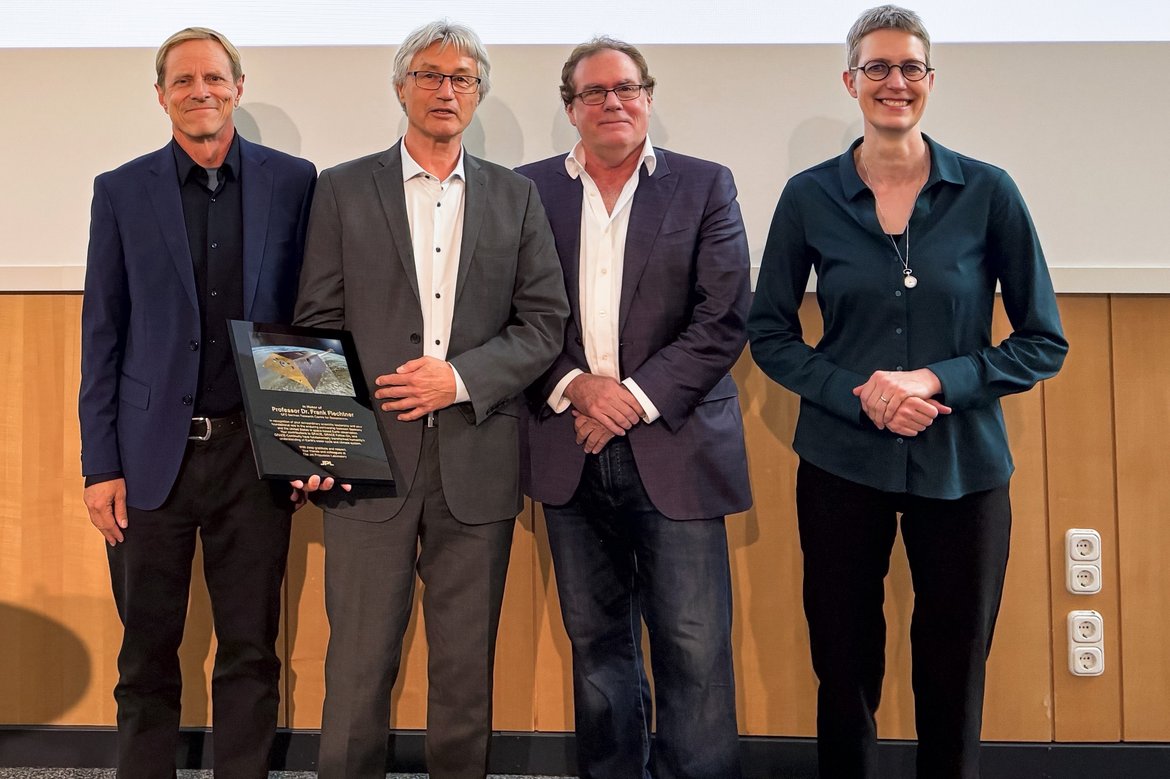
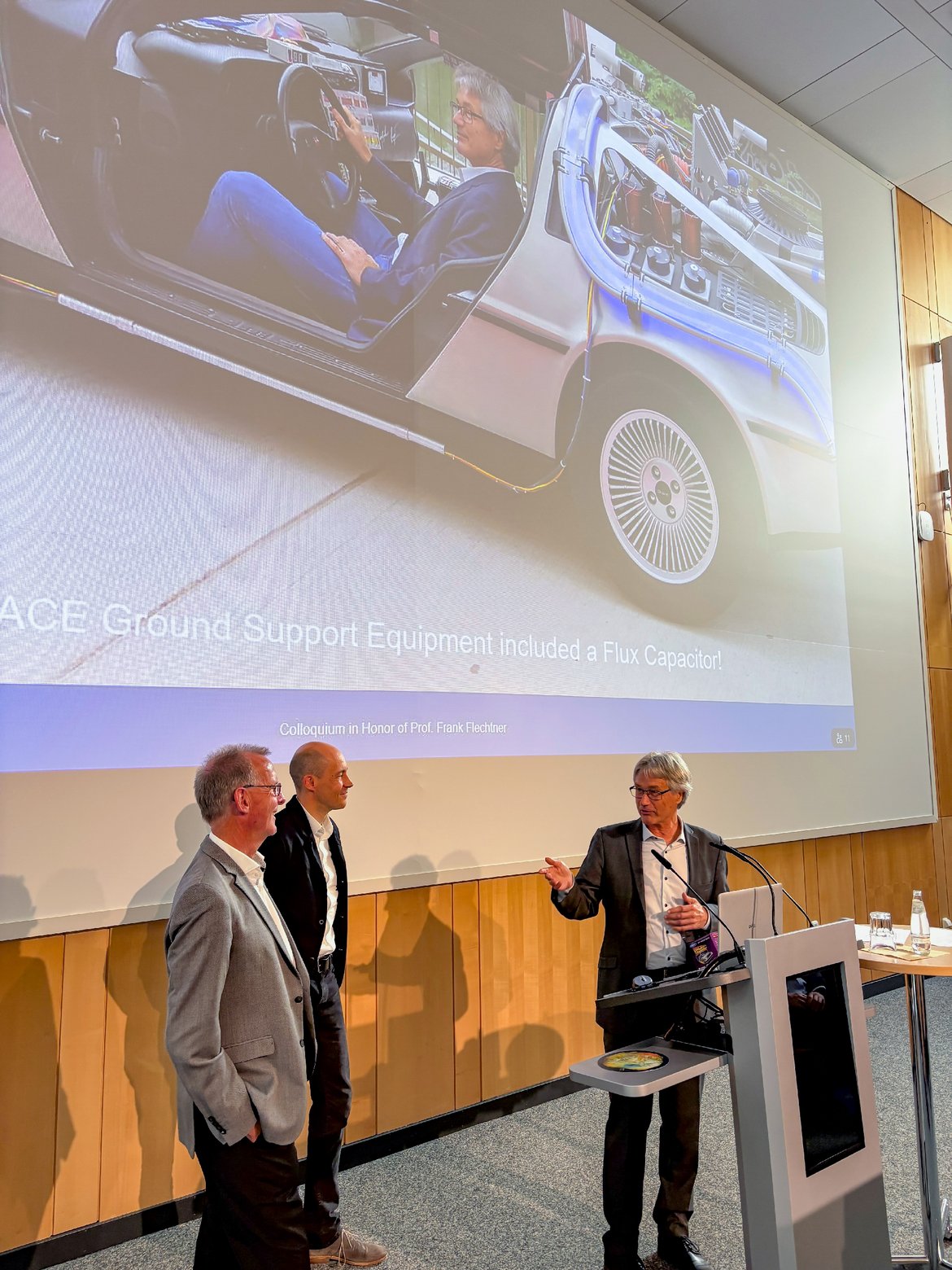
Prof. Dr. Frank Flechtner was recently awarded the Vening-Meinesz Medal at the EGU General Assembly in Vienna. The Geodesy Division of the European Geosciences Union (EGU) awarded the prize to Frank Flechtner for his innovative work in determining the gravitational field and for his outstanding contributions to the realization of groundbreaking satellite missions. Shortly thereafter, Frank Flechtner was honored with a farewell colloquium at the GFZ to mark his retirement. He had been a member of the GFZ staff since its founding in 1992. Since 2010, he had headed the Global Geomonitoring and Gravity Field Section. On March 1st 2026, he handed over leadership of the section to Prof. Dr.-Ing. Annette Eicker.
A large part of Frank Flechtner’s career is linked to the satellite missions of the GRACE family. The first pair of satellites for the “Gravity Recovery and Climate Experiment” (GRACE) was launched into space in 2002 and measured the Earth’s gravitational field and its monthly variations with unprecedented precision. It was a joint mission between NASA and the German Aerospace Center (DLR). It had been planned since 1996 by the University of Texas at Austin, Center for Space Research (UTCSR), the GFZ, and the Jet Propulsion Laboratories (JPL) in Pasadena.
GRACE data has revolutionized climate research in particular: for the first time, it was possible to make concrete measurements of ice mass loss from the major ice sheets and to track changes in groundwater reservoirs from space. Prof. Michael M. Watkins, former JPL director and co-developer of GRACE, called the mission one of NASA’s most important climate missions. In recent years, the focus has shifted to groundwater. More than 5,000 scientific studies are based on data from GRACE (in space until 2017) and its successor mission, GRACE-FO (in space since 2018). On average over the past few years, nine new studies using GRACE data have been published each week.
Prof. Dr. Susanne Buiter, Scientific Director of the GFZ, highlighted Frank Flechtner’s leadership role in realizing the GRACE follow-on mission on the occasion of his retirement and quoted from the laudatory speech for the Vening-Meinesz Medal: “It is thanks to Frank Flechtner’s personal dedication and commitment that the satellites are delivering the highest quality data, continuing the legacy of the GRACE mission. His vision now guides the development of next-generation missions such as GRACE-C and MAGIC, as well as the introduction of innovative quantum technologies on spaceborne platforms.” GRACE-C is currently being built by Airbus and is scheduled to launch in 2028. Distance measurements between the two satellites will no longer be made using microwaves as before, but with a laser ranging interferometer (LRI). The LRI is currently in use as a highly successful technology demonstrator on GRACE-FO.
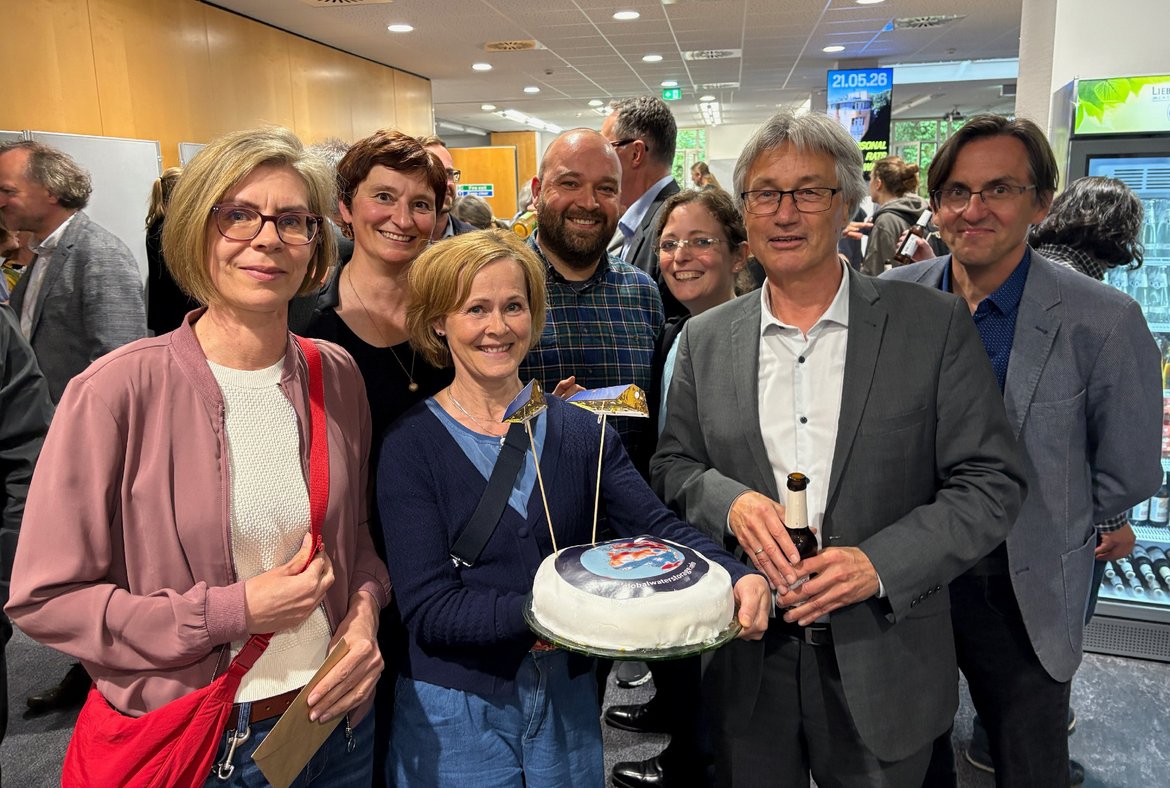
Frank Flechtner was not only a scientist and manager, but also a university professor and mentor. He was active in organizations such as the International Association of Geodesy (IAG) and EGU and was a driving force behind international collaboration. He was always committed to communicating science to the public. His input was crucial to the development of the website www.globalwaterstorage.info, which explains how global water reservoirs are changing and how measurements from space work. At the end of the colloquium, Frank Flechtner was presented with a “water storage” cake to sweeten his farewell.