Which rock formation is best suited for a final disposal site for radioactive waste? This question is relevant for a number of nations that are currently searching for a suitable location. In Germany, rock salt, clay rock, or crystalline rock are being considered. In Switzerland, the decision has already been made in favour of Opalinus Clay. But what exactly are the barrier properties of this clay rock? A few days ago, an international research team began drilling at the Mont Terri rock laboratory in Switzerland. The project, called DEBORAH (Deep borehole to resolve the Mont Terri Anticline Hydrogeology), was initiated by the GFZ Helmholtz Centre for Geosciences and is implemented with the support of swisstopo, the operator of the Mont Terri underground rock laboratory, and an international consortium. Opalinus Clay has been intensively studied in numerous experiments at the rock laboratory for 30 years. DEBORAH builds on this wealth of experience.
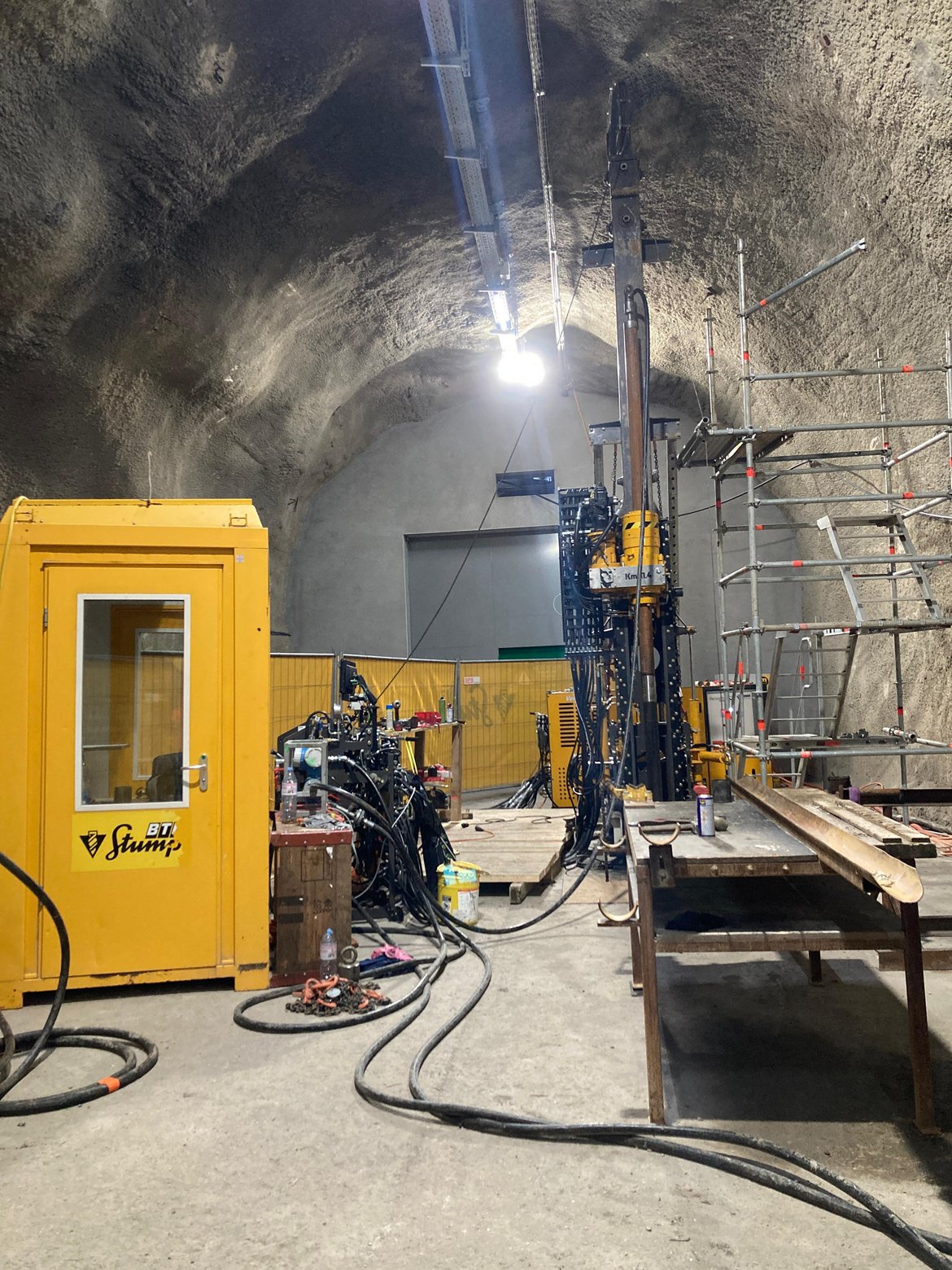
A highway tunnel runs at a depth of approximately 150 to 200 metres beneath Mont Terri in Switzerland. Parallel to this is the tunnel's safety gallery, which not only serves as an escape and rescue route, but also is the entrance to the rock laboratory. A drilling rig is currently located there, gnawing its way deeper and deeper, metre by metre. A hollow chisel is used to mill out a ring, leaving a column in the centre – the drill core, which is then pulled out of the borehole piece by piece. Current status: The first 55 m of the borehole have been successfully drilled, with almost 100% core recovery.
The aim is to drill to a depth of 800 metres and to document the layers with the cores throughout, including the Opalinus Clay as well as the rock formations above and below it. The results should help to precisely characterise the properties of potential host rock for nuclear waste disposal in Germany, England, and Switzerland. For this reason, in addition to the GFZ, the Federal Institute for Geosciences and Natural Resources (BGR), Nuclear Waste Services (NWS) from Great Britain, and Swiss researchers from the University of Bern as well as Naturhistorisches Museum Bern are also involved.
DEBORAH aims to provide a holistic hydrogeological characterization of the surrounding formations at a greater distance from the laboratory. This enables practical exploration and evaluation in terms of site investigation under simulated conditions. The many years of experience gained in the rock laboratory help to calibrate and classify these results. Supplementary seismic experiments are used to “X-ray” the rock formations and gravimetric measurements to “weigh” them in order to gain a detailed understanding of the water balance around the Opalinus Clay.
Dr Felix Kästner, researcher in GFZ Section 3.4 “Reactive Fluids and Geomaterials” is the scientific head on site. He says: “Despite initial delays, the first drilling section was completed on schedule. The rapid drilling progress kept the researchers involved in core logging and sampling continuously busy. The work is a special experience for everyone involved in the cross-partner collaboration and allows researchers to experience first-hand the data collection that is essential for later laboratory analyses and computer-based models. We are looking forward to the upcoming weeks and the next drilling sections.”