European damage Earthquakes
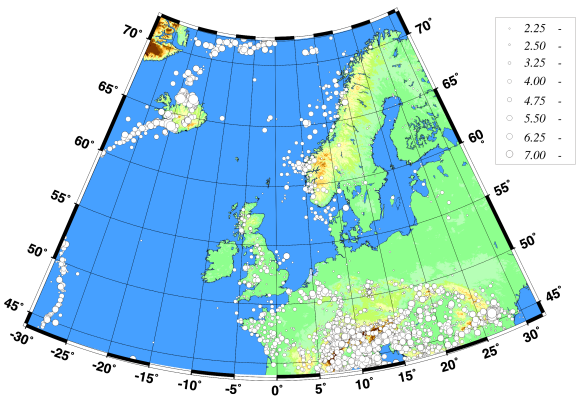
North of the Mediterranean region, elevated seismicity is observed in the western Alps and in the southern parts of the Eastern Alps, including the transition area to the Dinarides. North of the Alps in continental Europe, Germany is affected by the highest level of seismicity. Furthermore, noticeable earthquake activity is observed on the continental margin offshore Norway (Figure 1). In the northwestern part of Figure 1, a distinct spatial concentration of earthquakes is found along the Mid-Atlantic Ridge which is the plate boundary between Europe and North America. It is clearly seen that this plate boundary crosses Iceland with an offset to the east.
Also in Europe, earthquakes can cause catastrophic damages. The 6 deadliest earthquakes in the European history are listed in Table 2. Most damaging was the Messina earthquake in 1908. Most of the casualties due to this event, as well as the Lisbon earthquake in 1755, were due to associated earthquake generated tsunamis.
| Table 2. Ranking of most destructive known historical earthquakes in Europe (listed in order of numbers of casualties). | |||||
| Date | Country | Location | Casualties | M | |
| 1908, Dec. 28. | Italy | Messina | 86.000 | 7.5 | |
| 1755, 1. Nov. | Portugal | Lisbon | 70.000 | 8.7 | |
| 1693, 11. Jan. | Italy | Catania | 60.000 | 7.4 | |
| 1999, 17. Aug. | Turkey | Kocaeli | ca. 20.000 official; ca.45.000 estimated | 7.4 | |
| 1783, 5. Feb. | Italy | Calabria | 35.000 | 6.9 | |
1915, 13. Jan. | Italy | Arezzano | 33.000 | 7.0 | |
A selection of well investigated damaging earthquakes in Europe since 1976 is listed in Table 3. The most destructive earthquake was the Irpinia earthquake in southern Italy in 1980, where almost 4.700 people were killed, 9000 were injured and 250.000 lost their homes. Damages amounted to up to 20 billion contemporary US-$. The second largest earthquake disaster since 1976 was in 1977 in Bucharest, where 1.500 people died because of an earthquake which occurred at a depth of 150 km. The last two earthquakes in Table 3 are also remarkable as they, despite their moderate magnitudes, caused enormous damages, though luckily only a relatively small number of casualties.
| Table 3. Selection of damaging earthquakes in Europe since 1976. | |||||
| Location | Year | M | Casualties | Details | Damages in Mio US-$ |
| Italy, Friaul | 1976 | 6.5 | 978 | 2,000 | |
| Romania, Bucharest | 1977 | 7.0 | 1,581 | 150 km depth | 800 |
| Germany, Albstadt | 1978 | 5.7 | 0 | 6,850 beschädigte Häuser | 140 |
| Portugal, Azores | 1980 | 6.8 | 56 | 400 injured | 10 |
| S Italy, Irpinia | 1980 | 6.9 | 4,689 | 9.000 injured, 250.000 homeless | 20,000 |
| Greek, Athens/Korinth | 1981 | 6.8 | 16 | >25 | |
| Belgium, Lüttich | 1983 | 5.0 | 2 | 26 injured, hundreds of damaged buildings | 50 |
| S Italy, Abruzzo | 1984 | 5.8 | 7 | 100 injured | 25 |
| Romania, Bucharest | 1986 | 6.9 | 2 | enormous damages, | 730 |
| Greek, Kalamata | 1986 | 5.9 | 20 | 300 injured, 1,500 damaged buildings | >25 |
| The Netherlands , Roermond/ Heinsberg (D) | 1992 | 5.9 | 1 | 25 injured, 7,200 damaged buildings | 145 |
| Greek, Aigion | 1995 | 6.6 | 5 | 12,000 homeless, 6,300 damaged buildings | 450 |
| Italy, Umbria/Marken | 1997 | 5.6 | 4 | 4,525 | |
| Greek, Athens | 1999 | 5.9 | 145 | 70,000 homeless | 4,000 |
Table 3 also includes 3 earthquakes in Germany and in the border-zone areas, respectively: 1978 with hypocenter in Albstadt (Baden-Württemberg), 1983 in Liège (Belgium) and 1992 in Roermond (north of Heinsberg), i.e. in the German-Dutch border region. Despite the moderate magnitude, the damage sum was considerable.