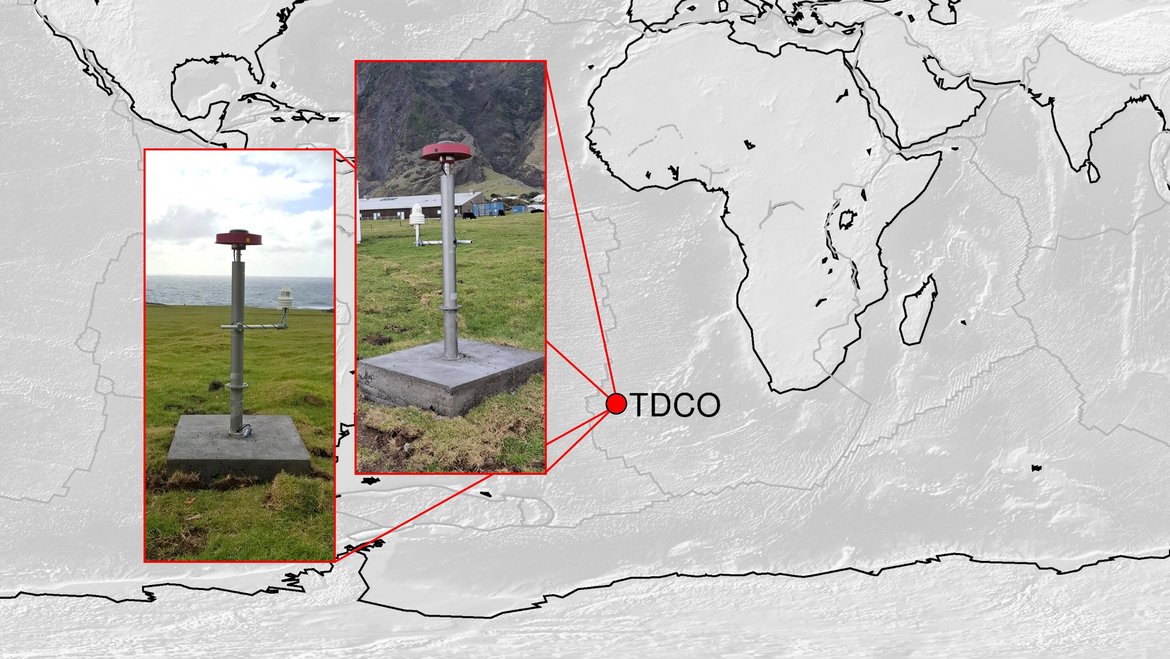
TRISTAN DA CUNHA — The latest GFZ station for observing Global Navigation Satellite Systems (GNSS) has been installed on Tristan da Cunha, the world’s most remote inhabited island. Located in the South Atlantic, the station marks a significant expansion of the GFZ’s global geodetic Earth observation network.
Installing high-precision scientific infrastructure on this remote island was a challenge made possible by the logistical support and active commitment of our local partners on Tristan. The newly established GNSS station also creates valuable synergy with the existing geomagnetic observatory on the island, which is operated by the GFZ. Colleagues from the Geomagnetic Monitoring Network are also establishing on-site contact.
The station’s continuously collected GNSS data supports several critical scientific tasks at the GFZ:
- Atmospheric Research: By measuring signal delay in the atmosphere, precise values for precipitable water vapor can be derived, which improves global climate models and meteorological analyses. The remote location also fills an observational gap in this area.
- Tectonics and Crustal Dynamics: Located near the Mid-Atlantic Ridge, the station offers ideal conditions for monitoring active crustal deformations, plate tectonics, and local volcanic activity.
- International Terrestrial Reference System: In a region of the South Atlantic where historical data has been scarce, the station fills an important geographical gap for anchoring and refining the International Terrestrial Reference Frame (ITRF), which serves as the basis for global satellite navigation.
The station’s integration into the International GNSS Service is already underway.