

Summary
The Earth continuously rotates constantly on its axis like a giant spinning top. However, this rotation is not constant; it is influenced by factors such as high-pressure areas in the atmosphere, the shifting of water masses by the tides, and even the melting of the ice sheets in Greenland and at the poles. It is precisely these fluctuations that are the focus of the new research group “RING: Rotations in Physics, Geophysics and Geodesy”, which is being funded by the German Research Foundation (DFG) with four million euros over four years. The project is based on the technological advancement of ring laser systems, which can be used to measure the Earth’s rotation with high precision.
“Precise measurements of the Earth’s rotation are essential not only for climate change research but also for the proper functioning of navigation devices,” explains Heiner Igel, Professor of Geophysics and Seismology at Ludwig Maximilian University of Munich (LMU) and spokesperson for the new research group. The principal investigators (PIs) from the GFZ Helmholtz Centre for Geosciences are Dr Robert Heinkelmann, head of a research group in Section 1.1 “Space Geodetic Techniques”, and Prof. Dr Andreas Güntner, head of a research group in Section 4.4 “Hydrology”.
Development of ring lasers for use in geodesy and geophysics
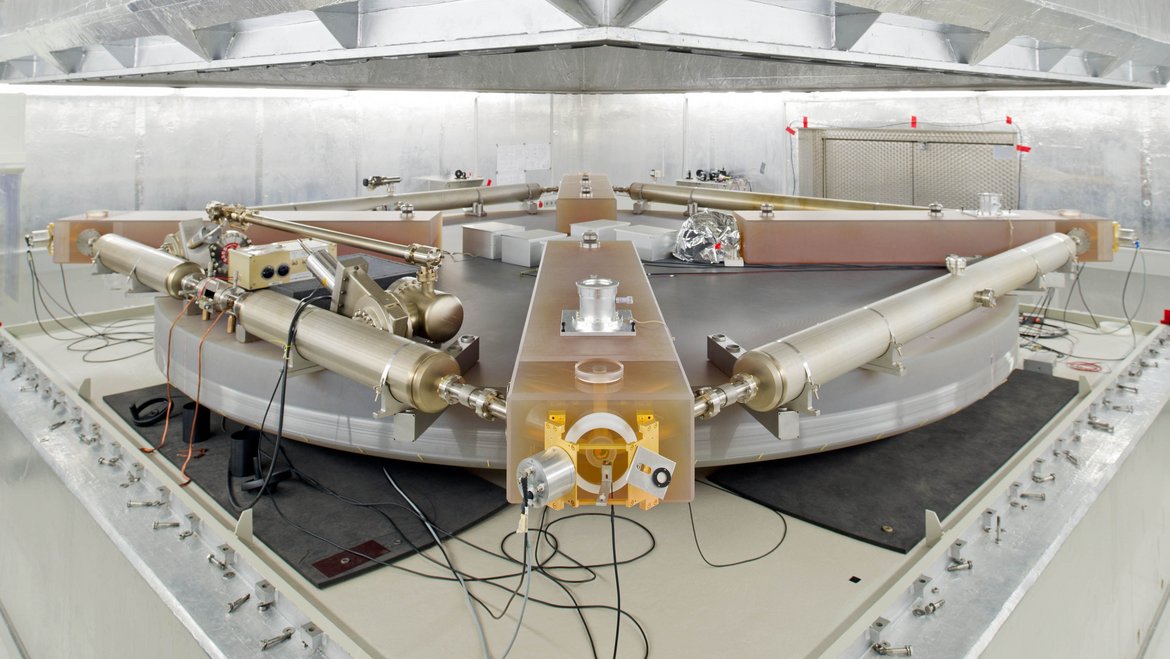
To make visible changes in the Earth’s rotation – which have hitherto been barely measurable –, the new DFG research group is relying on ring lasers. These optical measuring instruments detect rotational movements using the so-called Sagnac effect. This involves two coherent laser beams travelling in opposite directions in a circle; after one revolution, they are superimposed and generate a corresponding interference pattern. When the Earth’s rotation changes – whether it speeds up or slows down – the component of the beam path in the direction of rotation of the entire system becomes longer or shorter, respectively, whilst the path in the opposite direction becomes correspondingly shorter or longer. This results in a frequency shift during interference and a corresponding change in the interference pattern, which can be measured with extreme precision by the ring laser.
The research group is building on its many years of expertise with the technology and aims to further develop both large stationary ring lasers – such as the ROMY ring laser near Fürstenfeldbruck or the Ringlaser G at the Wettzell Geodetic Observatory – and portable sensors. “Our aim is to develop extremely sensitive rotation measurements with a high degree of short- and long-term stability that can be used in both geodesy and geophysics,” says Igel.
From a geodetic perspective, ring lasers currently provide the only alternative sensor technology to geodetic space-based methods capable of measuring Earth rotation with the requisite accuracy. However, in order to utilise the ring laser data for Earth rotation research, other geophysical effects such as seismic activity, crustal deformations and sensor tilting must be modelled alongside the Earth rotation signals. The research group’s expertise offers a unique opportunity to address all these geophysical aspects within a comprehensive framework.
New DFG Research Group with six sub-projects
DFG Research Groups enable researchers to address current and pressing questions in their fields and to establish innovative lines of research. They are funded for up to eight years.
The new Research Group comprises a total of six sub-projects, two of which involve researchers from the GFZ. The lead applicant is LMU Munich. Other co-applicants alongside the GFZ are the University of Bonn, the Federal Agency for Cartography and Geodesy (BKG), the Technical University Munich, the KIT in Karlsruhe, the University of Hamburg, the Hamburg Observatory, the Leibniz University Hannover, the Technical University Berlin, and the Wettzell Geodetic Observatory, which is jointly operated by the BKG and the Technical University of Munich.
The sub-projects led by the GFZ
Sub-project P4:
Combination of ring laser, LLR, and VLBI for the optimal determination and prediction of Earth orientation parameters (EOP)
PI Dr Robert Heinkelmann, Section 1.1 “Space Geodetic Techniques”, GFZ
In contrast to space geodetic techniques, the ring laser maps the Earth rotation signal with respect to the local reference frame defined by the laser plane. Unlike in geodetic space techniques, no distinction is made between Earth-fixed and space-fixed signal components. One task is therefore initially to transform the local Earth rotation signals from the ring laser onto the Earth’s rotation axis and to separate them into Earth-fixed (polar motion) and space-fixed (precession-nutation) components.
Since the ring laser signal is referenced to its own inertial plane, it is in principle not possible to determine absolute spatial directions to astronomical objects using the ring laser. The sensor is merely capable of indicating changes in rotation. Absolute orientation in space must continue to be determined using the established geodetic space methods VLBI (Very Long Baseline Interferometry; linked to the sky-fixed reference system ICRS) and LLR (Lunar Laser Ranging; linked to the lunar ephemerides). These two geodetic space methods are the only two measurement techniques capable of determining the complete set of all five Earth orientation parameters (EOP) – that is, the parameters that define our planet’s orientation in space and its rotation, and which are essential for many applications.
“Ring lasers can provide Earth rotation data in near real-time and with high temporal resolution. They therefore represent a particularly interesting tool for predicting Earth rotation. Combining ring laser data with that from VLBI and LLR presents an extremely interesting challenge, as both measurement methods are complementary. The combined dataset can simultaneously provide the highest accuracy and characterise high-temporal-resolution signals if the combination succeeds in separating polar motion from variations in the celestial pole. “We intend to tackle these challenges together with our LLR colleagues from the Institute of Geodesy at Leibniz University Hannover,” explains Robert Heinkelmann, head of the “Combination and VLBI” working group in Section 1.1 at the GFZ.
Sub-project P6:
Environmental effects on long-period rotational measurements
PI Prof. Dr Andreas Güntner, Section 4.4 “Hydrology”, GFZ
Measurements from ring lasers are influenced not only by changes in Earth’s rotation, but also by processes in the immediate vicinity of a ring laser. For instance, temporal fluctuations in air pressure and changes in the volume of water stored in the subsurface can trigger small deformations of the Earth’s surface or cause variations in gravitational mass attraction effects. These effects are spurious signals that reduce the accuracy of ring laser measurements for the actual target variable, Earth rotation.
The aim of sub-project P6 is to understand the effect of small-scale atmospheric and hydrological mass changes on the ring laser and to correct for them using the measurement data.
“At the ring laser site at the Geodetic Observatory in Wettzell in the Bavarian Forest, we will work with colleagues from the Federal Agency for Cartography and Geodesy (BKG) to precisely determine and model changes in groundwater and soil moisture content using on-site measuring equipment. If we understand these processes better, we can analyse the ring laser’s measurement data even more accurately to determine the Earth’s rotation. At the same time, we hope to gain insights into water storage and the water cycle in this region,” says PI Prof. Andreas Güntner, head of the “Hydrogravimetry” working group in Section 4.4 at the GFZ.
(Based on the press release by the LMU München.)
More information:
FOR 5939: RING: Rotations in Physics, Geophysics, and Geodesy
Deutsche Forschungsgemeinschaft (DFG) – Project Number 553176123
Project-Website: https://www.ringlaser.de/