The ESA mission Genesis (launch around 2028) will be the first mission to combine all four space geodetic techniques – DORIS, GNSS, SLR and VLBI – on a single satellite. A particularly innovative feature is the planned integration of a VLBI transmitter on the satellite that can be observed by VLBI telescopes on Earth. This combination of techniques should make it possible to detect systematic errors between the techniques.
The aim of the mission is to improve the realisation of global terrestrial reference frames. Reference frames are an essential basis for Earth observation and subsequent applications, such as monitoring sea levels. The accuracy requirements were defined by the Global Geodetic Observing System (GGOS) and aim for a positioning accuracy of 1 mm and a long-term stability of 0.1 mm per year for the reference frame defining parameters. The importance of this goal was also stated in a United Nations resolution.

In cooperation with the Federal Agency for Cartography and Geodesy (BKG), the Deutsches Geodätisches Forschungsinstitut at Technical University of Munich (DGFI-TUM), University of Bonn (IGG Uni-Bonn), Technical University of Berlin (TU Berlin) , and GeoBM GmbH (GeoBM), GFZ is conducting simulations that will provide essential insights for the planning and success of the Genesis satellite mission. In addition, the work at GFZ includes improvements of the scheduling and simulations as well as developing innovative methods for VLBI satellite observations.

The GFZ contributes its long-standing expertise in the field and its internationally recognised software solutions such as EPOS-OC to the project. This software is continuously being developed for GENESIS-D tasks in order to process the complex data from the mission. The GENESIS-D project thus lays the foundation for determining the best possible global reference frames with the first complete Space Tie Mission in the future.
Project partners:
- Federal Agency for Cartography and Geodesy (BKG)
- Deutsches Geodätisches Forschungsinstitut at Technical University of Munich (DGFI-TUM)
- University of Bonn
- Technical University of Berlin
- GeoBM GmbH
- Section 1.2, GFZ
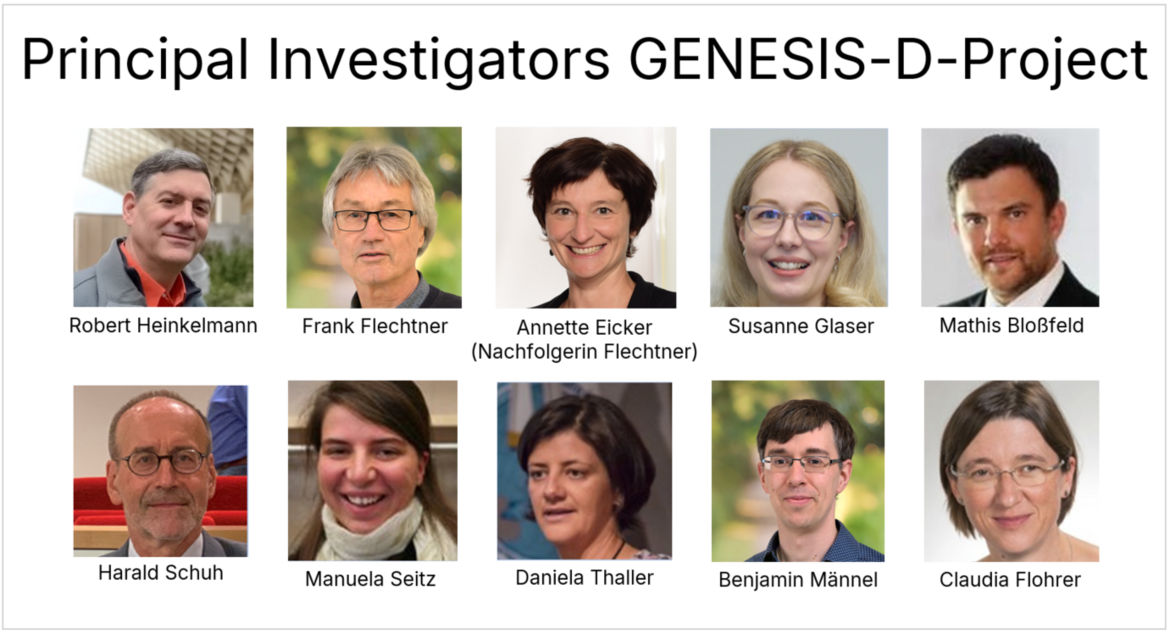
Principal Investigators: Robert Heinkelmann, Frank Flechtner, Susanne Glaser, Mathis Bloßfeld, Harald Schuh, Manuela Seitz, Daniela Thaller, Benjamin Männel, Claudia Flohrer
Personnel GFZ: Soobin Jeon, Patrick Schreiner
We welcome Ms. Annette Eicker to the project management team. She will take over leadership of the GFZ’s project activities in Section 1.2, succeeding Mr. Flechtner. We thank Mr. Flechtner for his contributions and support.
Meetings:
1. Meeting 26.04.2024, online with external participants
2. Meeting (Kick-Off) 28.02.2025, online with external participants
3. Meeting 05.06.2025, GFZ, Telegrafenberg, 14473 Potsdam
4. Meeting 04. & 05.12.2025, DGFI-TUM, Alfons-Goppel-Str. 11, 80539 Munich
5. Meeting 16. & 17.06.2026, TU Berlin, Kaiserin-Augusta-Allee 104, 10553 Berlin

External links:
- ESA: https://www.esa.int/Applications/Satellite_navigation/Genesis
- IVS WG7: https://ivscc.gsfc.nasa.gov/about/wg/wg7/index.html
- Genesis WG: https://colab.tuwien.ac.at/spaces/GW/pages/228921499/Genesis+WG
Project-related publications:
Delva, P., Altamimi, Z., Blazquez, A., et al. (2023). GENESIS: co-location of geodetic techniques in space. Earth, Planets and Space, 75(1), 5. https://doi.org/10.1186/s40623-022-01752-w
Heinkelmann, R., Schuh, H., Thaller, D., Bloßfeld, M., Glaser, S., Schreiner, P., Flohrer, C., Seitz, M., Männel, B., Flechtner, F., Jeon, S., Balidakis, K., Weinem, L., Yeskali, Y., Baumgartner, M., Zeitlhöfler, J., & Seitz, F. (2026). GENESIS-D: a geodetic project from German organizations to support ESA's Genesis mission. IAG Symposium Reference Frames for Applications in Geosciences (REFAG2026), München, Germany. Zenodo. https://doi.org/10.5281/zenodo.20742420
Neumayer KH, Schreiner P, König R, Dahle C, Glaser S, Mammadaliyev N, Flechtner F (2024) EPOS-OC, a universal software tool for satellite geodesy at GFZ. In: Freymueller J, Sánchez L (eds) Proceedings of the IAG Symposia at IUGG Berlin. Springer. https://link.springer.com/chapter/10.1007/1345_2024_260
Raut, S., Glaser, S., Mammadaliyev, N., Schreiner, P., Neumayer, K.H., Schuh, H. (2023). Assessing the Potential of VLBI Transmitters on Next Generation GNSS Satellites for Geodetic Products. In: Freymueller, J.T., Sánchez, L. (eds) Gravity, Positioning and Reference Frames. REFAG 2022. International Association of Geodesy Symposia, vol 156. Springer, Cham. https://doi.org/10.1007/1345_2023_217
Schreiner, P., Glaser, S., König, R., Neumayer, K. H., Flechtner, F., Schuh, H. (2026). Assessing the Potential of Co-location in Space for Global Reference Frame Realisation Using End-to-End Simulations by Patrick Schreiner
Schuh, H., Heinkelmann, R., Beyerle, G., Anderson, J. M., Balidakis, K., Belda, S., ... & Xu, M. H. (2021). The Potsdam open source radio interferometry tool (PORT). Publications of the Astronomical Society of the Pacific, 133(1028), 104503.
Thaller, D., Dach, R., Seitz, M. et al. Combination of GNSS and SLR observations using satellite co-locations. J Geod 85, 257–272 (2011). https://doi.org/10.1007/s00190-010-0433-z