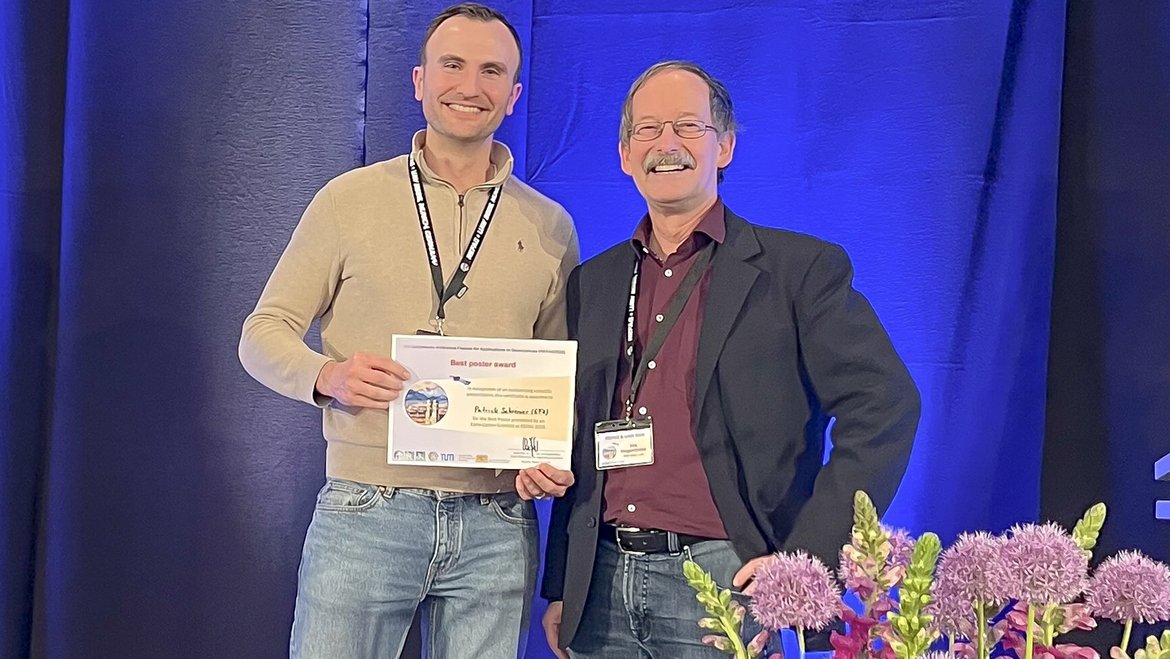
At the symposium “Reference Frames for Applications in Geosciences” (REFAG 2026) REFAG 2026) organised by the International Association of Geodesy (IAG), Patrick Schreiner, a researcher in Section 1.2 “Global Geomonitoring and Gravity Field” at the GFZ Helmholtz Centre for Geosciences, was awarded the “Early Career Scientist Best Poster Award” in Munich at the beginning of March. The internationally oriented symposium takes place every four years and brings together experts, researchers and institutions to refine geodetic research relating to the representation of the Earth and to promote collaboration.
As part of the work presented in his poster, Patrick Schreiner investigated the potential of the planned ESA Genesis satellite mission, in which all four space geodetic techniques – DORIS, GNSS, SLR and VLBI – are to be combined on a single satellite platform for the first time. The aim of the mission is to improve the consistency and long-term stability of the global terrestrial reference frame by bringing together these various techniques on a single satellite – also known as “Space Ties”. The reference frame forms the basis for precise navigation, satellite missions and numerous Earth observation applications.
The importance of reliable geodetic reference systems was also highlighted by the United Nations in Resolution A/RES/69/266, which emphasises the central role of global geodesy for the 17 UN Sustainable Development Goals (SDGs). In this context, the Global Geodetic Observing System (GGOS) also aims to provide a high-precision global reference frame. In the long term, this is intended to achieve an accuracy of 1 mm and a stability of approximately 1 mm per decade.
Patrick Schreiner’s award-winning work is based on comprehensive end-to-end simulations carried out at the GFZ using the EPOS-OC software. These simulations combine realistic observational data from various space geodetic techniques. The aim here is to quantitatively investigate the potential contribution of such a multi-technique satellite to improving the reference frame, the Earth orientation parameters and other geodetic parameters. Among other things, the results show a significant increase in precision in the determination of Earth rotation parameters, as well as improved consistency between the various space geodetic techniques. The simulations suggest that by co-locating the measurement methods on a common satellite platform, inter-technique reference links (local ties) could be determined with millimetre accuracy. This could make a significant contribution to improving the global reference frame.
The study was conducted as part of the GENESIS-D project, which is funded by the DLR Space Agency and comprises scientific contributions from the GFZ and other German institutions in preparation for the ESA Genesis mission. [edit:] The team at the Chair of Space Geodesy at the University of Bonn is advising the GFZ on simulation studies. [/edit]
About the person
M.Sc. Patrick Schreiner is a researcher in Section 1.2 “Global Geomonitoring and Gravity Field”. He studied geodesy and geoinformation at the Technical University of Munich and began his PhD at the GFZ after graduating in 2019. After completion at the GFZ, he recently defended his doctoral thesis in the field of satellite geodesy at the Technical University of Berlin.
In his research, Schreiner focuses in particular on the high-precision determination of satellite orbits, the combination of various space geodetic techniques, and the improvement of global geodetic reference frames. A current focus is on investigating future satellite missions to further improve the global reference frame.
In addition, he is actively involved in the International Association of Geodesy (IAG), including the International DORIS Service (IDS) and the International Laser Ranging Service (ILRS).


![[Translate to English:] Veranschaulichung der Veranstaltung.](/fileadmin/_processed_/c/5/csm_20260928_Kachel_37c583cb50.webp)


![[Translate to English:] Alle Länder Afrikas gelistet mit relativem Malariarisiko](/fileadmin/_processed_/1/b/csm_2026-08-20-L%C3%A4nderliste_Malariarisiko_web_d547ebb81d.webp "[Translate to English:]")


![[Translate to English:] Bewaldetes Gebiet mit historischen Gebäuden](/fileadmin/_processed_/5/e/csm_Telegrafenberg-2021_300dpi_Marcel-Ludwig-GFZ_web_70a5c15a88.webp "[Translate to English:]")


![[Translate to English:] Karte](/fileadmin/_processed_/4/8/csm_20260625-0945b_Venezuela_Nachbeben_-c-EarthquakeExplorer-GFZ_04f208410a.webp)
