
Summary
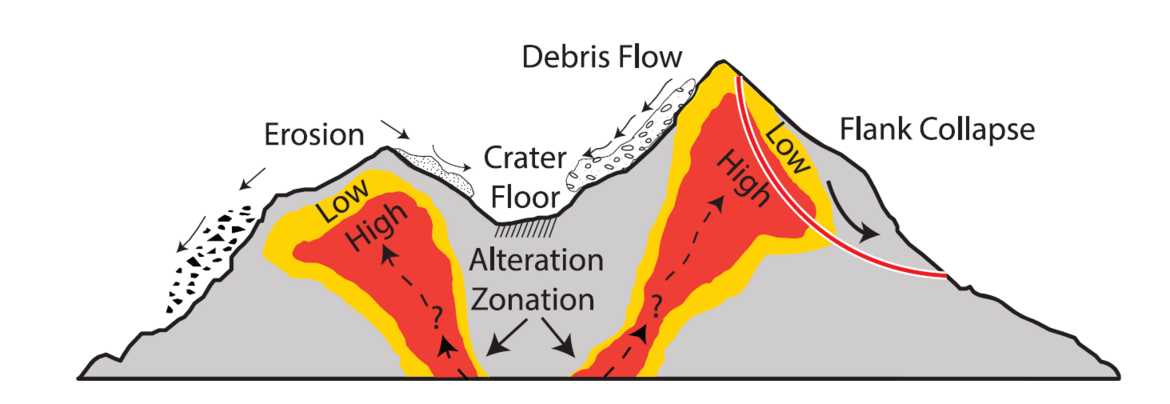
Unstable volcano flanks pose a significant hazard worldwide, both on active and demonstrably dormant volcanoes. Researchers at the Helmholtz Centre for Geosciences have now shown that even without magma involvement within a volcano, ascending aggressive and corrosive fluids can weaken the volcanic edifice. Hot fluids attack the rock, leading to erosion or even partial collapses. Using three-dimensional drone imagery and in-situ strength measurements on Vulcano (Aeolian Islands, Italy), the research team was able to demonstrate this convincingly. The innovative combination of their methods opens up new possibilities for early detection of hazards on steep, hard-to-reach volcano flanks and for making more reliable predictions. The study was recently published in Communications Earth & Environment.
Hazards at Volcanoes: Causal Factors of Instability
Volcano flanks can become very unstable very suddenly. By contrast, also a slow mass movement process can manifest, gradually becoming apparent. For example, the ground may creep slowly or a rock may barely perceptibly begin to slide. In either case, a significant amount of debris and rock material can move downhill, sometimes with devastating consequences. In rare, large-scale landslides, more than 1000 cubic kilometers of rock and debris have moved in the past, potentially depositing over wide areas. If many megatons of scree and debris suddenly slide into the sea, a tsunami can be triggered (see, e.g., GFZ press release: “Early warning signals heralded fatal collapse of Krakatau volcano”). Volcanic debris avalanches can also pose a direct threat to nearby communities and their infrastructure.
Because large-scale landslides on volcanoes are rare, there is limited data available for scientists to work with. Documented observations are limited to a few well-studied cases. Consequently, the ability to assess the stability of slopes on volcanoes and predict potential hazards has been limited. Furthermore, there are a number of different processes that contribute to instability in volcanic edifices, making things even more complex. Excessive steepness of the volcano flanks is one factor, as is the intrusion of magma, changes in stress, weakened bedrock, altered pore pressure, and increased seismic activity. In addition, the bedrock may expand, or hot, corrosive fluids may alter the rock's chemistry and physics (hydrothermal alteration).
Hydrothermal Alteration at Volcanoes: Research Needs
Although a single process can critically destabilize volcano flanks, instability is often the result of a combination of all these processes. Nevertheless, hydrothermal alteration is receiving particular attention due to its continuous role in weakening volcano flanks. Hydrothermal alteration in volcanic environments typically involves the circulation of aggressive, acidic, and over 200°C hot hydrothermal fluids, which promote interactions between fluids and rocks, leading to the dissolution, replacement, and precipitation of minerals. Detecting and observing hydrothermal alteration provides valuable insights into the timing and origin of instabilities on a volcano.
However, hydrothermal alteration often occurs in steep, dangerous, or otherwise inaccessible areas of a volcano, making monitoring difficult. In the past, the link between rock altered by aggressive hot fluids (hydrothermal alteration) and the unstable zone on the volcano could often only be established after the collapsed debris had been investigated. The alteration of rock material is sometimes even visible to the naked eye. Color changes can sometimes indicate hydrothermal alterations on the surface. The intensity of the discoloration or bleaching is then a good initial indicator. Otherwise, only rock analyses can determine altered composition and mineralogy. Therefore, assessing mechanical properties and identifying areas particularly prone to failure, especially in complex terrain, remains challenging. Areas subject to hydrothermal alteration are typically found near volcanic craters and along the flanks of volcanic edifices, where the ascent of fluids is controlled by stress and fracture networks.
Ideal Study Area: "La Fossa Cone"
The La Fossa Cone volcano on the island of Vulcano (Italy), explored in this research, offers ideal conditions due to its exceptionally good accessibility, especially the crater rim. Vulcano is part of the Aeolian Islands north of Sicily, which are tectonically very active. The archipelago lies above a subduction zone related to the convergence of the African and Eurasian plates. Here, the Ionian lithospheric plate subducts beneath the Tyrrhenian lithosphere. The resulting high stresses and hydrothermal activity contribute to the instability of the flanks of the volcanoes in the Aeolian Arc. Due to its active hydrothermal system and frequent landslides, the La Fossa Cone on the island of Vulcano is an ideal natural laboratory for the researchers, allowing them to develop and test observation methods. Although the landslides on the La Fossa Cone are much smaller than large sector collapses on other volcanoes, their frequency and accessibility offer the possibility of developing a workflow that can later be scaled to evaluate volcano flanks of larger size and with greater destructive potential.
Previous Instabilities at the La Fossa Volcanic Cone
- Volcanic Crater: Degassing via Fumaroles – Last in 2021
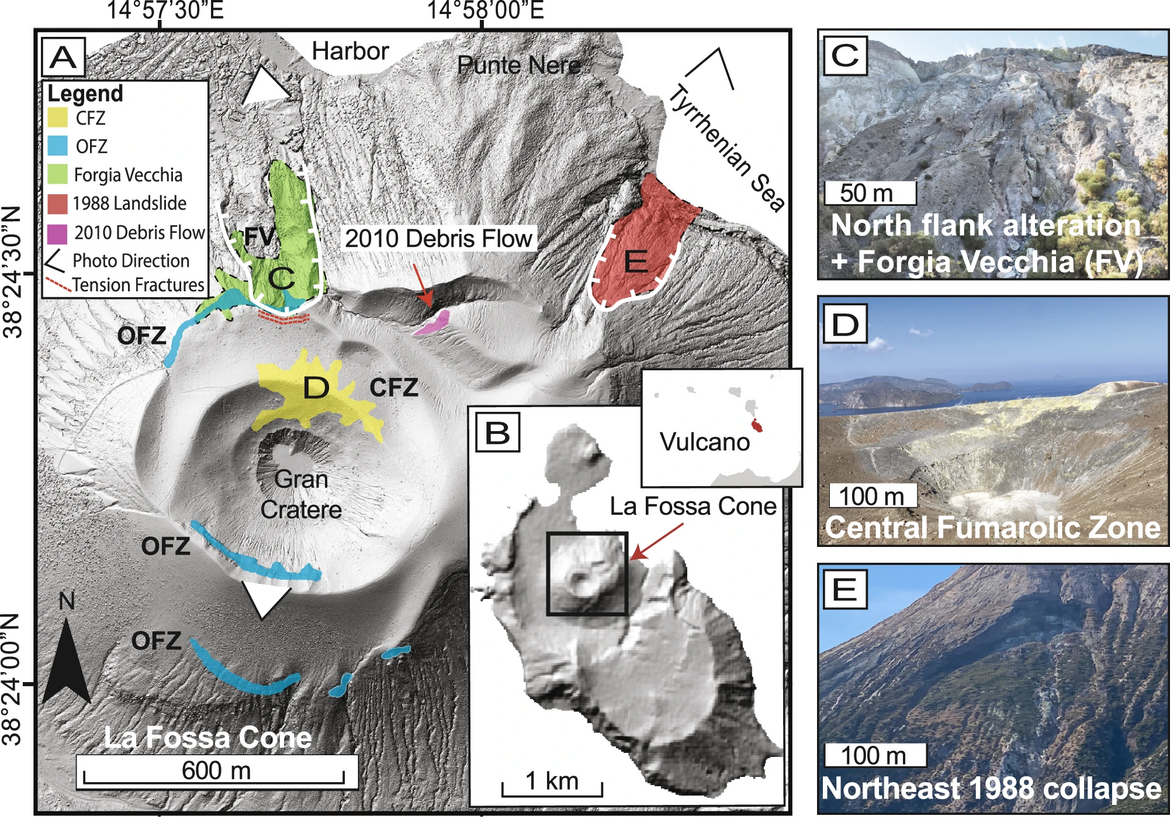
The volcanic crater contains numerous high-temperature fumaroles, referred to in the figures as the Central Fumarole Zone (CFZ) and Outer Fumarole Zone (OFZ). La Fossa has experienced frequent periods of anomalous fumarole degassing, particularly in the years 1979–1981, 1985–1986, 1988–1991, 1996, 2004–2005, 2009, and most recently since September 2021. These periods are characterized by increased fumarole gas concentrations (carbon dioxide, nitrogen, and helium) relative to H2O, indicating increased magmatic influence. The unrest of the volcanic cone in 2021 was triggered by a rapid, widespread injection of magmatic gas and heat into the shallow hydrothermal reservoir, leading to boiling, overpressure, and fracturing. This resulted in a massive steam-driven degassing, leading to measurable crater uplift and increased seismicity.
- Large Landslide on the Northeast Flank in 1988
One of the most remarkable events in recent history occurred in 1988 (Fig. 1A,E) when approximately 200,000 m³ of material slid from the northeast flank of La Fossa into the sea, triggering a small tsunami. Previous scientific work identified hydrothermally altered surfaces on the main steep slope and the upper landslide sections in this context.
- North Flank
Further signs of instability are evident along the north flank, particularly in the Forgia Vecchia area (Fig. 1A, C), which exhibits active deformation. This area is continuously monitored using geophysical methods such as GPS and seismic stations, as morphological slope changes, subparallel stress cracks near the slope edge, and proximity to the village of Vulcano and the nearby harbor are constantly changing.
Methods
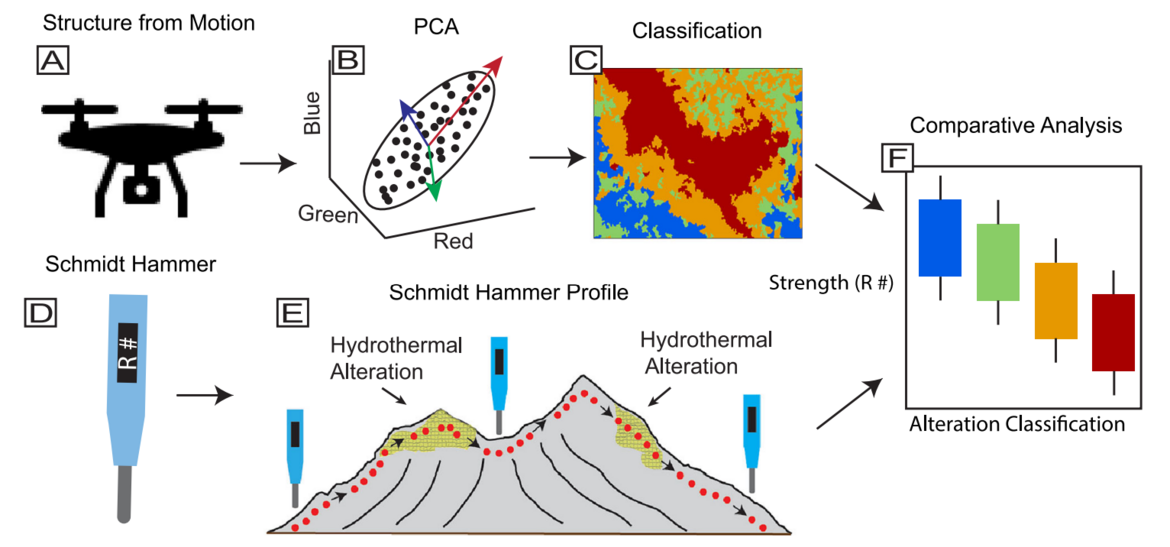
The researchers aimed to determine the strength of the rock as reliably as possible and then extrapolate that strength to inaccessible areas of the volcanic edifice. They combined high-resolution drone imagery with mechanical strength tests conducted directly on site in accessible areas. Over 1000 such relative strength measurements were made using a Schmidt hammer. Schmidt rebound values are considered a proxy for relative compressive strength of rock/soil. This second dataset for evaluating rock mechanical properties was crucial for assessing the accuracy of the data automatically collected via drones. Drone-based photogrammetry (DJI Phantom 4 Pro, Structure-from-Motion SfM) created a high-resolution orthomosaic. Principal Component Analysis (PCA) was used to statistically analyze the RGB data of the orthomosaic. The goal was to highlight color differences associated with hydrothermal alteration, such as bleaching or the formation of sulfur or clay minerals. Four classes were defined for this purpose.
Results
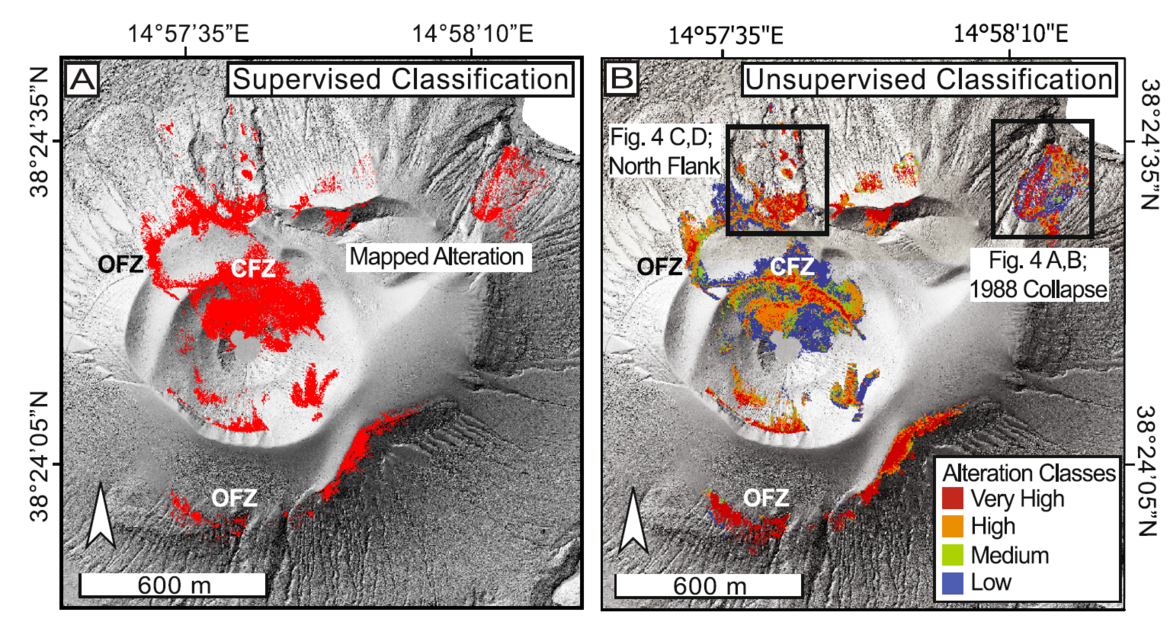
A result of the research is a detailed true-color orthomosaic map covering an area of 3.74 km² with a very high accuracy reaching down to approximately 7.6 cm ground resolution. The researchers were able to demonstrate that there is approximately a 48-50 percent reduction in relative strength between unaltered and strongly altered rock. The map marks strongly hydrothermally altered areas in red. The research also showed that the classification created automatically with the help of drones (unsupervised) is as accurate as the classification created on-site with the help of direct rock strength measurements (Schmidt hammer method). The least strong rocks are found in the Central Fumarole Field, on steep north and south flanks, and in areas of previous slope failures (years: 1988, 2010). Highly altered zones mark potential future instability areas.
Conclusion
The alteration intensity, as measured by drone data, has proven to be a good proxy for mechanical weakening of the rock material. The alteration intensity and orthomosaic map enable hazard assessment for volcano flanks that are otherwise inaccessible but potentially unstable.
Original Study:
De Jarnatt, B.F., Walter, T.R., Heap, M.J. et al.: Hydrothermal weakening and slope instability at Vulcano (Italy) analyzed using drones and in-situ strength measurements. Commun Earth Environ 7, 3 (2026). https://doi.org/10.1038/s43247-025-03014-5


![[Translate to English:] Veranschaulichung der Veranstaltung.](/fileadmin/_processed_/c/5/csm_20260928_Kachel_37c583cb50.webp)


![[Translate to English:] Alle Länder Afrikas gelistet mit relativem Malariarisiko](/fileadmin/_processed_/1/b/csm_2026-08-20-L%C3%A4nderliste_Malariarisiko_web_d547ebb81d.webp "[Translate to English:]")


![[Translate to English:] Bewaldetes Gebiet mit historischen Gebäuden](/fileadmin/_processed_/5/e/csm_Telegrafenberg-2021_300dpi_Marcel-Ludwig-GFZ_web_70a5c15a88.webp "[Translate to English:]")


![[Translate to English:] Karte](/fileadmin/_processed_/4/8/csm_20260625-0945b_Venezuela_Nachbeben_-c-EarthquakeExplorer-GFZ_04f208410a.webp)
