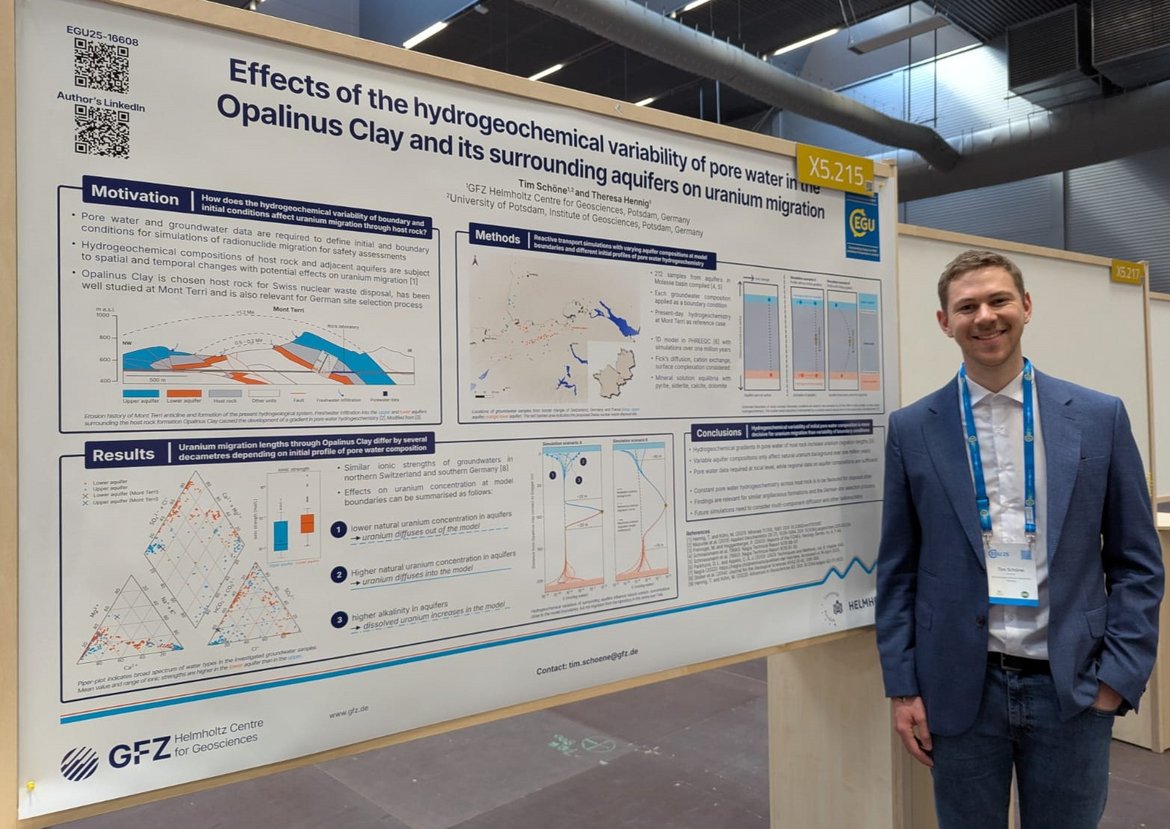
Tim Schöne was awarded the “2025 Outstanding Student and PhD Candidate Presentation (OSPP) Award” for his scientific poster entitled “Effects of the hydrogeochemical variability of pore water in the Opalinus Clay and its surrounding aquifers on uranium migration”. The OSPP Award is presented by the European Geosciences Union. Tim Schöne received the award within the EGU Division of Energy, Resources and the Environment.
Research Background
Uranium is a major component of high-level radioactive waste. As a society, we must ultimately find safe disposal sites for hazardous uranium to allow it to decay harmlessly underground over hundreds of thousands of years. Geochemically, uranium is a complex radionuclide. Understanding its specific migration behavior in potential host rocks is crucial for assessing the long-term safety of its underground storage. How well can a host rock retain uranium? Thick clay rock formations are likely ideal natural barriers for retaining high-level radioactive materials. The processes controlling this retention capacity need further investigation. Previous scientific work has shown that the chemistry of pore water found in Opalinus Clay (a potential host rock) is a significant factor in determining the distances over which uranium migrates in the subsurface over a period of one million years – the timeframe for which a rock must reliably and safely retain high-level radioactive material.
Using his computer simulations, based on coupled hydrogeological and geochemical processes, Tim Schöne has shown that the distance of diffusive uranium migration can differ by tens of meters over a period of one million years, depending on the chemical composition of the water involved. Fluctuations in groundwater chemistry in the surrounding aquifers have a limited influence. In contrast, the pore water composition within the Opalinus Clay is crucial.
The results provide important guidance for geochemically comparable systems and support the site selection process for a high-level radioactive waste repository in Germany.
The work will be published in a special issue of the EGU Division of Energy, Resources and Environment in the journal Advances in Geosciences and is currently under review with the title “Schöne, T. and Hennig, T.: Pore water or groundwater chemistry: what governs uranium migration in Opalinus Clay?”.
Further Information
Hennig, T., Kühn, M. (2021): Potential Uranium Migration within the Geochemical Gradient of the Opalinus Clay System at the Mont Terri. - Minerals, 11, 10, 1087. https://doi.org/10.3390/min11101087


![[Translate to English:] Alle Länder Afrikas gelistet mit relativem Malariarisiko](/fileadmin/_processed_/1/b/csm_2026-08-20-L%C3%A4nderliste_Malariarisiko_web_d547ebb81d.webp "[Translate to English:]")


![[Translate to English:] Bewaldetes Gebiet mit historischen Gebäuden](/fileadmin/_processed_/5/e/csm_Telegrafenberg-2021_300dpi_Marcel-Ludwig-GFZ_web_70a5c15a88.webp "[Translate to English:]")


![[Translate to English:] Karte](/fileadmin/_processed_/4/8/csm_20260625-0945b_Venezuela_Nachbeben_-c-EarthquakeExplorer-GFZ_04f208410a.webp)


