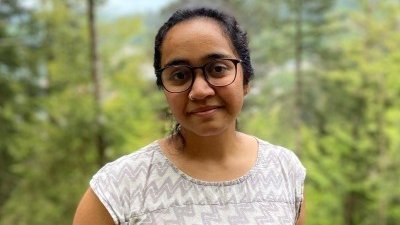
Dr Nivedita Sairam, head of the HydroHealth junior research group in the Hydrology Section at GFZ, is awarded the 2026 Arne Richter Prize by the EGU Natural Hazards Division (European Geosciences Union) to outstanding young scientists. The prize recognises her outstanding scientific contributions and her key role in the further development of systemic flood risk science, as well as her expansion and maintenance of networks in the international natural hazards community. The award ceremony will take place during the next EGU General Assembly in Vienna in early May 2026. The European Geosciences Union (EGU) is the leading organisation for Earth, planetary and space science in Europe. The EGU's activities are organised into scientific-thematic divisions. The Natural Hazard Division is one of the largest divisions of the EGU and has been since the EGU was founded.
With its annual General Assembly, the EGU organises the largest and most important event in the European geosciences. It brings together geoscientists from all over the world, far beyond Europe. It is a forum where scientists, especially young scientists, present their work and discuss their ideas with experts from all areas of the geosciences. The sessions of the meeting cover a wide range of topics, including hydrology and meteorology, remote sensing, natural hazards, geomorphology, tectonics and volcanology. This year, the EGU took place from 27 April to 2 May 2025 in Vienna, Austria, welcoming more than 20,000 participants. With around 19,000 contributions, 56% of which were from young scientists, the General Assembly was a great success.
About the person
Nivedita has made significant scientific contributions to the further development of systematic approaches to understanding the cascading effects of flooding on society and health. In addition to the Arne Richter Prize for Outstanding Early Career Scientists in 2025, she also received the 'Allianz Climate Risk Research Award - Runner-Up’ in 2020 for her doctoral thesis on modelling flood damage.
Nivedita Sairam has been working at the GFZ Helmholtz Centre for Geosciences since 2016 – with a brief intermission – as postdoctoral researcher. She currently leads the BMBF-funded junior research group ‘HydroHealth’ (HI-CliF), which focuses on the effects of flood risks on human health. Sairam researches the impacts of flooding on the built environment, society and human health. She works on the further development of systemic methods and data-driven approaches by combining concepts such as human-water systems with climate-related flood risks, as well as socio-economic driver and impact models. She researches models of flood vulnerability and impacts, working with spatial database systems and GIS, as well as statistical models for estimating the effects of natural hazards. With more than 30 peer-reviewed publications, including contributions to global flood and drought analyses, her research shapes the analysis of climate risks and corresponding adaptation strategies. Sairam is actively involved in teaching and mentoring, as well as in public relations work. In addition to her role in the EGU Task Force on Climate Hazards and Risks, she was a member of the Helmholtz delegation to the European Parliament, among other things.
Academic career
After her Bachelor’s degree of Engineering in Geoinformatics at the College of Engineering Guindy, Anna University (Chennai, India) in 2015 Sairam moved to Florida to the United States, to complete her Master’s degree in Geomatics at the Florida Atlantic University in Boca Raton. From 2016 to 2020 she obtained her PhD in mathematics und natural sciences at the Humboldt University in Berlin und participated as doctoral student in the Marie-Curie EU-project „SystemRisk” at the GFZ Helmholtz Centre for Geosciences.
From 2015 to 2016 Sairam worked as Network advisor of the American Society for Photogrammetry and Remote Sensing (ASPRS). Since 2022, she is scientific advisor of the EGU Natural Hazards and Society Divison, in which she will take over the office of President from Heidi Kreibich for a term of two years starting in 2027.


![[Translate to English:] Veranschaulichung der Veranstaltung.](/fileadmin/_processed_/c/5/csm_20260928_Kachel_37c583cb50.webp)


![[Translate to English:] Alle Länder Afrikas gelistet mit relativem Malariarisiko](/fileadmin/_processed_/1/b/csm_2026-08-20-L%C3%A4nderliste_Malariarisiko_web_d547ebb81d.webp "[Translate to English:]")


![[Translate to English:] Bewaldetes Gebiet mit historischen Gebäuden](/fileadmin/_processed_/5/e/csm_Telegrafenberg-2021_300dpi_Marcel-Ludwig-GFZ_web_70a5c15a88.webp "[Translate to English:]")


![[Translate to English:] Karte](/fileadmin/_processed_/4/8/csm_20260625-0945b_Venezuela_Nachbeben_-c-EarthquakeExplorer-GFZ_04f208410a.webp)
