Summary
The Arctic is warming four times faster than the rest of the Earth, and this is particularly pronounced in Greenland. The melting ice there contributes significantly to global sea level rise. The increasingly rapid melting is largely due to global warming, but there is another factor that is exacerbating the problem: pigmented algae on the ice. They darken the surface, thus reducing the albedo and accelerating glacier melt.
Two new studies show that both the underlying ice and mineral dust from the surrounding area can provide enough nutrients for the algae to bloom every summer. This does not bode well for the ice sheet, because the more ice melts, the more mineral dust thaws out of the old ice or is blown from ice-free rock areas onto the ice and snow surface – providing even more food for the algae, which then grow even faster. The two studies, in which several GFZ researchers played a key role, have been published in the journals Nature Communications and Environmental Science and Technology.
“Algae will inevitably continue to grow”
Senior author Prof. Dr Liane G. Benning says: “Phosphorus is an important nutrient that controls and promotes the growth of glacier ice algae on the Greenland ice sheet and on glaciers worldwide. With these two studies—led by two early career researchers—we show that phosphorus is not limited. It can come from melting snow and ice as well as from local mineral dust carried by the wind from ice-free areas.”
Liane G. Benning heads the Interface Geochemistry Section at the GFZ Helmholtz Centre for Geosciences and has been researching pigmented algae in Greenland for many years, e.g. as part of the ERC Synergy Grant “DEEP PURPLE.” Her conclusion from both studies: “In a warming world, more melting towards the interior of Greenland, will lead to more nutrients from bare ice. At the same time, glaciers are retreating and large polar dust deserts are forming in the ice-free areas, which can supply more nutrient-rich dust to the ice surfaces farther inland. Both processes provide more than enough nutrients to further accelerate algal blooms and intensify melting.”
Studies determine the amount and origin of nutrients
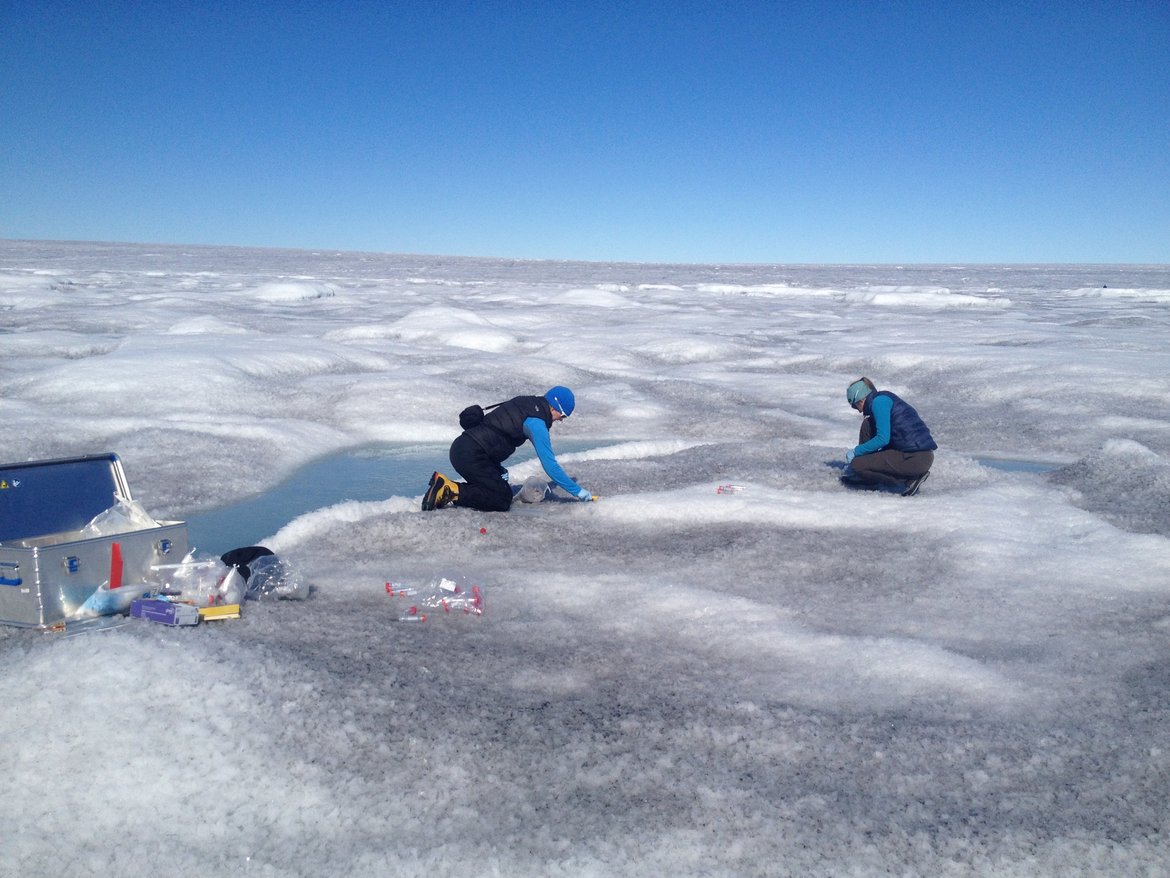
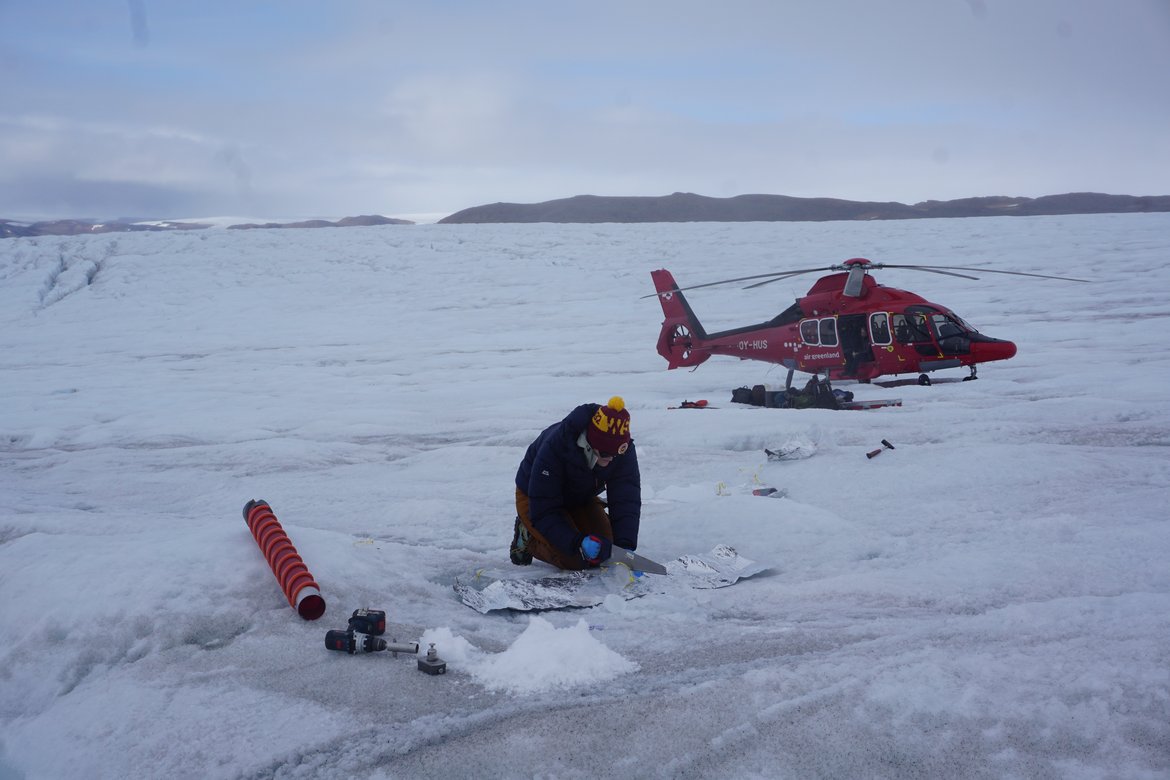
The study in Environmental Science and Technology examined the amount, composition, and origin of phosphorus-containing dust landed on the ice in the dark zone in southwestern Greenland. The team, led by Dr Jenine McCutcheon of the University of Waterloo (Canada), found that the minerals in the dust originate from local glacier retreat areas and contain enough phosphorus to feed glacier ice algae during the melting season.
The other study in Nature Communications examined the purple algae blooms in northwestern Greenland. This study was led by Dr Beatriz Gill-Olivas from Aarhus University in Denmark and showed that there is no need for additional dust blown in from coastal regions for the algae to bloom. Instead, the microorganisms here benefit from an oversupply of nutrients in the melting ice and thus can also spread further inland.
Climate change and algae growth are linked
Algae darkening the ice surface already contribute to around 13 percent of glacier melt. The warming of the atmosphere, which is happening faster in the Arctic than anywhere else on the globe, creates conditions that promote algae growth. The further the algae spread, the faster the Greenland ice will melt. “Both studies show once again that we urgently need to counteract global warming,” says Liane G. Benning. “We should treat our environment with greater care, as the consequences of the melting of the Greenland ice sheet will affect the whole world.”
Original studies
Jenine McCutcheon et al.: “Atmospheric Deposition of Local Mineral Dust Delivers Phosphorus to the Greenland Ice Sheet,” in: Environmental Science & Technology (2026) DOI: 10.1021/acs.est.5c13873
https://doi.org/10.1021/acs.est.5c13873
Paper in press. The paper is accepted but might undergo further editing:
B. Gill-Olivas et al.: “Ablation provides key macronutrients (nitrogen and phosphorous) to glacier ice algae in NW Greenland,” in: Nature Communications (2026) DOI: 10.1038/s41467-026-68625-8
https://doi.org/10.1038/s41467-026-68625-8


![[Translate to English:] Veranschaulichung der Veranstaltung.](/fileadmin/_processed_/c/5/csm_20260928_Kachel_37c583cb50.webp)


![[Translate to English:] Alle Länder Afrikas gelistet mit relativem Malariarisiko](/fileadmin/_processed_/1/b/csm_2026-08-20-L%C3%A4nderliste_Malariarisiko_web_d547ebb81d.webp "[Translate to English:]")


![[Translate to English:] Bewaldetes Gebiet mit historischen Gebäuden](/fileadmin/_processed_/5/e/csm_Telegrafenberg-2021_300dpi_Marcel-Ludwig-GFZ_web_70a5c15a88.webp "[Translate to English:]")


![[Translate to English:] Karte](/fileadmin/_processed_/4/8/csm_20260625-0945b_Venezuela_Nachbeben_-c-EarthquakeExplorer-GFZ_04f208410a.webp)
