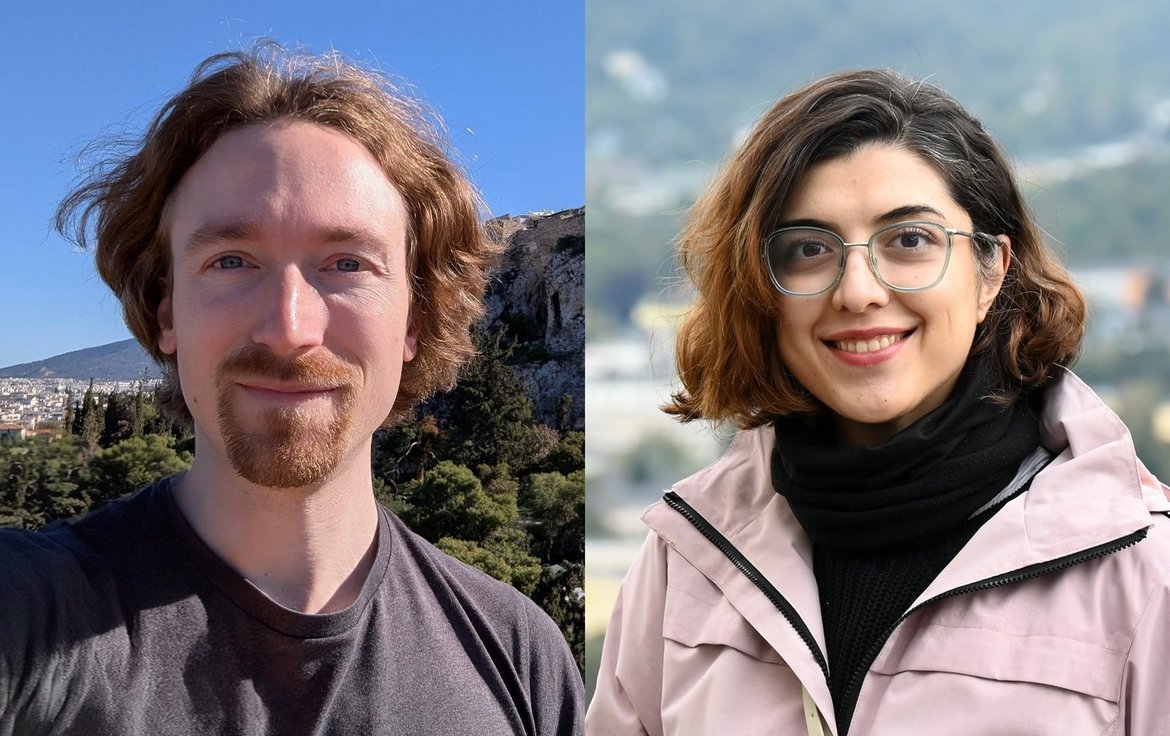
On January 1, 2026, Dr. Sahar Sobhkhizmiandehi and Dr. Jannes Münchmeyer began the GFZ Discovery Fellowship Program as part of the 7th call. The GFZ Discovery Fellowship supports highly innovative and daring projects across all disciplines of the GFZ, and covering topics within the Program-Oriented Research (PoF). The "GFZ Discovery Fund" annually offers up to two postdoctoral positions for a term of three years for junior scientists. They are intended to help further develop the direction of GFZ research. Successful candidates are expected to initiate innovative scientific projects and identify future research fields within the GFZ’s areas of expertise. The research topic can be chosen independently, but must relate to at least one of the GFZ’s PoF themes, pursue an interdisciplinary approach, and be carried out in close collaboration with at least two GFZ sections.
Multidecadal Trends in the Ionosphere
+++ Dr. Sahar Sobhkhizmiandehi +++
Sahar Sobhkhizmiandehi’s research focuses on the intersection of space geodesy, upper atmosphere dynamics, and geomagnetism. Within the framework of her GFZ Discovery Fellowship project, in GFZ Section 1.1 Geodetic Space Techniques, together with Section 2.3 Geomagnetism, she is investigating how climate change and the evolving Earth’s magnetic field shape long-term multidecadal trends in the ionosphere – an atmospheric layer that directly affects satellite navigation and communication. Sobhkhizmiandehi combines complementary observations from various data sources to create an observation-based understanding of ionospheric changes. The central goal is to understand how various factors influence the thermosphere over the long term, including its cooling due to CO2 enrichment, changes in the magnetic field, and the impact of atmospheric waves from the lower atmospheric layers, the troposphere and stratosphere. Models based on this data will, in the future, support the diagnosis of space weather phenomena and lead to long-term improvements in Global Navigation Satellite Systems (GNSS), such as increasing the accuracy of positioning. These insights are intended to provide long-term understanding of how the near-Earth environment responds to climate-related changes and, in parallel, to make satellite-based technologies more reliable.
About
Sahar Sobhkhizmiandehis has been conducting research at GFZ since 2019, previously in the Geomagnetism Section. She received her doctorate from the University of Potsdam. Her scientific career began with studies in Iran, where she focused on geodesy, geomatics, and surveying.
Influence of Rock Microstructure on Subduction Zones
+++ Dr. Jannes Münchmeyer +++
In his GFZ Discovery Fellowship project, Jannes Münchmeyer, in Section 4.1 Lithosphere Dynamics, together with Sections 2.4 Seismology and 1.1 Geodetic Space Techniques, is investigating how the properties of rock structures in a subduction zone influence its behavior over long periods of time. As a computer scientist and seismologist, Münchmeyer combines geophysical questions with the development of new methods for analyzing large datasets. Earthquake catalogs based on deep learning have almost tenfold increased the density of detectable micro-earthquakes. However, current methods for locating these are limited due to the amount of data. The aim of the project is to develop a corresponding scalable method for more precise localization of these micro-earthquakes. Based on this, Jannes Münchmeyer plans to map the microstructure of the interfaces that affect the behavior of the subduction zone. In addition, the project aims to integrate data from Distributed Acoustic Sensing (DAS), a method that transforms conventional telecommunications fiber into a dense sensor network, enabling continuous recordings in hard-to-reach areas.
About
Jannes Münchmeyer studied mathematics and computer science as a minor at HU Berlin. From 2018 to 2022, he completed his doctorate in cooperation with the GFZ and developed deep learning methods for early earthquake warning and real-time estimation of earthquake magnitude and location. He received numerous awards for his doctoral thesis, including the Helmholtz Doctoral Award (see GFZ announcement). After three years of research as a postdoc at the Institut des Sciences de la Terre (Grenoble, France) and a six-month research stay at the Massachusetts Institute of Technology, he is now returning to the GFZ with this GFZ Discovery Fellowship.


![[Translate to English:] Alle Länder Afrikas gelistet mit relativem Malariarisiko](/fileadmin/_processed_/1/b/csm_2026-08-20-L%C3%A4nderliste_Malariarisiko_web_d547ebb81d.webp "[Translate to English:]")


![[Translate to English:] Bewaldetes Gebiet mit historischen Gebäuden](/fileadmin/_processed_/5/e/csm_Telegrafenberg-2021_300dpi_Marcel-Ludwig-GFZ_web_70a5c15a88.webp "[Translate to English:]")


![[Translate to English:] Karte](/fileadmin/_processed_/4/8/csm_20260625-0945b_Venezuela_Nachbeben_-c-EarthquakeExplorer-GFZ_04f208410a.webp)


