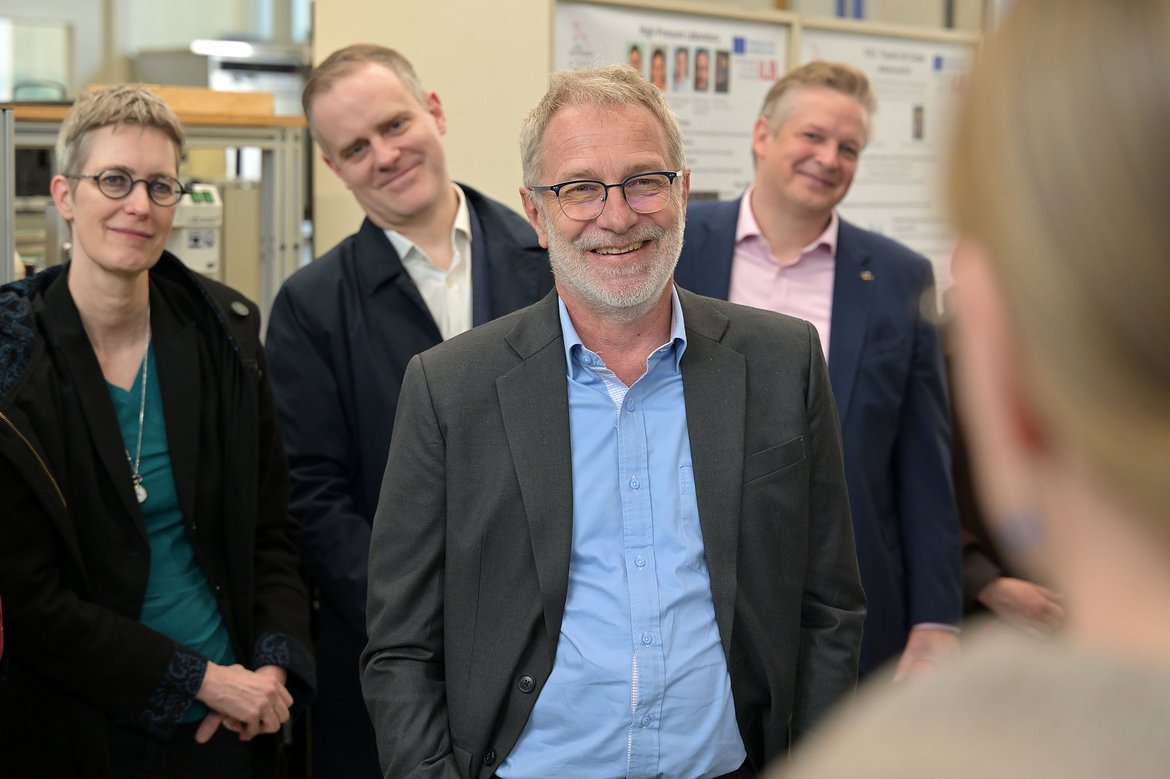
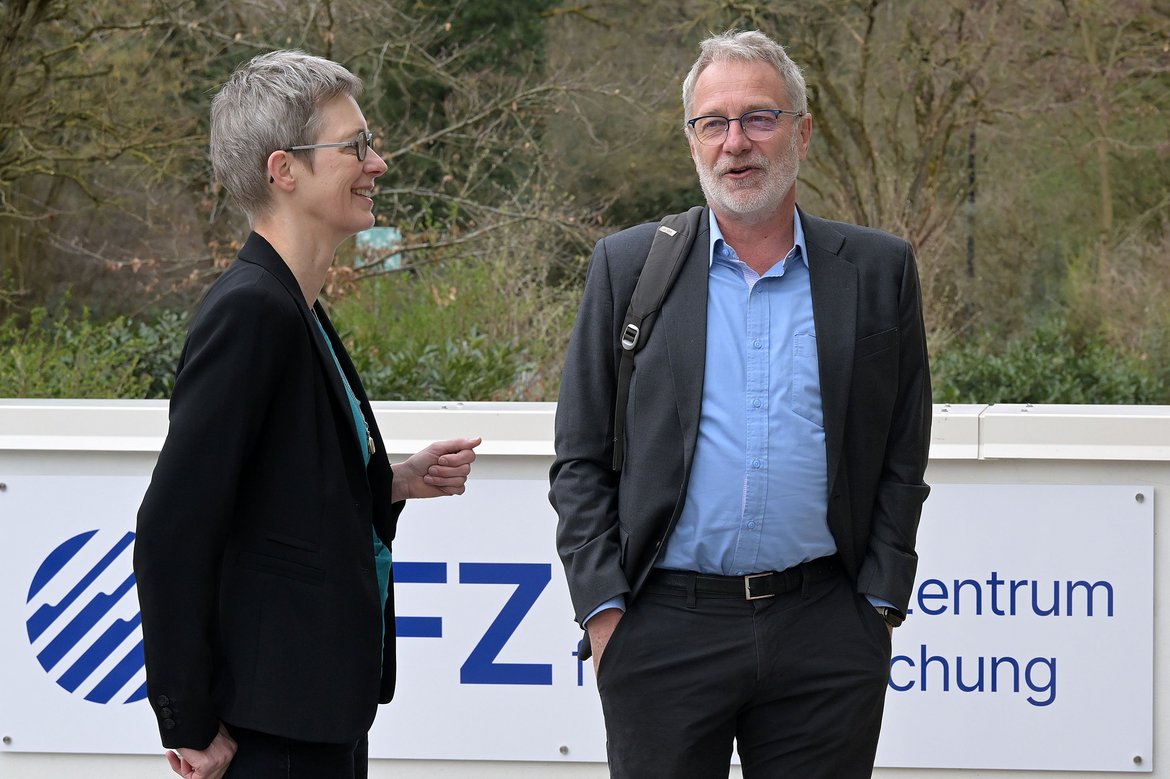


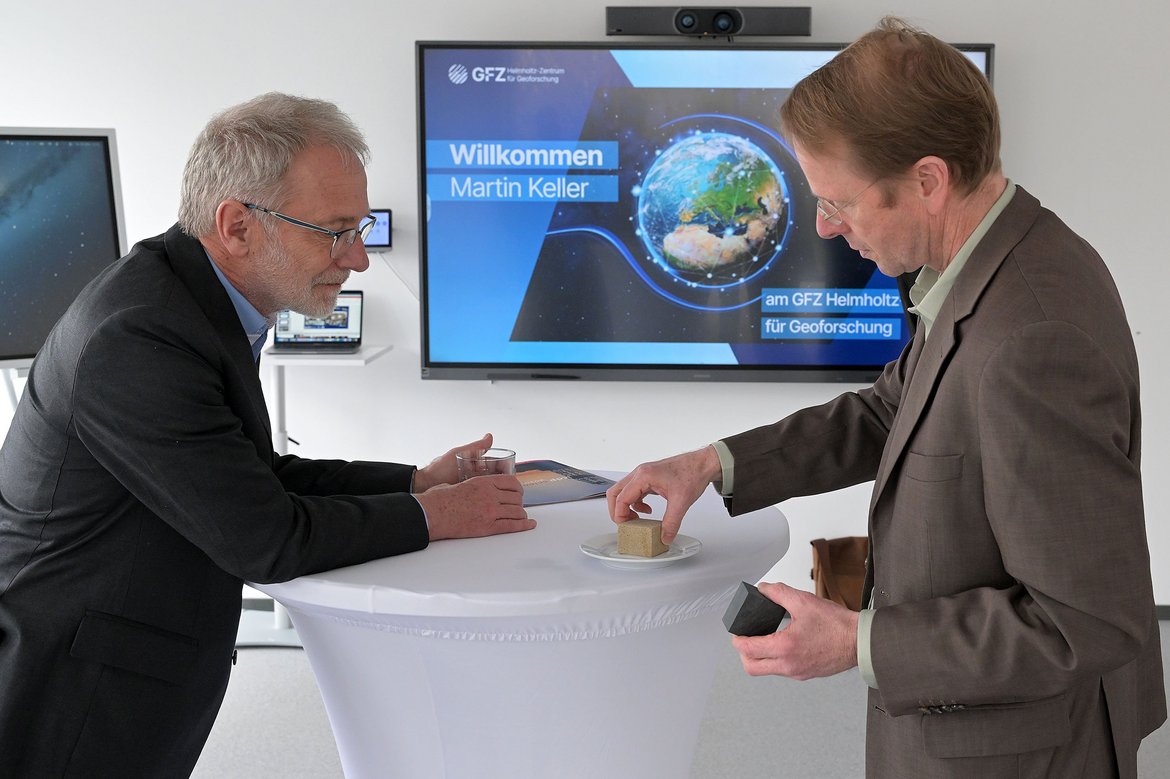
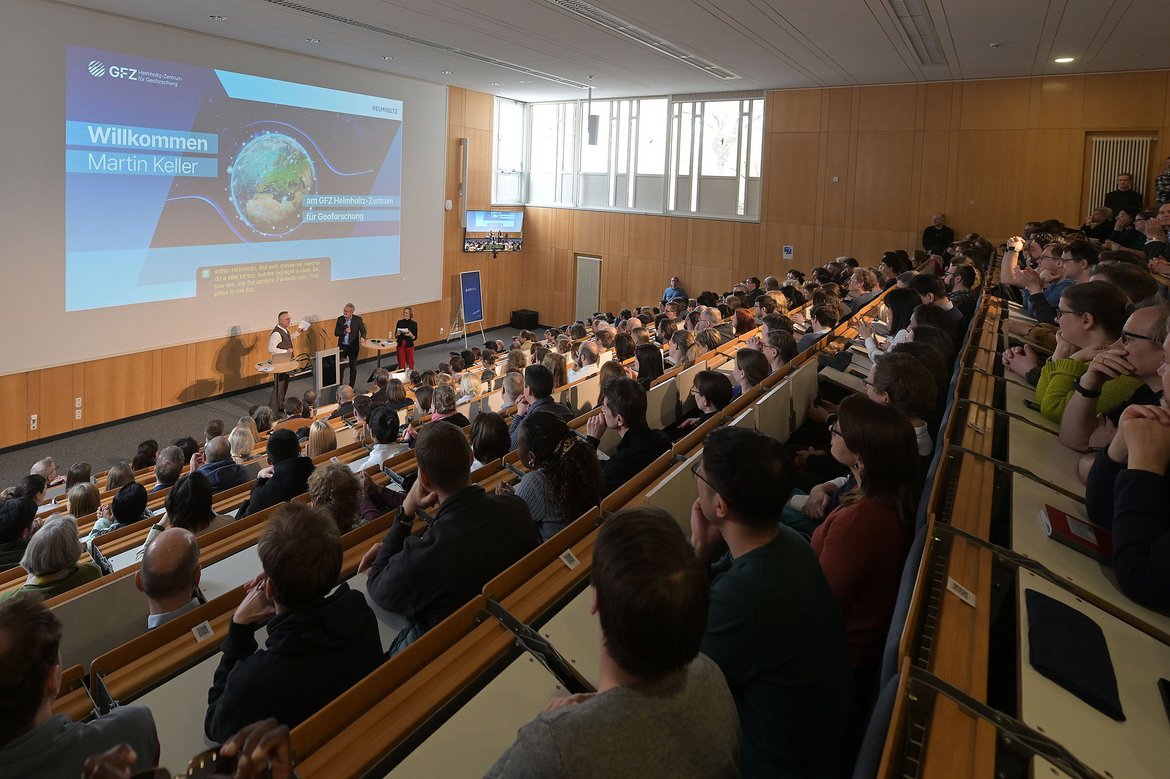
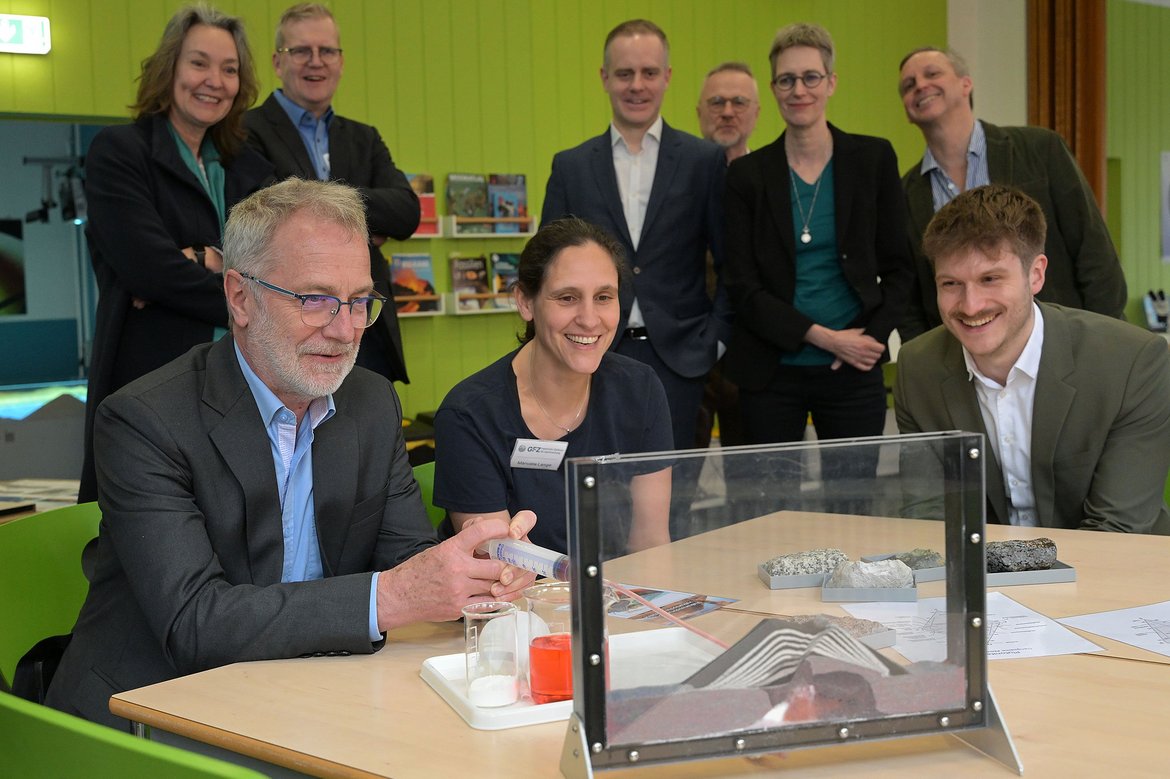
On 24 March, the new Helmholtz President, Prof. Dr Martin Keller, visited the GFZ Helmholtz Centre for Geosciences. Keller, who has held the post since 1 November 2025, is currently visiting all 18 centres of the Helmholtz Association. The one-day visit to Potsdam’s Telegrafenberg took Martin Keller and his delegation to key GFZ laboratories and facilities with topics ranging from the monitoring and prediction of geohazards, through Earth surveying, the utilisation of the geological subsurface, the Helmholtz Laboratory for Integrated Geological and Biological Research (GeoBioLab), and the transformative sustainability research of the RIFS, to the GFZ Start-up and Innovation Floor GITA and the GFZ School Lab. This agenda provided numerous opportunities for personal discussions with the Executive Board, researchers and staff on current and future priorities in Earth system research. A Townhall meeting in a packed lecture theatre, featuring a moderated quiz and Q&A sessions, rounded off the varied programme for the day.
Martin Keller’s conclusion on his visit to the GFZ:
“The Earth is the foundation on which our lives are built. How we treat it today shapes the environment for future generations. This makes it all the more important to better understand the Earth system and to make this knowledge usable for society, politics and the economy. This is precisely where the GFZ comes in. It brings together research into the Earth system with unique depth and breadth – from processes within the Earth’s interior, such as volcanism and earthquakes, through to the formation and extraction of critical raw materials, and on to global changes such as climate change, sea-level rise and water scarcity. With state-of-the-art infrastructure, ranging from satellite missions to global monitoring networks, it lays the foundation for concrete courses of action on the path to a sustainable future.”
The GFZ stations in detail
The agenda included the monitoring and prediction of geohazards such as earthquakes and volcanic eruptions using proven and unique research infrastructures such as the Global Seismic Monitoring network GEOFON, the GIPP Geophysical Instrument Pool Potsdam, and the GONAF Geophysical Observatory at the North Anatolian Fault – currently undergoing further expansion – for monitoring the region around the Sea of Marmara off Istanbul, which is particularly at risk from earthquakes. New approaches include, among other things, the use of fibre-optic measurement techniques and telecommunications cables for monitoring earthquakes and volcanoes, for example in the recently launched SAFAtor project.
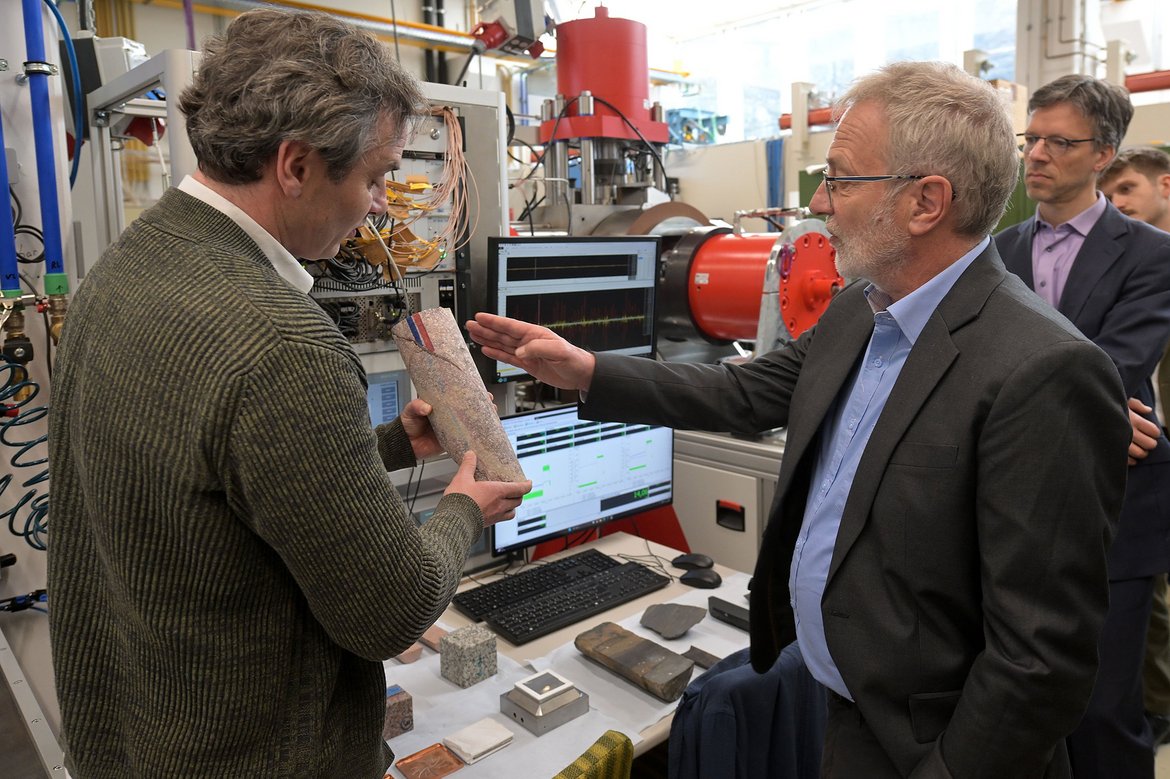
The use of the geological subsurface was the focus of the visit to the High-Pressure Labs. Here, a demonstration was given of how the TrueTriax polyaxial high-pressure testing system can be used to replicate real-time pressure and temperature conditions at a depth of several kilometres for rock investigations. This provides important insights, particularly in the context of geothermal energy and the geological storage of CO₂ (German only) and hydrogen.
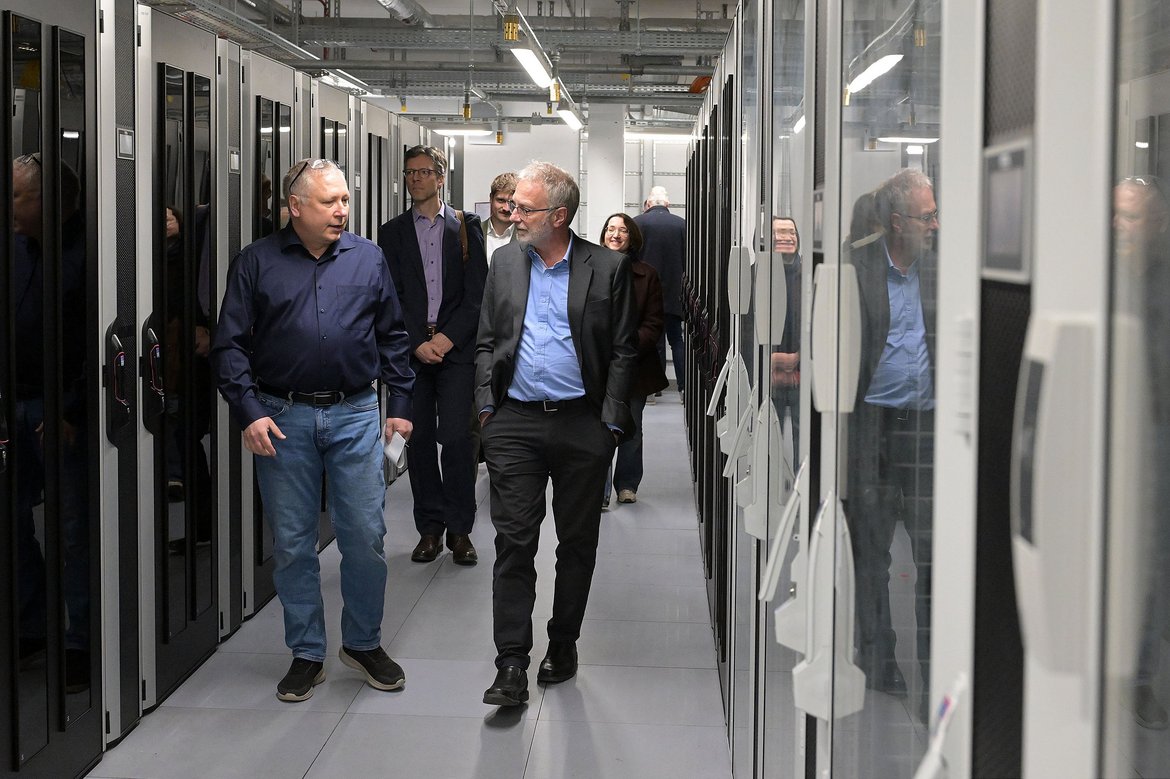
At the GeoBioLab, the Helmholtz Laboratory for Integrated Geological and Biological Research, the motto was: Innovative research in an innovative and sustainable building. The building, which has been awarded the silver plaque for sustainable construction, houses state-of-the-art laboratories for geomicrobiological research. Research here focuses, among other topics, on questions regarding the metabolic processes and survival strategies of microorganisms under extreme conditions such as cold, heat and drought, the role of microorganisms in resource formation, and the role of ice algae in glacial melt. What makes the building services special is that the waste heat from the integrated server room is used to heat the air in the GeoBioLab and adjacent GFZ buildings on the Telegrafenberg.
At a marketplace event, the RIFS Research Institute for Sustainability at the GFZ, part of the GFZ and the Helmholtz Association since early 2023, demonstrated how transdisciplinary, transformative and co-creative sustainability research can enrich the Helmholtz Association – which is largely oriented towards the natural sciences and technology – in matters of the energy transition, climate change and socio-technical transformation, as well as in matters of sustainable governance and participation.
“We measure the Earth” was the theme on the roof of Building A17 and at the historic Helmert Tower. Here, researchers from GFZ Sections 1.1 Space Geodetic Techniques and 1.2 Global Geomonitoring and Gravity Field demonstrated, for example, how they use signals from global navigation satellites to obtain information on atmospheric temperature and water vapour content – thereby improving daily weather forecasts. The Helmert Tower, currently hidden behind tarpaulins and scaffolding, is not only being renovated in accordance with heritage conservation standards, but is also being prepared to house the fourth generation of the Satellite Laser Ranging station on the Telegrafenberg. The SLR station is used for the millimetre-precise measurement of satellite orbits.
Selected success stories demonstrated how society and science can benefit from long-term developments: from the successful demonstration of CO2 storage at the Ketzin site in Brandenburg to the planned underground storage of hydrogen. From the past GRACE mission, through the current GRACE-FO, to the future GRACE-C satellite mission, whose gravity field measurements enable the monitoring of the global water cycle and provide important long-term data series for climate research. And the development of national and international deep drilling programmes, from KTB (Federal Republic of Germany’s Continental Deep Drilling Programme) and the ICDP (International Continental Scientific Drilling Programme) to the GONAF monitoring network around the Sea of Marmara and to KTB 2.0 – the use of KTB as a deep laboratory.
Another key focus was the successful transfer of knowledge and technology at the GFZ: at the GITA Start-up and Innovation Floor, Martin Keller discussed strategies and framework conditions with the Transfer and Innovation team as well as with successful founders from DiGOS, RIM2D and VFGLab. This part of the visit was rounded off by a visit to the GFZ School Lab, where Martin Keller himself carried out experiments demonstrating a volcanic eruption and the evolution of a mountain range.
Of particular importance to Martin Keller was the direct dialogue and exchange with researchers and staff at the GFZ. There was a lively discussion session with Early Career Scientists. And as part of a Townhall meeting, all GFZ staff were given the opportunity to get to know Martin Keller. A moderated quiz provided a fun insight into fascinating facts about the GFZ and the Helmholtz Association. During a question-and-answer session, Martin Keller also valued suggestions from GFZ staff. His communiqué at the end: “Helmholtz is you, it is all of us, in the most diverse roles,” was one of Keller’s key messages. “Thank you for the passion with which you approach your scientific work and for joining us on this research adventure, using the systemic approach that makes us at Helmholtz so unique and ensures we are well equipped to face future challenges.”


![[Translate to English:] Veranschaulichung der Veranstaltung.](/fileadmin/_processed_/c/5/csm_20260928_Kachel_37c583cb50.webp)


![[Translate to English:] Alle Länder Afrikas gelistet mit relativem Malariarisiko](/fileadmin/_processed_/1/b/csm_2026-08-20-L%C3%A4nderliste_Malariarisiko_web_d547ebb81d.webp "[Translate to English:]")


![[Translate to English:] Bewaldetes Gebiet mit historischen Gebäuden](/fileadmin/_processed_/5/e/csm_Telegrafenberg-2021_300dpi_Marcel-Ludwig-GFZ_web_70a5c15a88.webp "[Translate to English:]")


![[Translate to English:] Karte](/fileadmin/_processed_/4/8/csm_20260625-0945b_Venezuela_Nachbeben_-c-EarthquakeExplorer-GFZ_04f208410a.webp)
