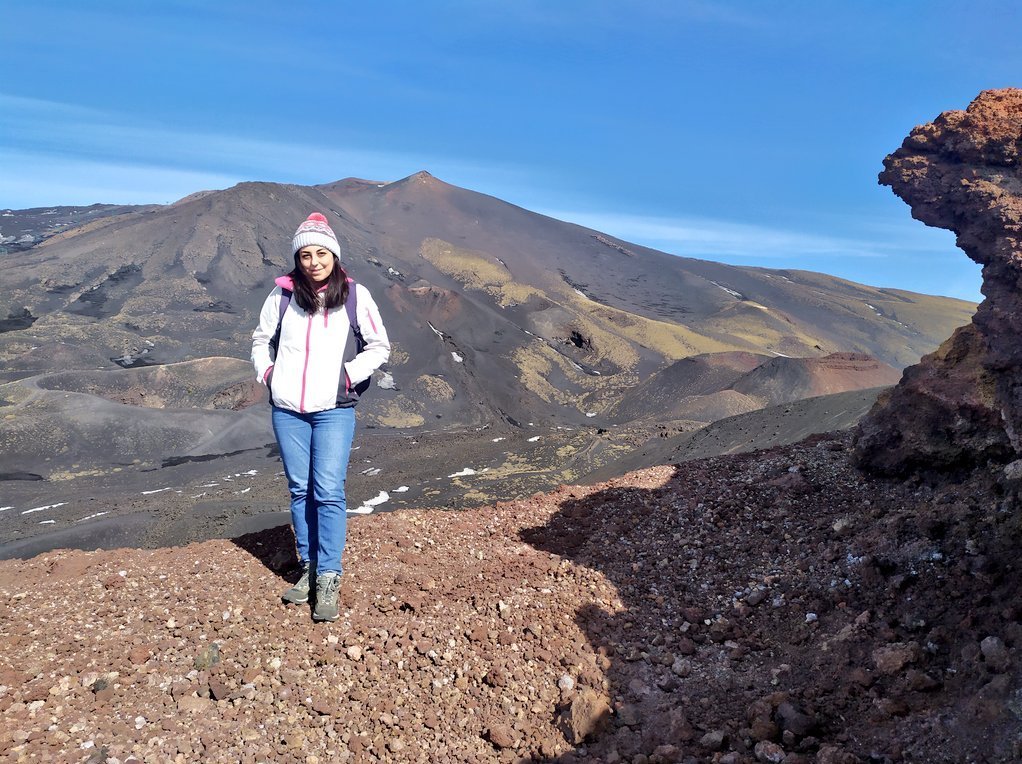
Dr Pinar Büyükakpınar joined the Coordinating Committee of the TopoAsia Initiative, an international collaborative platform recently launched to advance a 4D understanding of Asia’s dynamic Earth, from mantle convection and lithospheric processes to surface interactions with climate, erosion, and active tectonics. Pinar Büyükakpınar, Scientist in GFZ Section 2.1 “Physics of Earthquakes and Volcanoes”, will – together with the other 17 members of the Coordinating Committee – be contributing to the development of the initiative’s scientific strategy, the expansion of its international network, and the implementation of its long-term research vision.
The TopoAsia Initiative
The TopoAsia Initiative was launched in Shanghai on 21 October 2025, during the 23rd China International Talent Exchange Conference (CIEP). Over 250 participants from nearly 30 countries attended the first international workshop. To date, more than 15 countries and over 40 research institutions have officially joined the initiative.
The Initiative seeks to unravel how deep Earth dynamics, crustal deformation, and tectonic processes collectively shape Asia’s topography over geological timescales. It builds on integrating multidisciplinary datasets from natural laboratories – geologically significant areas within the region. This includes the Tethyan – comprising West Asian Oceans like the Mediterranean Sea and the Indian Ocean, and the inland Black and Caspian Sea –, the Pacific, and the mountain-building orogenic systems that stretch along the Eurasian plate boundary from the Alps to the Himalayas, as well as the Central Asian mountain belt and tectonically stable continental areas (cratons).
TopoAsia emphasises the coupling between mantle processes and surface expressions, including basin evolution, plateau uplift, erosion, sediment transport, seismicity, and volcanic activity, offering a unique opportunity to study Asia as a natural laboratory for 4D topographic evolution.
Through coordinated field studies, large scale monitoring networks, AI enhanced data integration, and open access archives, the initiative promotes interdisciplinary collaboration and capacity building, transforming regional observations into a continent-wide framework for understanding the evolution of Asian topography, earthquake and volcanic hazards.
Inspired by the successes of EUROPROBE (since 1984) and TOPO EUROPE (since 2006), TopoAsia aims to create a sustainable, globally connected research network to address fundamental questions in geodynamics, tectonics, surface processes, and natural hazard mitigation.
Outlook: International Symposium in November 2026
As part of its ongoing activities, TopoAsia will co organize the 2026 International Symposium on Deep Earth Exploration and TopoAsia in Beijing, China (November 7–9), a flagship event bringing together deep Earth and surface process communities to advance the understanding of Asian continental geodynamics, tectonics, and 4D topographic evolution.
About the person
Dr Pinar Büyükakpinar is a Principal Investigator at the GFZ Helmholtz Centre for Geosciences in Potsdam. She has been conducting research here since 2022, following positions at Boğaziçi University in Türkiye and the Istituto Nazionale di Geofisica e Vulcanologia (INGV) in Italy.
Since 2023, she has been leading the DFG funded CHASING project, focusing on earthquake swarm activity in the Eger Rift, a natural laboratory where high resolution seismic monitoring reveals fluid migration, localized mantle upwelling, CO2 degassing, and the presence of magmatic melts. She is also the scientific coordinator of the ELISE Large N Experiment, a large-scale passive seismic deployment of 300 sensors initiated in 2025 in the Eger Rift.
Her research combines high resolution earthquake source characterization, advanced seismic waveform analysis, and machine learning techniques to investigate the role of fluids in driving seismic swarm activity across different tectonic environments. Her work also explores whether the fluid driven and magmatic processes observed in the Eger Rift, including the dense magmatic carbonatitic melts detected in the crust, might also be active in other intraplate regions, such as Western Anatolia, where similar seismic swarm activities have been recorded.
More information on the TopoAsia Initiative:


![[Translate to English:] Veranschaulichung der Veranstaltung.](/fileadmin/_processed_/c/5/csm_20260928_Kachel_37c583cb50.webp)


![[Translate to English:] Alle Länder Afrikas gelistet mit relativem Malariarisiko](/fileadmin/_processed_/1/b/csm_2026-08-20-L%C3%A4nderliste_Malariarisiko_web_d547ebb81d.webp "[Translate to English:]")


![[Translate to English:] Bewaldetes Gebiet mit historischen Gebäuden](/fileadmin/_processed_/5/e/csm_Telegrafenberg-2021_300dpi_Marcel-Ludwig-GFZ_web_70a5c15a88.webp "[Translate to English:]")


![[Translate to English:] Karte](/fileadmin/_processed_/4/8/csm_20260625-0945b_Venezuela_Nachbeben_-c-EarthquakeExplorer-GFZ_04f208410a.webp)
