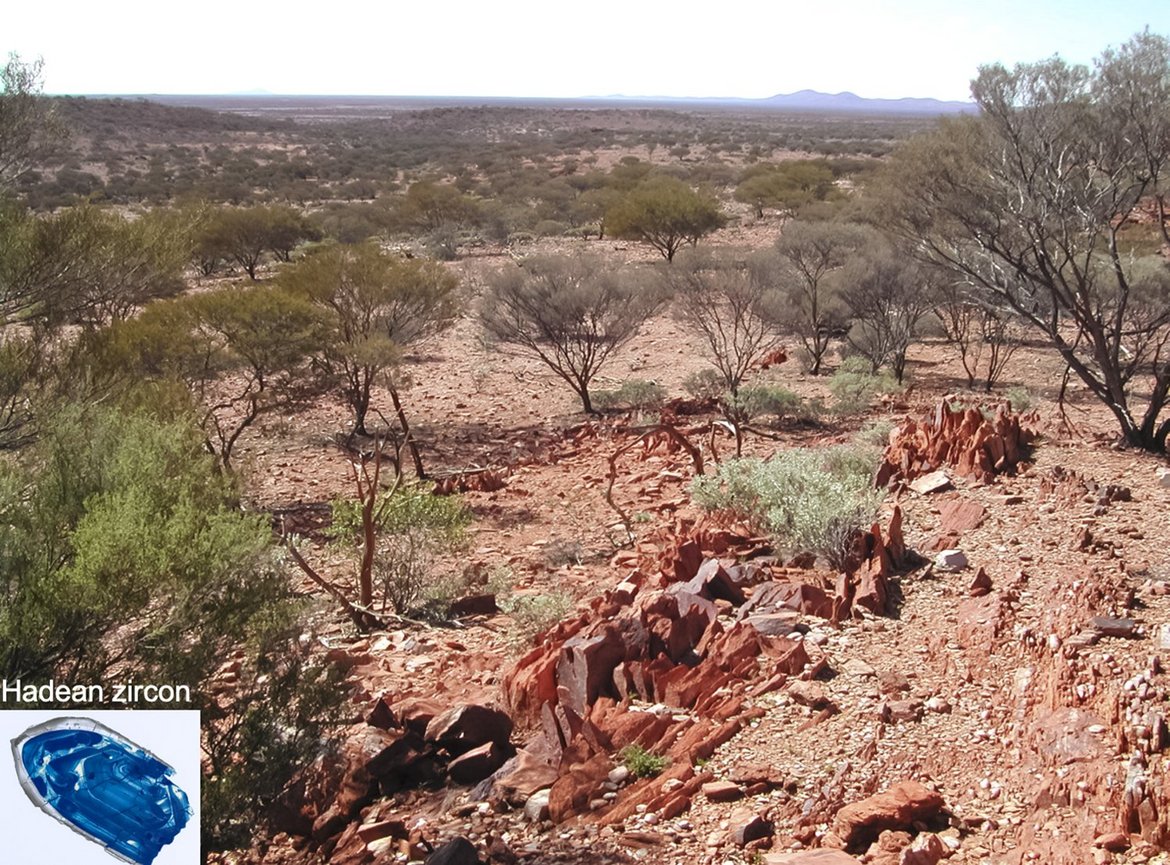
How did our planet evolve over time? The further back we look, the harder it is to obtain a clear picture of Earth’s past. Now, an international team of researchers presents evidence that contrasting tectonic regimes already operated in the Hadean, i.e., the first geologic eon more than four billion years ago. Their Nature paper suggests that tectonic regimes in the very early Earth were much more variable than previously thought.
The results indicate that some areas of early Earth experienced a so-called stagnant lid tectonic regime, while other regions were dominated by subduction. The study was led by John Valley from the University of Wisconsin-Madison (USA). It is an outcome of the MEET project funded through a Synergy Grant by the European Research Council ERC. Stephan Sobolev from GFZ Helmholtz Centre for Geosciences is one of the principal investigators and co-author of the study.
The study is the result of comprehensive geochemical analyses of a unique collection of Hadean-age zircons from Jack Hills in Australia. These zircons are more than four billion years old. Trace elements within the zircons point to geological processes the surrounding rocks underwent, in that case subduction. When scientists compared the geochemical signature of Australian zircons with zircons from other ancient rock formations in South Africa, they found that some showed no signs of subduction. Co-author Stephan Sobolev from GFZ says: “Our research suggests that contrasting and variable tectonic regimes operated in the Hadean in different parts of the Earth over time. Geodynamic modelling carried out at GFZ supports tectonic interpretations of these results, showing that during the Hadean, subduction-dominated and non-subduction tectonic regimes probably alternated in space and time.”
About the MEET project:
In the "MEET" project, geophysicist Stephan Sobolev, together with his twin brother Alexander, who is a geochemist at the Institute of Sciences de la Terre at the University of Grenoble, and geochemist John Valley (University of Madison, Wisconsin, USA), are researching the evolution of our planet. MEET stands for "Monitoring Earth Evolution through Time" and spans the period from 4.4 billion years ago to the present day. Two questions are the focus of the researchers' interest: How has the chemical composition of the Earth developed over time? And what physical processes are behind these changes? The project started in 2020 and will end next year.
Press release about MEET (in German only):
https://nachrichten.idw-online.de/2019/10/11/synergy-grant-geht-an-stephan-sobolev-vom-gfz
MEET press release together with a second Synergy Grant (in German and English):
https://www.gfz.de/en/press/news/details/two-of-the-highest-european-research-prizes-awarded-to-gfz
Original study: John W. Valley et al.: Contemporaneous mobile- and stagnant-lid tectonics on the Hadean Earth; DOI: https://doi.org/10.1038/s41586-025-10066-2


![[Translate to English:] Alle Länder Afrikas gelistet mit relativem Malariarisiko](/fileadmin/_processed_/1/b/csm_2026-08-20-L%C3%A4nderliste_Malariarisiko_web_d547ebb81d.webp "[Translate to English:]")


![[Translate to English:] Bewaldetes Gebiet mit historischen Gebäuden](/fileadmin/_processed_/5/e/csm_Telegrafenberg-2021_300dpi_Marcel-Ludwig-GFZ_web_70a5c15a88.webp "[Translate to English:]")


![[Translate to English:] Karte](/fileadmin/_processed_/4/8/csm_20260625-0945b_Venezuela_Nachbeben_-c-EarthquakeExplorer-GFZ_04f208410a.webp)


