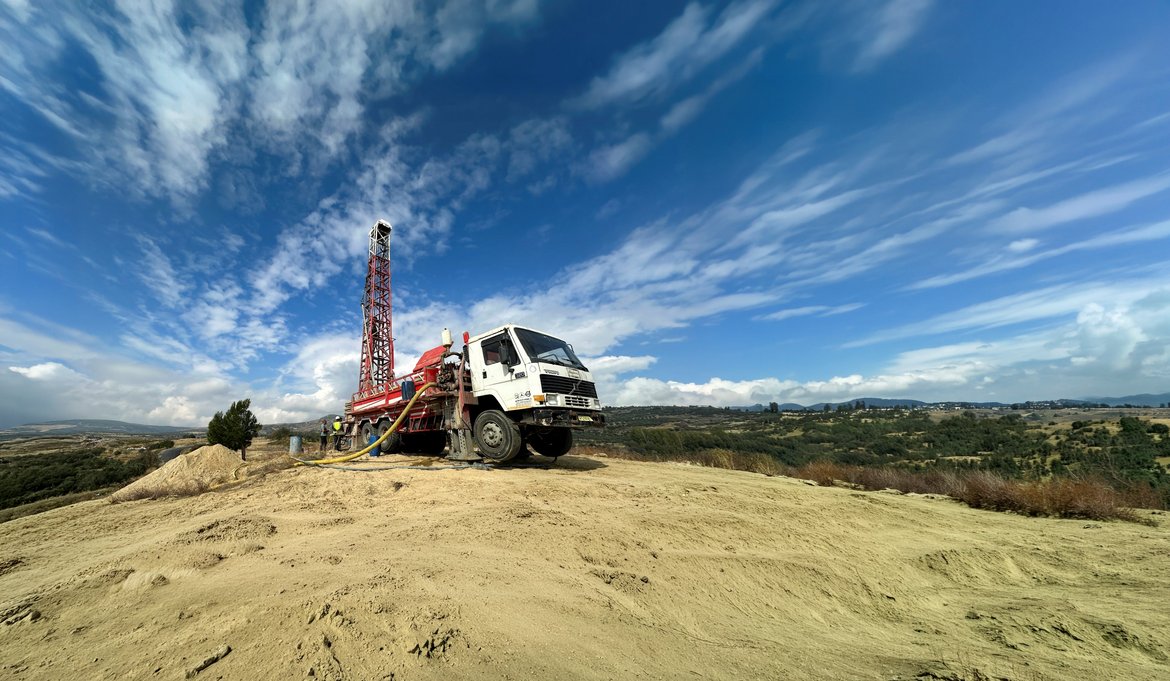


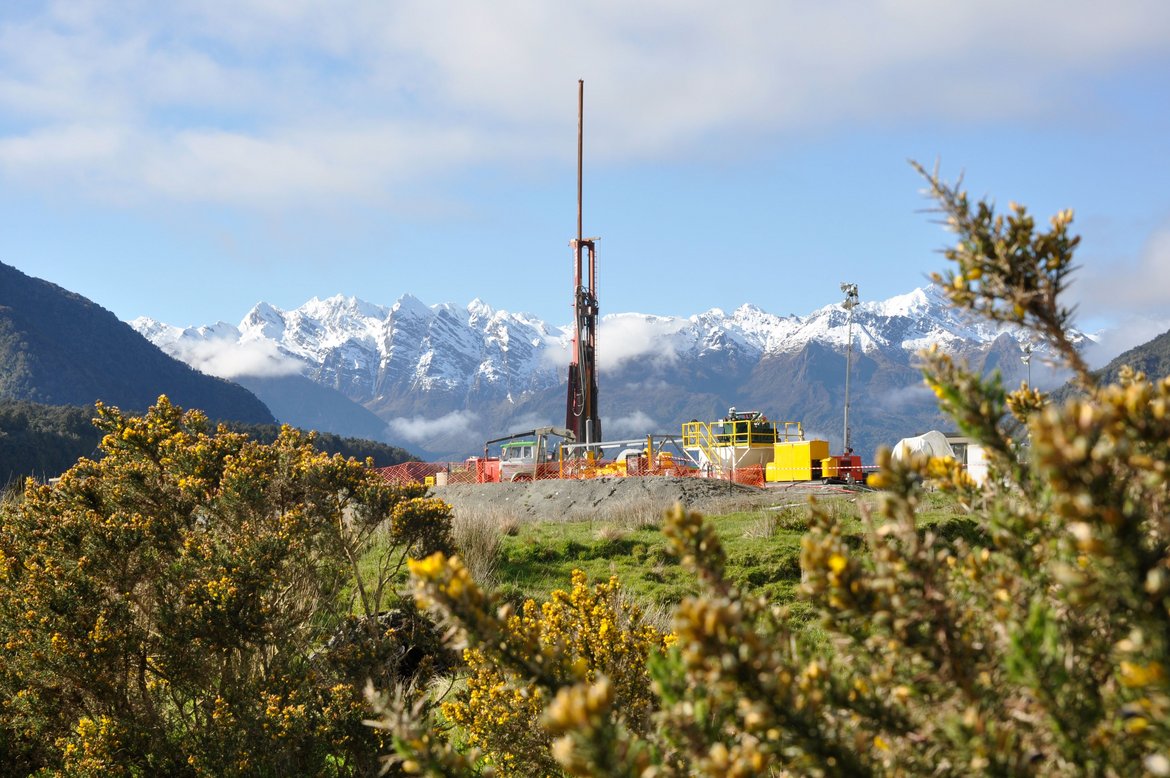
The International Continental Scientific Drilling Programme (ICDP) was launched on 26 February 1996. For 30 years, it has been making a significant contribution worldwide to unravelling the geological mysteries beneath our continents: How is the Earth's crust structured? What minerals, rocks, fluids and gases are found deep within the Earth? Under what conditions can life thrive there? What were the environmental and climatic conditions on Earth hundreds of thousands of years ago? How do earthquakes and volcanic eruptions occur? Where can geothermal energy be used economically?
To answer questions like these, research relies on drilling: only drilling allows data to be measured at close range underground – for example, temperature and pressure –, processes such as seismic movements to be monitored by inserting sensors, or even material – such as rocks, liquids or gases – to be extracted from the depths for examination in laboratories above ground.
In association with over 20 member states from around the world – from the USA, Germany, Iceland and China to Australia and New Zealand, including UNESCO – the ICDP, as a non-profit organisation, supports international research teams in large drilling projects, both financially and with technical and scientific expertise, including equipment, services, training and know-how. Each country is represented by a scientific institution. The ICDP management and administrative office are located at the GFZ Helmholtz Centre for Geosciences in Potsdam, Germany.
Over the past three decades, more than 60 major drilling projects have been carried out around the world. The ICDP has provided over 60 million US dollars for this purpose. Together with third-party funding from other sources amounting to around 240 million US dollars, a total of more than 300 million US dollars was available for the projects.
“Drilling is like a telescope into the Earth’s interior, giving us essential insights into the structure and processes within the Earth. On this basis, scientific hypotheses can be tested and models refined,” says ICDP Executive Director Prof. Dr Marco Bohnhoff who is also Head of Section 4.2 “Geomechanics and Scientific Drilling” at the GFZ. “The ICDP funds research projects that use borehole-based measurements at key locations around the world to gain fundamental insights into the distant past and, as a result, into future developments, such as climate change. These projects contribute to our understanding of natural hazards, research into the energy transition and the sustainable use of georesources.”
The founding history of the ICDP
The founding of the International Continental Scientific Drilling Programme (ICDP) dates back to 1993, when the GFZ organised a conference on “International Continental Scientific Drilling” in Potsdam with 250 participants. Within this framework, the scientific foundations of such an international continental drilling programme were formulated. The Continental Deep Drilling Programme (KTB) in Germany, led by GFZ founding director Prof. Rolf Emmermann, and the International Lithosphere Programme (ILP), which already existed at the time as a global network for research into the Earth’s interior, formed the framework and impetus for the idea of an international land drilling research programme.
On 26 February 1996, representatives of the US National Science Foundation (NSA), the Chinese Ministry of Geology and Mineral Resources, the German Federal Ministry of Education, Science, Research and Technology, and the then GeoForschungsZentrum Potsdam (GFZ) ratified a Memorandum of Understanding (MoU) on the establishment of the ICDP at the German Embassy in Tokyo.
ICDP and GFZ
The Executive Director of the ICDP is Prof. Dr Marco Bohnhoff, who heads Section 4.2 “Geomechanics and Scientific Drilling” at the GFZ. This section also houses the ICDP Operational Support Group (ICDP-OSG), a working group that provides operational support for the planning and implementation of scientific drilling projects. As a recent development, a network for young scientists interested in the ICDP was formed last year.
More than 300 GFZ scientists from a wide range of disciplines – geochemistry, geophysics, deep biosphere, palaeoenvironmental sciences, sedimentology – have been and continue to be involved in numerous ICDP projects.
The results in facts and figures
Highlight projects
- Volcanism (Hawaii, Unzen, Long Valley, Campi Flegrei, Snake River Plain)
- Geothermal energy (Krafla and Reykjanes in Iceland)
- Active fault zones (San Andreas Fault, North Anatolian Fault, Koyna, Eger Rift, Corinth Rift Laboratory, Alto Tiberina Fault)
- Palaeoclimate research (Dead Sea, Lake Towuti, Lake Junín, Petén Itzá)
- Gas hydrates (Mallik)
- Deep time (Scandinavian Caledonides, Outokumpu)
- Meteorite impacts (Bosumtwi , El'gygytgyn)
Total number of projects
61 to date
Number of projects in Germany
Two: 1. Eger Rift (with one borehole in Germany, see above “Landwüst” and boreholes in Czechia), 2. DOVE (Drilling Overdeepened Alpine Valleys) with one borehole in Tannwald, Baden-Württemberg, as well as boreholes in Switzerland and planned boreholes in Italy and Austria).
Deepest ICDP borehole
The deepest borehole promoted by the ICDP is located in Songliao (a sedimentary basin in China) and is 7108 m deep.
Oldest layer drilled
The BARB (Barberton Drilling Project: Peering Into The Cradle Of Life) and follow-up BASE (Barberton Archean Surface Environments, Moodies Group, Barberton Greenstone Belt) projects drilled the 3.5-3.2 billion-year-old Barberton Greenstone Belt in South Africa.
Longest core ever extracted
In a single core run, a drill core over 40 m (40.86 m to be precise) long and 21.4 cm in diameter was extracted, again from the Songliao project.
Total core length drilled by ICDP
Over 100 km
Highest drilling location
Lake NamCore on the Tibetan Plateau (4718 m above sea level).
Lowest drilling site
DSEIS (Drilling into Seismogenic Zones of M2.0 - M5.5 Earthquakes in Deep South African Gold Mines): Drilling took place 2.9 km below the Earth’s surface in a South African gold mine (Moab Khotsong), equivalent to 1.6 km below sea level.
The project closest to the GFZ
The borehole in Landwüst (Saxony, 240 km as the crow flies) is the closest borehole and was drilled as part of the Eger Rift Project.
The project furthest from the GFZ
The Deep Fault Drilling Project (DFDP) in Whataroa on New Zealand's South Island (18,051 km as the crow flies according to Google Earth) - see picture gallery above, followed by SWAIS2C in Antarctica (approx. 17,170 km).
Drilling with the most publications to date
The frontrunners are the Chixculub drilling project in Mexico and the Songliao Basin Drilling Project in China, each with more than 300 publications.
Further information:
General information on scientific drilling:
GFZ focus website on scientific drilling
Continental Deep Drilling Programme (KTB)
PM 30 years of KTB – Germany's deepest point celebrates its anniversary
Further information on the KTB GEO Centre website
Podcast on scientific drilling and 30 years of ICDP, available from 26 February 2026 at:
The Research Quartet – Science at detektor.fm
In cooperation with the GFZ Helmholtz Centre for GeoResearch, Prof. Marco Bohnhoff is our guest.


![[Translate to English:] Veranschaulichung der Veranstaltung.](/fileadmin/_processed_/c/5/csm_20260928_Kachel_37c583cb50.webp)


![[Translate to English:] Alle Länder Afrikas gelistet mit relativem Malariarisiko](/fileadmin/_processed_/1/b/csm_2026-08-20-L%C3%A4nderliste_Malariarisiko_web_d547ebb81d.webp "[Translate to English:]")


![[Translate to English:] Bewaldetes Gebiet mit historischen Gebäuden](/fileadmin/_processed_/5/e/csm_Telegrafenberg-2021_300dpi_Marcel-Ludwig-GFZ_web_70a5c15a88.webp "[Translate to English:]")


![[Translate to English:] Karte](/fileadmin/_processed_/4/8/csm_20260625-0945b_Venezuela_Nachbeben_-c-EarthquakeExplorer-GFZ_04f208410a.webp)
