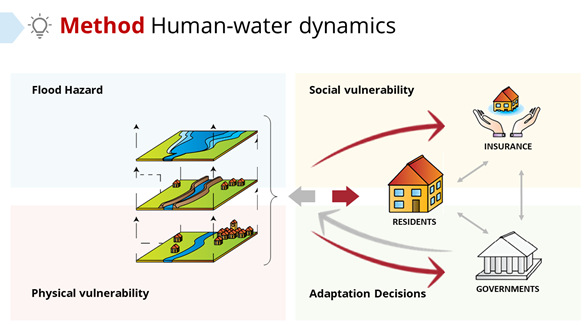
LIMIT2ADAPT is an interdisciplinary ERC synergy grant project that investigates where and when societies reach the limits of adaptation to flooding. As climate change and the urbanization of low-lying areas drive flood risk upward, households increasingly need to adapt. Yet adaptive capacity is not unlimited: social vulnerability factors such as low income or advanced age can constrain household adaptation and leave homes physically more vulnerable, while the measures taken by governments and insurers can either stimulate or further limit these adaptive decisions. Where further adaptation ceases and risk becomes intolerable, an adaptation limit is reached, and relocation may be the only remaining option. LIMIT2ADAPT sets out to quantify, for the first time, where and when these limits emerge across the globe and how they are shaped by the underlying drivers of hazard, vulnerability, and adaptation decisions.
To do this, the project integrates two state-of-the-art approaches, flood risk modelling and agent-based modelling, into a coupled global model. This model is used to reconstruct historical trajectories of social and physical vulnerability for four selected river basins, drawing on exposure, survey and census data, and to produce global projections of vulnerability hotspots and future flood risk. Together, these enable the first spatially and temporally explicit simulation of future adaptation limits worldwide.
Section Hydrology at GFZ contributes its expertise in the physical vulnerability of buildings, assessing how and why flood damage changes across time and space. Further, novel household surveys will provide empirical insights on the perception of intolerable risk, which, together with the socio-hydrological modeling, will lay the groundwork for a new theory on risk assessment considering the limits of adaptation.
The project brings together four partner groups: GFZ Helmholtz Centre for Geosciences, Princeton University, the University of Bristol, and VU University Amsterdam, to work together for the next 6 years.
The project is funded by the European Research Council (ERC) through an ERC Synergy Grant under the European Union's Horizon Europe research and innovation programme (grant agreement 101224116).
Project duration: 2026 – 2032
https://www.limit2adapt-ercsyg.eu/