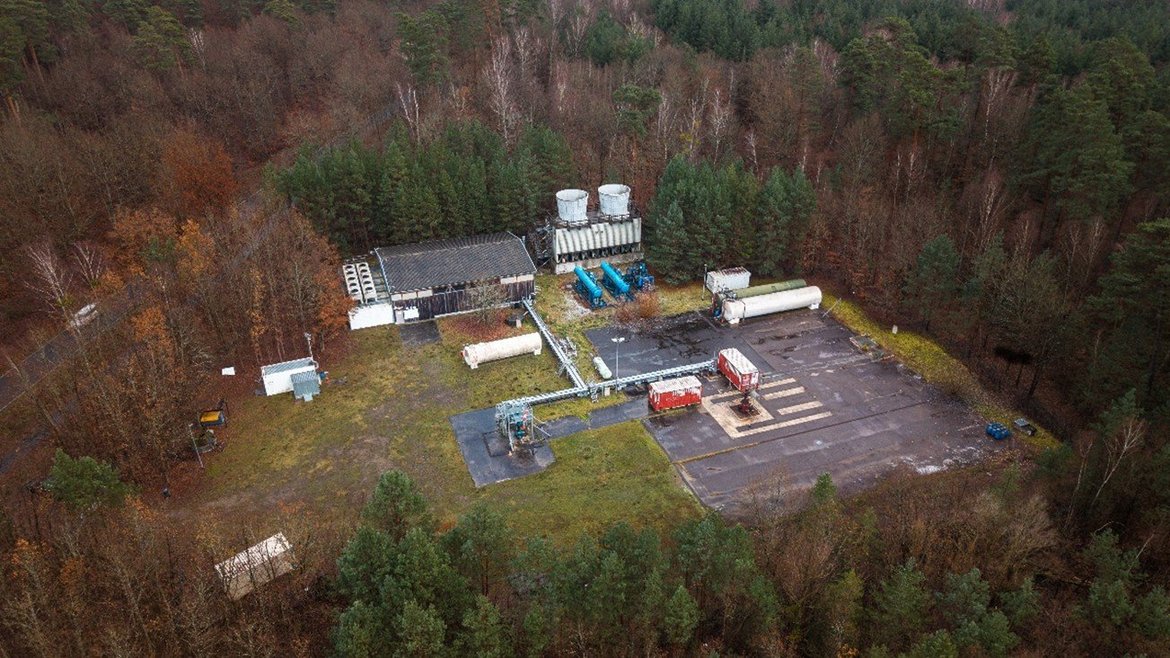
The GFZ Geothermal research platform Groß Schönebeck is situated northeast of Berlin on the southern edge of the North German Basin. Two research wells form a geothermal doublet and give access to water-bearing horizons at depths between 3,9 and 4,4 km at temperatures of 150 °C. They are used as an in situ laboratory for investigating deep sedimentary structures and fluids under natural conditions. The activities cover research in a holistic approach along the whole chain of geothermal technologies, from the geothermal reservoir to the provision of power, heat and chill.
The downhole laboratory represents an important pilot project for the geothermal technology development in Europe. In situ experiments and borehole measurements can be performed with the focus of studying how to enhance the productivity of low-permeability geothermal reservoirs to create Enhanced Geothermal Systems (EGS). Facilities for testing plant components and materials complete the research facility.
Reuse of the Gt GrSk 4/05 borehole as a deep geothermal heat probe
The Groß Schönebeck research platform is one of the demonstration sites in the EU research project TRANSGEO.
In order to further develop the technology for petrothermal systems and to explore strategies for reusing existing wells, tests are currently underway at the site in cooperation with the Danish company Greentherma with the aim of converting the borehole Gt GrSk 4/05 A into a deep geothermal probe. A one-year test, scheduled to begin in summer 2026, will assess the efficiency of the isolation, the stability of the vacuum, as well as the thermal output and production temperature of the deep geothermal probe under various flow conditions – particularly under the influence of thermally conductive salt layers.
The Groß Schönebeck site thus illustrates the transition from hydrocarbon to geothermal utilisation and demonstrates the potential for reusing abandoned boreholes. At the same time, it serves as a test site for advanced coaxial borehole heat exchanger technologies, thereby contributing to the development of sustainable geothermal utilisation concepts in sedimentary basins such as the North Basin.
EU Project TRANSGEO: Reuse of abandoned boreholes
TRANSGEO is investigating how abandoned boreholes and facilities from gas and oil production can be reused for geothermal applications. This is a topic of great interest, as drilling represents the largest cost factor in geothermal projects. Furthermore, the risk of failing to find a suitable site is significantly lower than with a new borehole, as records of old boreholes provide information on geological conditions. In addition to the borehole itself, existing infrastructure can often be utilised. Reuse also avoids new interventions in the landscape, thereby reducing the carbon footprint.