Aims
- to reconstruct the temporal and spatial variability of the climate of the past utilizing multi-parameter tree ring analysis
- to assess and verify the causes of climate change and its impact on woody plants
Tasks
- quantitative analysis of the climate-signal transfer from atmosphere through soil and leaf into the wood of tree rings (Monitoring, calibration and verification of tree ring parameters vs. instrumental data)
- to establish multi-centennial to millennium long time series of tree-ring parameters (ring width, cellstructure parameters, stable isotope ratios) for networks of sites from selected regions of the earth
- comparative study of time series of climate proxies from different geo-archives (varved sediments, spelethemes, corals etc.)
Trees store climate and environmental information from the past within their annual growth rings. Physical measurements of annual ring parameters, such as ring width and density, or the concentrations of certain chemical elements of different masses (isotopes), form the basis for reconstructing past climate and environmental dynamics. To do this, these annual ring parameters are compared and calibrated with measurement data from instrumental observations.
With its over 200-year-old tree stock and the continuously operating climate station of the German Meteorological Service since 1893, the Telegrafenberg is an ideal location for the development of new measurement methods, calibration of tree ring data, the investigation of climate dynamics, and the impact of climate change on tree growth and forest health.


3-D seismometers, also known as geophones, are installed on trees to record seismic waveforms. Different seismic waves are generated by vibrations and movements of the trees, caused by the interaction of weather and environmental influences with the trees. Influencing factors include wind load, soil-root interaction, tree structure, tree water content, and tree health. As healthy trees often exhibit different vibration patterns than sick or weakened trees, it may be possible to detect early signs of stress or damage (e.g., drought stress) in trees.

Dendrometers are instruments for measuring the radius or diameter of trees. Here, radius dendrometers are used which measure the expansion or contraction at a specific point (radius) of the tree trunk every 30 minutes. Water loss through the transpiration of leaves and needles causes the elastic tissue of the tree trunk to contract and the trunk diameter to shrink during the day. At night, water uptake through the roots is greater than the water loss through the crown. This causes the tree trunk to expand. New wood cells (annual rings) are primarily formed at night, leading to an irreversible increase in the thickness of the tree trunk.
- Equipment for sampling wood from living trees, historical timbers, and subfossil/fossil wood: increment borer (3-piece: borer, core extractor, handle); Diameters: 5 mm, 10 mm; lengths: 200–600 mm
- Various hand saws / chainsaw (for subfossil trunks or short cross-sections)
- Measuring tape (≥ 30 m)
- Digital diameter-at-breast-height tool (DBH tool) or caliper
- First-aid kit
- Protective gear (gloves, safety glasses, helmet)
- Cool box / insulated bag for moist samples (for anatomical series)
- Core holders (wooden strips, paraffin for fixation – in the laboratory)
- Storage boxes (twin-wall sheets, archival quality)
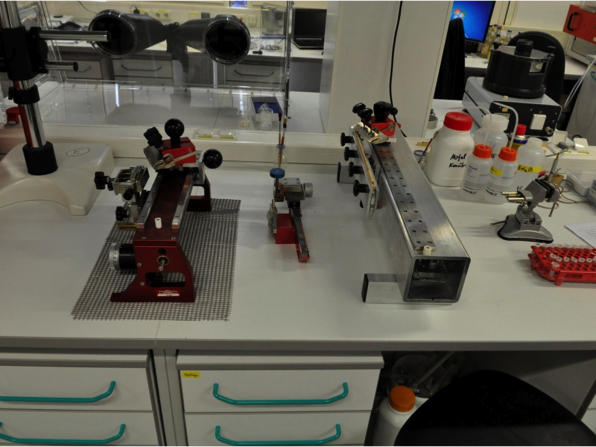
Band-saw
- Trimming of wood segments and cores
Beltsander OPTI
- Coarse preparation wood surfaces
Precision saw
- A precision saw (Buehler Isomet 5000) was modified by our GFZ workshop for dissecting thin cross sections from wood cores or wood segments.
WSL sliding microtomes
- Production of extremely thin sections
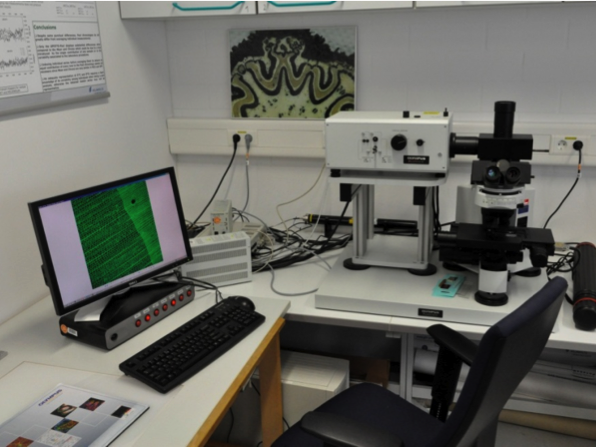
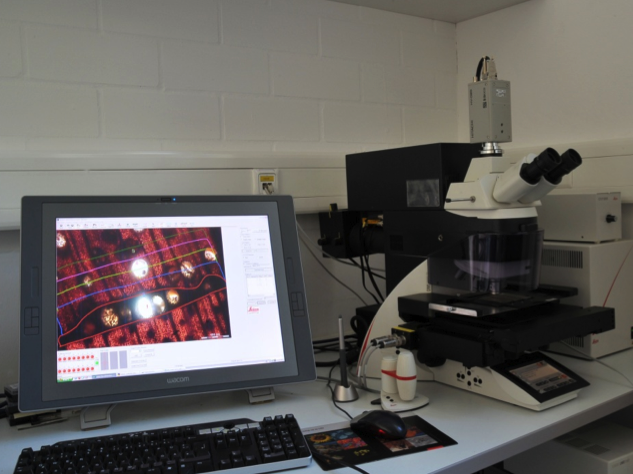
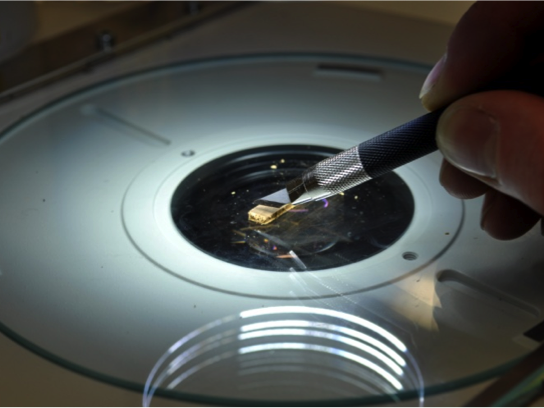
Laser microdissection microscope
- Research microscopes with UV laser application are used for high-resolution inter- and intra-annual analysis of tree rings. With the help of these microscopes, it is possible to produce precise, reproducible cuts in the micrometre range.
Cellulose extraction
- The wet chemical extraction of cellulose from raw wood is carried out in preparation for stable isotope analysis. During this extraction process, various wood components (resins, tannic acids, lignin) are gently removed from the wood over several days, leaving only pure cellulose.
Ultrasonic Homogenisation of cellulose
- Ultrasound is used to homogenise the sample material.
Freeze drying devices
- Freeze-drying is one of the gentlest drying methods.
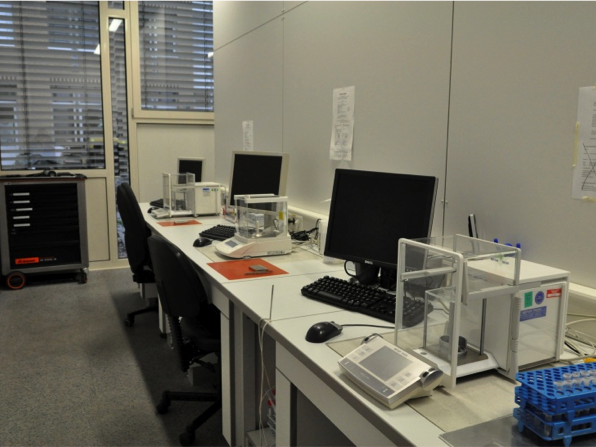
Weighing chamber
- The weighing of samples (50-180 µg) for isotope ratio mass spectrometry is carried out on a special weighing table using microbalances.
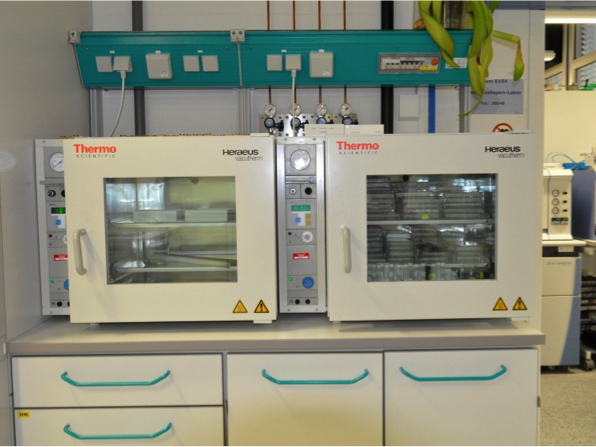
Vacuum drying oven
- Until measurement, weighed samples are stored in vacuum drying cabinets.