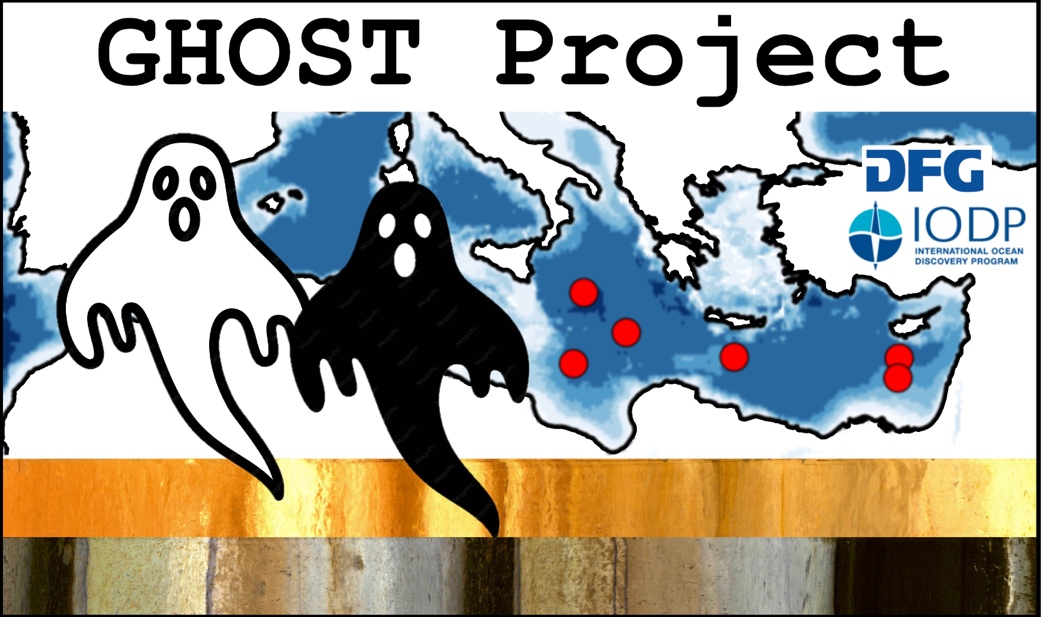
The GHOST project will focus on elucidating the climatic and oceanic drivers leading to the formation of the engimatic "ghost sapropels" in Mediterranean sediments during the past 3 million years. Sapropels are organic-rich sediments preserved over geological times in the deepest parts of the Mediterranean Sea. Because their formation process involves complex land-ocean linkages and large-scale ocean deoxygenation, they are often considered natural laboratories for understanding the timing and drivers of such processes.
In this project, we will focus on sapropels where the organic carbon is not preserved, called "ghost sapropels". They occur synchronously in the Mediterranean basin and seem paced by Milankovitch cycles but the driving mechanism remains elusive. This project will exploit national and international collaborations to use multiple isotopic tools and the extraction of specific sedimentary fractions on four ODP sites, as well as numerical models. By this data-model approach, we will test a set of working hypotheses that will enable us to understand the processes leading to the lack or loss of carbon in ghost sapropels. Ultimately, we aim to assess how the lack or loss of organic carbon in ghost sapropels affected the carbon cycle. The dataset generated during the GHOST project will provide new insights into the long-term changes in hydroclimates in North Africa as well as into Mediterranean Sea paleocirculation.
- Ed Hathorne, GEOMAR Helmholtz Centre for Ocean Research, Kiel, Germany
- Martin Frank, GEOMAR Helmholtz Centre for Ocean Research, Kiel, Germany
- Eric Viollier, Laboratory for Climate and Environmental Sciences (LSCE), France
- Christophe Rabouille, Laboratory for Climate and Environmental Sciences (LSCE), France