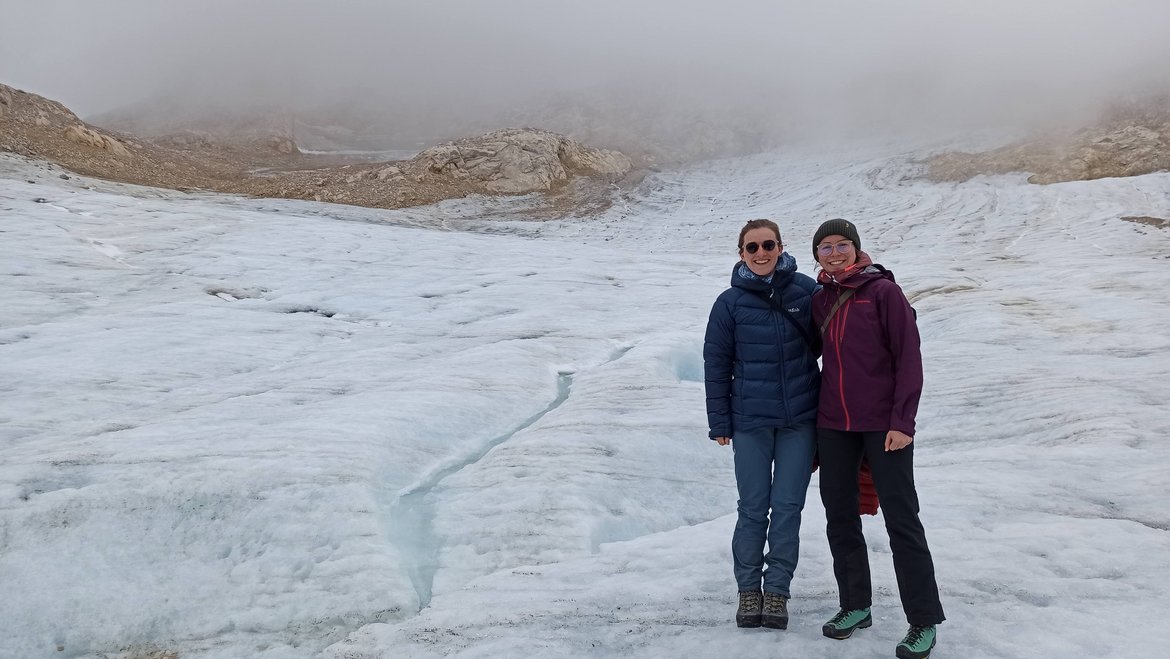
Under the theme “Melting Glaciers in a Changing World”, the 11th Gateway to the Arctic Workshop brought together more than 20 early-career researchers at the Schneefernerhaus research station on Germany’s Zugspitze – among them the two doctoral students Kim Sander and Mirjam Paasch (Section 3.5, Interface Geochemistry). Their research addresses the physiology of snow- and glacier ice algae as well as soil development in the forefield after glacier retreat. Located just below the summit and next to one of the country’s last remaining glaciers, the station provided the perfect setting for the event.
Over the course of three days, PhD candidates and Master’s students from the natural sciences, social sciences, humanities, literature, and political science exchanged insights from their ongoing research. The program combined lectures, group work, discussions, and excursions. Topics ranged from natural science perspectives—such as glacier and permafrost dynamics and the associated hazards, satellite-based methods for studying the Earth’s surface, and the role of biomass in accelerating glacier melt—to broader social and cultural perspectives. These included debates on the geopolitical situation in the Arctic, literary representations of the North, and the preservation and teaching of the Sami language.
Excursions to the Zugspitze glacier and to nearby permafrost areas allowed participants to directly experience the processes they were studying.
“It was great to get to know the perspective of the other young scientists working in very different areas on the same topic and that in this impressive environment that illustrated the topic of the workshop – the glacier on Zugspitze will be gone in a few years.” – Mirjam Paasch
“Sitting in a research tunnel on permafrost and walking across a melting glacier the next day – that’s climate change made tangible. The excursions, talks and conversations in the Schneefernerhaus showed how changing glaciers and permafrost affect landscapes, people and policy decisions.” – Kim Sander
Special thanks go to the organizing team and to the funding bodies supporting the workshop: REKLIM, the Malaurie Institute of Arctic Research Monaco-UVSQ, the Alfred Wegener Institute and the Franco-German University in Saarbruck.