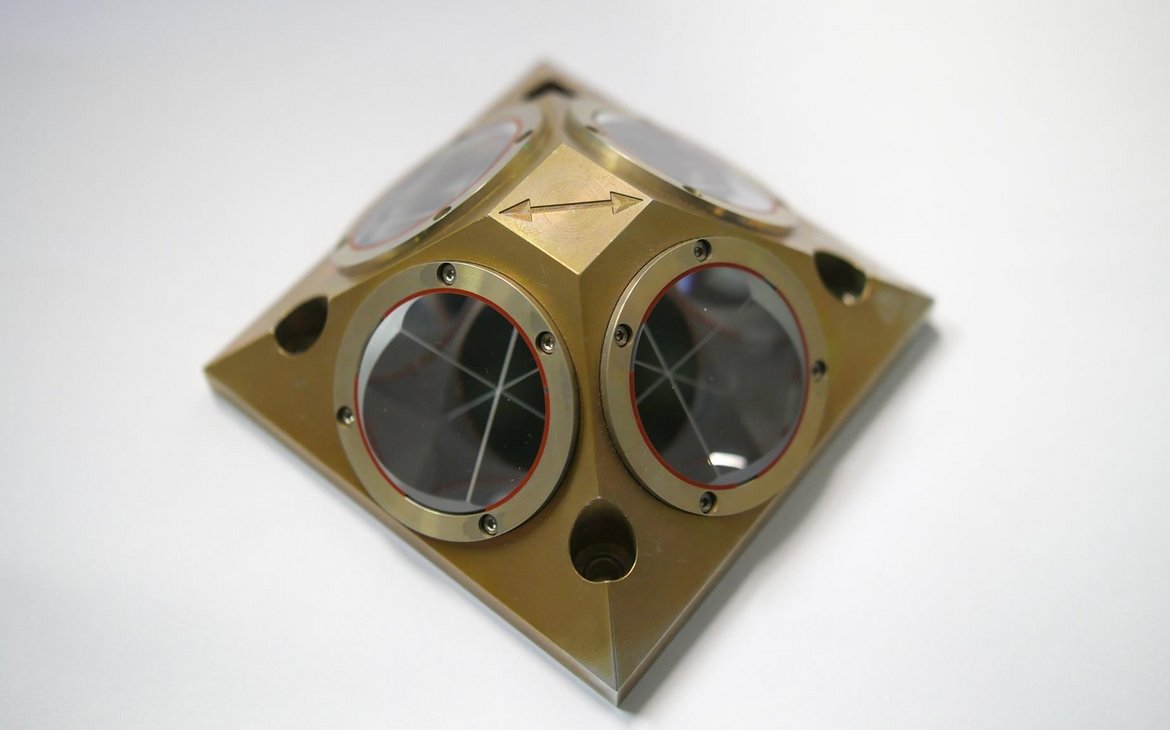
Space-borne GNSS (Global Navigation Satellite System) receivers are the main data source for orbit determination of Low Earth Orbiting (LEO) satellites, as they can be used to continuously track the entire orbit. The alternative method of Satellite Laser Ranging (SLR) is used as an independent and supporting technique for orbit determination. Its main limitation is its poor spatial and temporal coverage. However, SLR measurements are free of ambiguities and contribute significantly to the definition and generation of the ITRF (International Terrestrial Reference Frame), as they are used to determine the position of SLR stations and to define the coordinate origin and scaling of the ITRF.
Within the design and development activities for them CHAMP mission (launched on July 15, 2000) it was decided at GFZ to equip this small satellite with a Laser Retro Reflector (LRR) of novel design for external calibration and validation of the onboard “BlackJack” GPS receiver from JPL/NASA with at least centimeter resolution. A basic requirement for such a LRR is to enable the worldwide SLR station network of the ILRS to track the satellite with high accuracy and with a sufficiently high link budget under both night and daytime ranging conditions. Improvements of the SLR technology also suggested to make the design of the reflector suited for a measurement resolution even in the millimeter range.
The lower the number of individual reflecting prisms within such a laser reflector, the higher is the expected ranging accuracy. An ideal LRR target would thus be a single cube corner reflector but due to its limited angular field it is not well suited for very low orbiting satellites like CHAMP, GRACE or GRACE-FO. A reasonable compromise was found in a way that the array is formed of only four cube corner prisms mounted in a compact frame with the outer dimensions of (100x100x48) mm only.
This design ensures that only one prism is contributing to the signal in general, except for some cases (near culmination of the satellite) where the signals of two prisms are interfering. However, because of the small dimensions of the array this signature cannot be resolved by present SLR systems. This was validated by SLR stations with millimeter ranging accuracy during the CHAMP and GRACE missions.
Special care was taken to compensate for the effect of velocity aberration in order to deliver high signal strength for the SLR stations from the CHAMP LRR. This was achieved by making the diffraction far field of the LRR consisting of two spots which contain the reflected laser signal.
The main parameters of the GFZ LRR for LEO satellites are:
| Vertex length | 28 mm |
| Clear aperture of the front face | 38 mm |
| Dihedral angle offset | -3.8“ (smalle than 90 deg) |
| Radius of curvature of the front face | + 500 m (convex) |
| Index of refraction @ 532nm | 1.461 (fused quartz) |
| Nominal separation of the far field maxima | 24“ |
| Nominal width of the far field peaks (20% intensity of max.) | 10“ |
A detailed description of the LRR can be found here.
The performance of the GFZ-made LRR arrays is excellent. For this reason it was also delivered besides CHAMP, GRACE or GRACE-FO also for further space missions: the German radar satellites TerraSAR-X and TanDEM-X, the Korean KOMPSAT-5, the Spanish PAZand the ESA magnetic field mission SWARM, which consists of 3 individual satellites.
Project partners:
- NASA (National Aeronautics and Space Administration, Washington, USA)
- ESA (European Space Agency)
- DLR OP (German Aero Space Center, Oberpfaffenhofen, Germany)
- DLR RFA (German Space Agency at DLR, Bonn, Germany)
- KARI (Korea Aerospace Research Institute, Daejeon, South Corea)
- STI (Space Tech GmbH, Immenstaad, Germany)
- Zeiss (Carl Zeiss Jena GmbH, Jena, Germany)
Project duration:
- Since 2000
Funding:
- Swarm, PAZ: ESA
- KOMPSAT-5: KARI
- CHAMP, GRACE, GRACE-FO, TerraSAR-X, TanDEM-X: GFZ (Own Funds)
- GRACE-C: DLR RFA