Summary
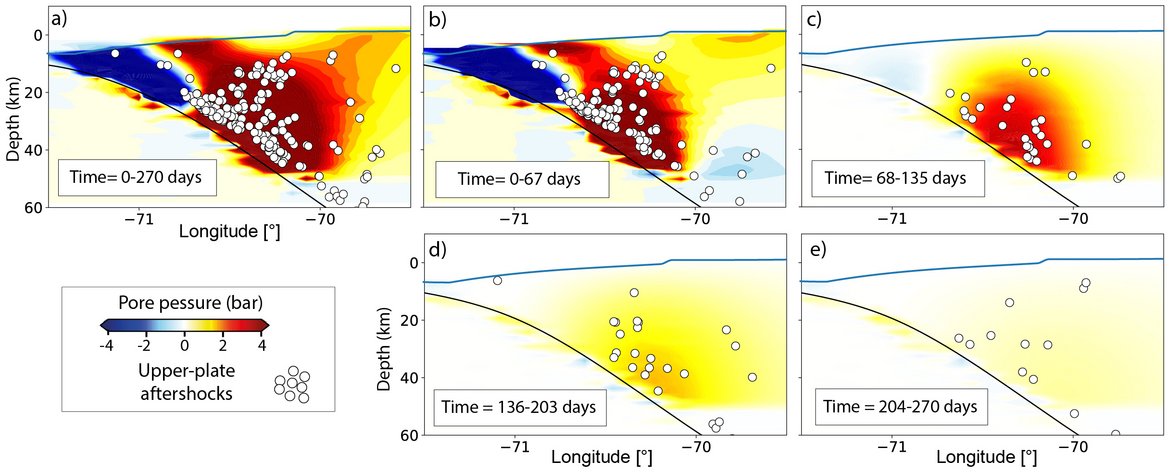
In subduction zones, where one tectonic plate dives beneath another, aftershocks within the upper plate can be particularly dangerous as they often occur at shallow depths beneath densely populated coastal regions. After the severe earthquake in Iquique in northern Chile in 2014 with a magnitude of 8.2, the aftershock sequence and surface deformations were observed and analysed in detail. A study in the journal Nature Communications, led by researchers from the GFZ Helmholtz Centre for Geosciences and the University of Potsdam in collaboration with international partners, shows that the main earthquake triggers fluid movements in the rock pores due to the deformation of the upper crust, resulting in a spatial and temporal change in pore pressure. This pore-pressure diffusion correlates with the distribution and temporal decay of aftershock activity. The team, led by Dr Carlos Peña, analysed this by combining high-resolution recordings of the aftershock sequence, time series of surface deformation from satellite data and 4D-hydromechanical models. The model results also show that pore-pressure diffusion is at least ten times more effective than other processes that alter stresses in the Earth's crust after the main earthquake. In summary, the researchers conclude that pore pressure diffusion is the most likely trigger for the observed aftershocks. If this is a common feature after strong earthquakes in subduction zones, these results may contribute to a physics-based prediction of aftershock sequences.
Background: Spatiotemporal deformation and stress changes during the aftershock sequence
After large earthquakes in subduction zones, where one tectonic plate dives beneath another, the Earth's crust continues to deform for weeks or even years. This post-seismic deformation has been observed using global navigation satellite systems (GNSS) and associated ground stations. It is accompanied by aftershocks that gradually decay over time.
Previous studies by Peña et al. (2020, 2022) show that post-seismic deformation is controlled by three different processes: creep processes due to viscoelastic relaxation, afterslip in the plate boundary where the main earthquake occurred, and pore-pressure diffusion. This latter temporal and spatial change in pore pressure is caused by fluid movements in the rock pores triggered by the main earthquake through deformation of the upper crust.
Only a combination of all three processes can explain the temporal evolution of the horizontal and vertical deformation signal. Their relative contribution depends on the distance from the epicentre and on how much time has passed since the main earthquake.
The three post-seismic deformation processes also alter the stress state in the upper plate. The creep processes and afterslip decrease over time, but can last for several years to decades, depending on the strength of the main earthquake. The earlier study by Peña et al. (2022) showed that pore pressure diffusion, on the other hand, decays relatively quickly and thus plays a major role primarily in the first few months after the main earthquake. It is also very similar to the decay of the aftershock sequence. This result was the trigger for the new investigations.
New study explains the diversity of fault types in the aftershock sequence
The study, recently published in Nature Communications Earth and Environment, investigates the correlation between the spatio-temporal patterns of aftershock sequences and pore-pressure diffusion based on the aftershocks of the severe magnitude 8.2 earthquake that struck Iquique in northern Chile in 2014. The study is the result of long-term research that Dr Carlos Peña began during his doctoral and postdoctoral work at the GFZ, together with other colleagues from the GFZ around Prof. Dr Oliver Heidbach, Working Group Leader in GFZ Section 2.6 “Seismic Hazards and Risk Dynamics”, PD Dr Sabrina Metzger, Working Group Leader in GFZ Section 4.1 “Lithosphere Dynamics”, and Prof. Dr Claudio Faccenna, Head of Section 4.1, as well as from the Ruhr University Bochum and Chile. This work is based primarily on continuously collected GNSS and seismic data from the international research network IPOC (International Plate Boundary Observatory Chile), which operates measuring instruments and projects for researching the subduction system in northern Chile and is mainly supported by the GFZ.
One would expect the fault surfaces of the aftershocks to have a similar orientation to those of the main earthquake. However, the researchers have observed that the fault surfaces in the aftershock sequence of earthquakes in subduction zones are oriented in a variety of ways. This observation as well can only be explained by pore pressure diffusion as the triggering mechanism: pore pressure changes act equally in all directions and thus reduce the stresses acting perpendicular to a fault plane, regardless of its orientation. Other post-seismic processes that alter stresses only act in a specific spatial direction. The new study thus provides a simple but impressive explanation for the observed diversity in the types of faults in the aftershock sequence.
Impact on seismic hazard assessment and outlook
In subduction zones, aftershocks within the upper plate can be particularly dangerous as they can occur at shallow depths beneath densely populated coastal regions. While scientists have long studied aftershocks based on changes in static stress, the time-dependent nature of these sequences remains poorly understood. Understanding the physical processes that control aftershock sequences can make an important contribution to seismic hazard assessment after strong earthquakes, as previously damaged infrastructure is particularly vulnerable at this time.
“These new insights into the role of fluid movements in the earthquake cycle can contribute to the development of improved physical models for predicting aftershocks,” summarises Carlos Peña. “This knowledge can help refine scenario simulations in regions where large subduction earthquakes are expected. This can support future disaster management.”
The new findings are also giving rise to new research questions: if pore pressure diffusion dominates the stress changes in the near field around the earthquake focus, especially in the first weeks or months, the question arises, for example, whether this process is also a driver for foreshock sequences and observed creep events, known as slow-slip events, along plate boundaries.
Funding
The research will be continued as part of Dr Peña's project funded by the German Research Foundation (DFG) – ‘Slip Budget in Subduction Zones Illuminated by Geodetic Measurements and Earthquake Cycle Deformation Modelling (STRONG)’ (54165067). The work was also supported by the DFG project ALPSHAPE2 (442567237), the Postdoc Bridge Programme of the University of Potsdam and the ERC Grant project TectoVision (101042674) by co-author Jonathan Bedford (at GFZ until 2022, now professor at Ruhr University Bochum).
Original publication
Peña, C., Heidbach, O., Metzger, S. et al. Pore-pressure diffusion controls upper-plate aftershocks of the 2014 Iquique earthquake. Nat Commun16, 9474 (2025). https://doi.org/10.1038/s41467-025-65013-6