Non-uniform lithospheric extension of the Qiongdongnan Basin driven by Hainan mantle plume migration: Insights from thermo-mechanical 2D modelling.
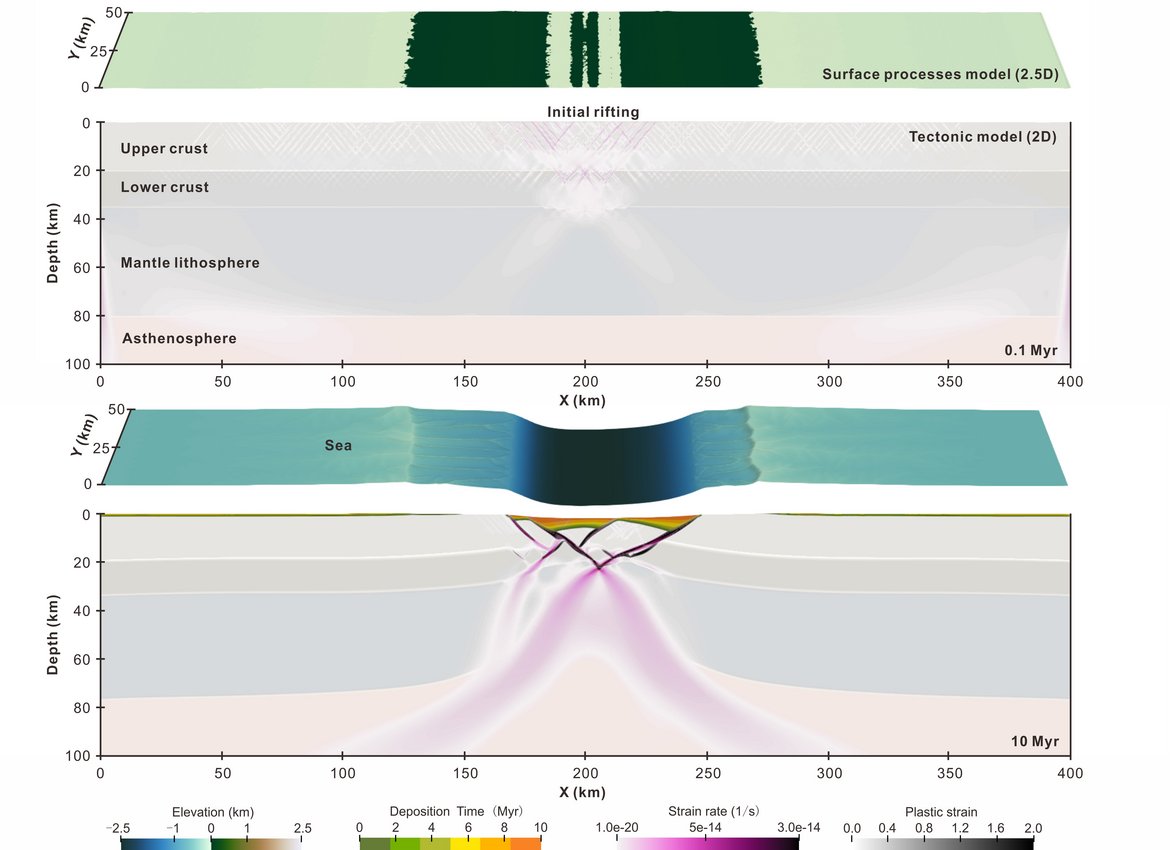
The classical two end-member classification of continental rifting (magma-rich vs. magma-poor) does not adequately explain the atypical thermo-mechanical evolution of the Qiongdongnan Basin (QDNB), located southeast of Hainan Island along the northern margin of the South China Sea. The basin is characterized by pronounced west-east variations in deformation style, indicating strong along-strike heterogeneity in lithospheric strength. The QDNB is surrounded by Late Cenozoic magmatism that has commonly been linked to deep-seated mantle upwelling associated with the putative Hainan mantle plume. These observations suggest that time-dependent mantle-lithosphere interactions, potentially related to plume migration, played a critical role in controlling rift evolution and subsidence patterns. In this project, we use a series of two-dimensional thermo-mechanical numerical models to systematically evaluate the influence of the Hainan mantle plume on along-strike variations in deformation style, subsidence history, and lower-crustal rheology within the QDNB. The results aim to provide new constraints on how migrating mantle upwelling can generate non-uniform lithospheric extension along the northern margin of the South China Sea and other plume-influenced continental rift systems.