Using high-resolution seismicity catalogs, we aim to characterize the 3D structure of the subduction megathrust at scales below 100 m and evaluate how it impacts large-scale dynamics.
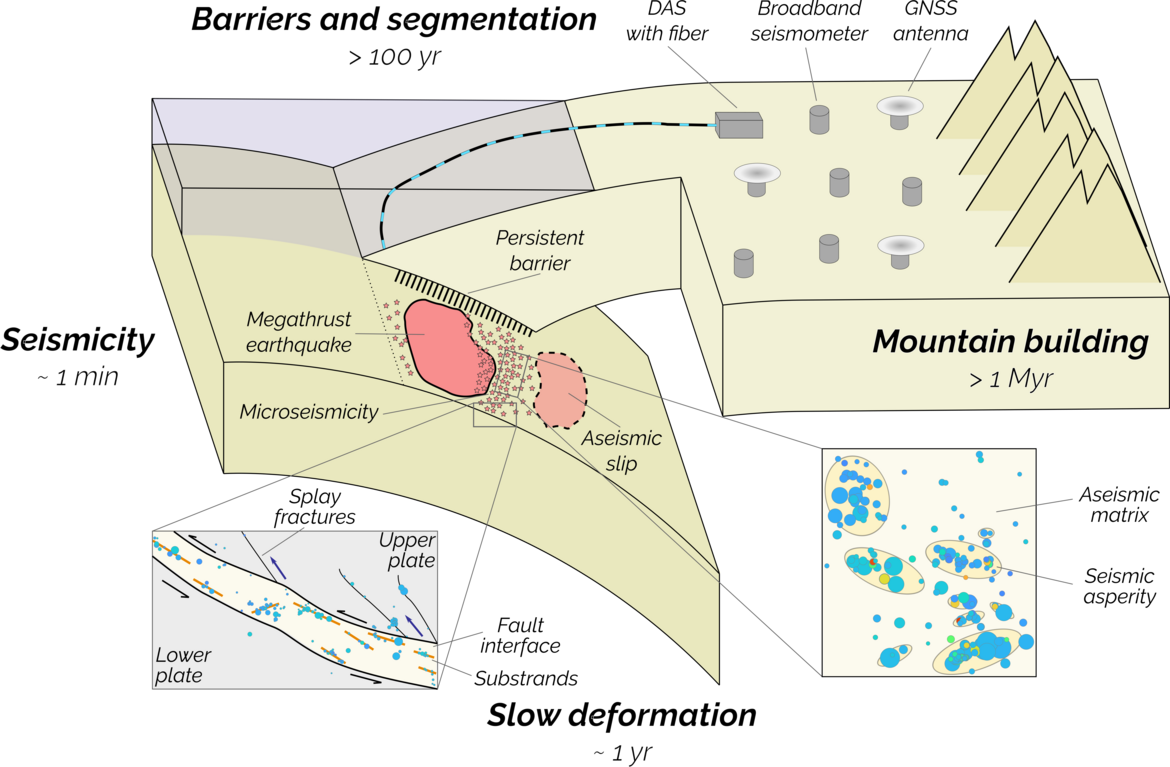
Subduction zones are among the fastest moving plate boundary systems. Plate convergence controls processes from the minutes-long megathrust earthquakes up to mountain building over millions of years. Key to understanding these processes are the structure, strength and frictional conditions of the subduction interface, controlling how the subduction zone megathrust behaves in the short-term and how stresses are exerted on the forearc in the long-term. Earthquake provide a unique view into both structual and dynamic conditions at the subduction interface and elucidate, how stress is released. However, high-resolution observations of megathrust seismicity are sparse and derived insights into large-scale implications are missing, due to insufficient observations and methods. In this project, we address these limitations by developing new methods to obtain high-resolution seismicity catalogs at subduction scale and inferring the interface structure from them. In addition, we incorporate novel observations from offshore fiberoptic sensing to obtain a continuous image of the interface from the trench to the decoupling depth. We apply these novel methods to the South American subduction zone, including dense deployments in Chile and Peru. With long running multi-modal observations, this region is optimal to understand the interconnected effects of interface structure on questions from earthquake recurrence to active tectonics. The project results will help integrating all time scales of subduction zone dynamics into a unified understanding.