Integrated exploration methods for imaging hydrothermal convection as target structures for deep geothermal development
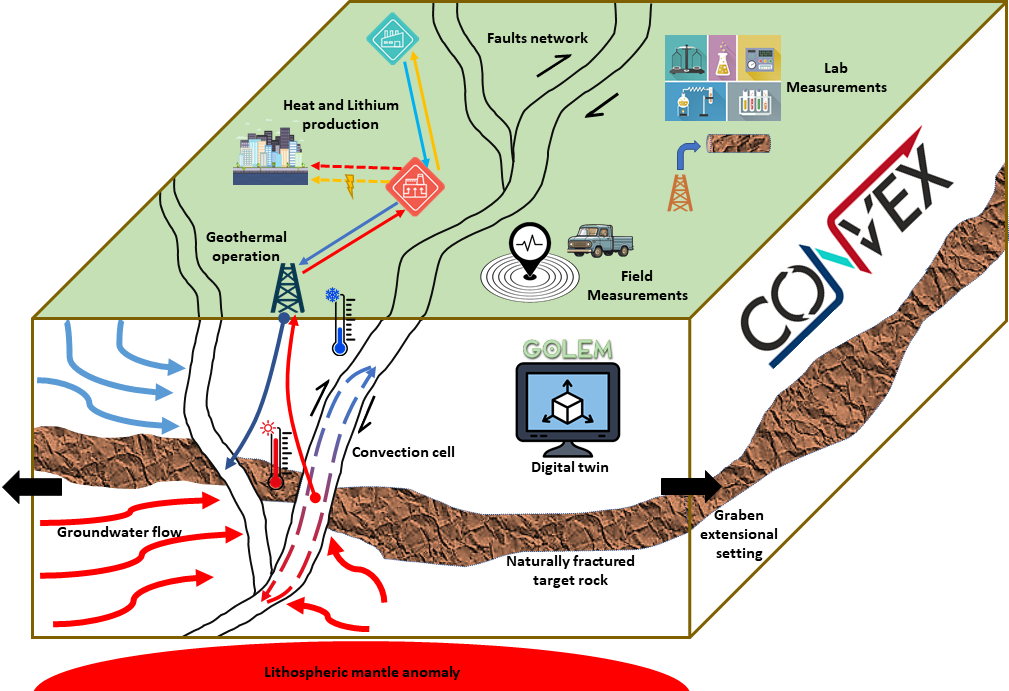
Deep geothermal projects rely on reliably predicting temperature and fluid flow in the target reservoir. ConvEx develops and tests an integrated exploration strategy to image hydrothermal convection along fault zones in the Upper Rhine Graben and to reduce the exploration risk before drilling.
Hydrothermal convection along permeable fault zones can strongly influence the thermal and hydraulic conditions of deep geothermal reservoirs. In low-enthalpy geothermal systems, such as those typical for Germany, the main exploration challenge is not only to identify geological structures at depth, but also to determine whether these structures are hydraulically active and connected to convective fluid flow.
ConvEx addresses this challenge by combining exploration methods with data-driven numerical process simulations. The project integrates electromagnetic field methods, especially Controlled Source Electromagnetics and Magnetotellurics, with 3D seismic information, petrophysical and borehole data, gravity-derived density information, temperature-gradient boreholes, and thermally, hydraulically, and mechanically coupled reservoir simulations.
The study focuses on geothermal exploration areas in the Upper Rhine Graben around Landau and Insheim, where fault-bound hydrothermal systems are important targets for deep geothermal energy and lithium extraction from thermal waters. By linking geophysical observations with 3D structural models and coupled THM simulations, ConvEx aims to improve the spatial characterization of hydrothermal convection cells and to quantify the role of fault zones in controlling temperature, fluid flow, and reservoir performance.
Within ConvEx, GFZ contributes to project coordination, electromagnetic field research, regional and local 3D structural modelling, and reservoir-scale process simulations. A central objective is to develop data-consistent models that can be validated against temperature measurements and operational monitoring data, and to quantify model sensitivities and remaining uncertainties.
The outcome will be a transferable exploration strategy and practical guideline for reducing exploration risk in deep geothermal low-enthalpy systems. This strategy is intended to support more reliable drilling target identification and to contribute to the sustainable development of geothermal energy resources.