Solution Lab Rur Erft (SLRE) | Co-designing solutions for extreme water events in the Rur-Erft region
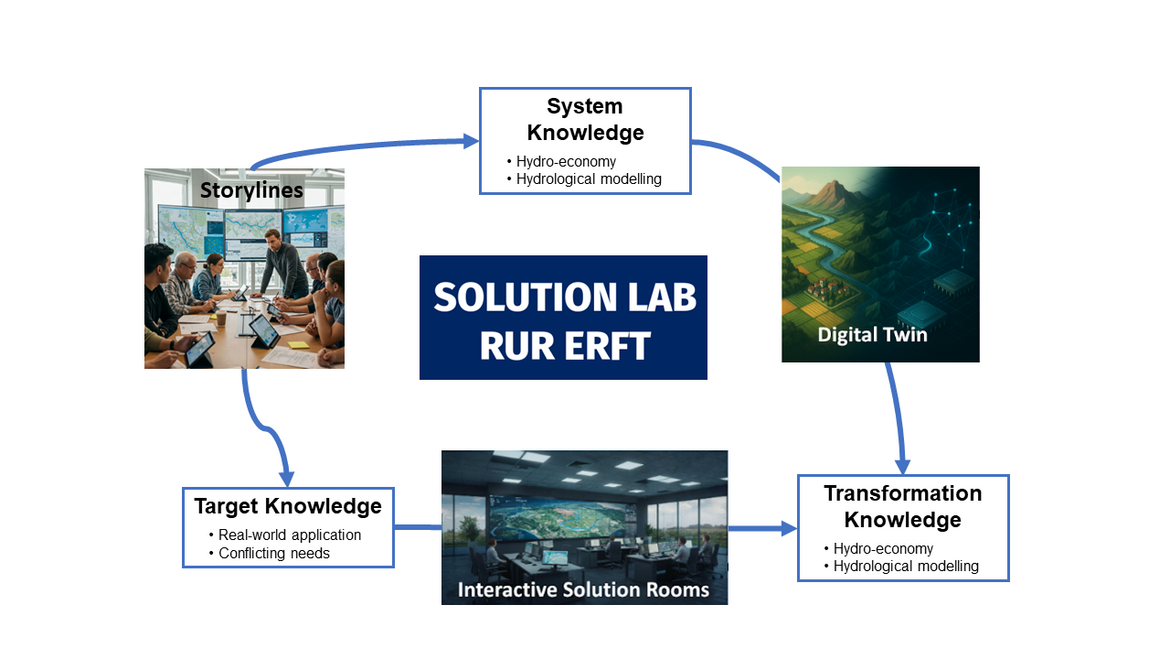
The Solution Lab Rur Erft (SLRE)is a collaborative research and knowledge-transfer project that develops practical solutions for managing extreme water events – such as multi-year droughts, floods, and rapid runoff – in the Rur-Erft region. Supported by the Helmholtz Water Initiative, SLRE combines a hydro-economic Digital Twin with stakeholder-driven Storylines and an Interactive Solution Room, in which decision-makers can explore scenarios and evaluate response options together with the project team. The approach follows a Transfer-by-Design philosophy: knowledge transfer is built into the project from the outset, rather than added as an afterthought.
Section Hydrology at GFZ, together with Dr. Pia-Johanna Schweizer – the System Risks Group Leader at RIFS – leads Workpackage 2, in which concrete Storylines are co-developed together with stakeholders from water management, administration, and agriculture in the Rur-Erft region. These Storylines translate real-world questions – for example on flood risk under changing climate conditions or the consequences of multi-year droughts – into scenarios that steer the simulations in the Digital Twin. In addition, Section Hydrology contributes its expertise in stochastic weather generation, hydrological and hydrodynamic modelling to the Digital Twin and the design of the flood modelling chain (Workpackage 1), and supports the design of interactive sessions in the Interactive Solution Room (Workpackage 3).
The project is funded by the Helmholtz Association in the framework of the Helmholtz Water Initiative and carried out jointly by Forschungszentrum Jülich (Project Coordinator), Karlsruhe Institute of Technology (KIT), GFZ Helmholtz Centre for Geosciences / RIFS Research Institute for Sustainability at GFZ, and Helmholtz Centre for Environmental Research (UFZ).
Project duration: January 2026 – December 2028
Relevant publications:
Apel, H., Vorogushyn, S., & Merz, B. (2022). Brief communication: Impact forecasting could substantially improve the emergency management of deadly floods: case study July 2021 floods in Germany. Natural Hazards and Earth System Sciences, 22, 3005–3014, https://doi.org/10.5194/nhess-22-3005-2022
Nguyen, V. D., Vorogushyn, S., Nissen, K., Brunner, L., and Merz, B. (2024). A non-stationary climate-informed weather generator for assessing future flood risks. Advances in Statistical Climatology, Meteorology and Oceanography, 10, 195–216, https://doi.org/10.5194/ascmo-10-195-2024
Vorogushyn, S., Han, L., Apel, H., Nguyen, V. D., Guse, B., Guan, X., Rakovec, O., Najafi, H., Samaniego, L., & Merz, B. (2025). It could have been much worse: spatial counterfactuals of the July 2021 flood in the Ahr Valley, Germany. Natural Hazards and Earth System Sciences, 25, 2007–2029, https://doi.org/10.5194/nhess-25-2007-2025