
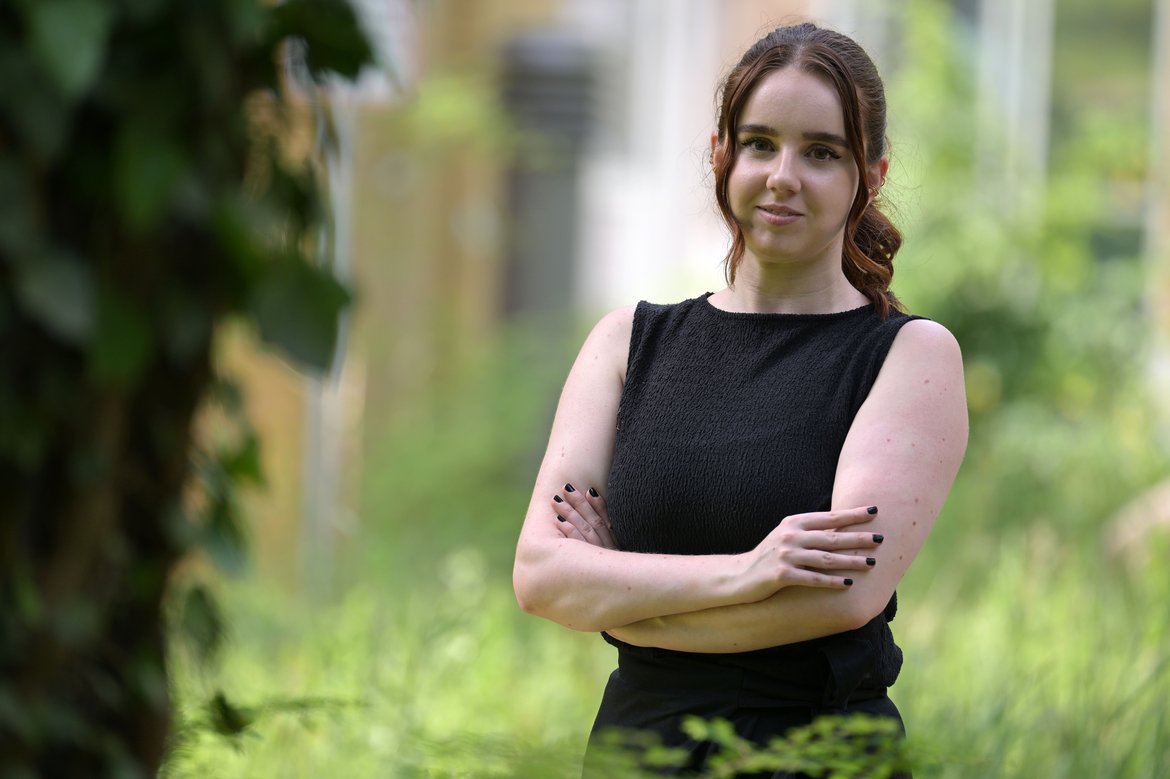
Candice Filoche, MSc, a PhD student in GFZ Section 3.1 “Inorganic and Isotope Geochemistry”, was awarded the Best Poster Award at the Gordon Research Conference (GRC) on Geochemistry of Mineral Deposits 2026 in Barcelona, Spain. Using a new approach, the GFZ PhD student investigated the factors leading to the exceptional enrichment of zinc (Zn) and lead (Pb) in sedimentary basins. These metals are important for applications including electric vehicles, batteries, and solar and wind energy.
Candice Filoche’s Best Poster award was determined from over 80 scientific poster submissions, with all conference participants voting.
After receiving her award, Candice Filoche said: “It is an honour to have received the Best Poster Award for my work on the ‘Reconstruction of sulfide deposition pathways in Proterozoic and Phanerozoic clastic dominated-type Zn and Pb deposits’. This recognition feels particularly important to me, given the outstanding quality of the poster presentations and research work shared throughout the conference. One of my goals during my PhD was to attend at least one GRC conference, this now represents an important milestone on my journey. This was such a unique opportunity to exchange ideas with researchers working on ore deposits from all over the world. It was a genuine pleasure to present my research and to see the interest it sparked.”
Background: Societal and economic relevance of zinc and lead
Base metals such as zinc and lead are key metals for our economy. With applications in electric vehicles, batteries, solar and wind energy, galvanization, and alloy brazing, they are critical for driving the low-carbon transition. Consequently, the demand for these metals will continue to grow over the coming decades. Base metal deposits in ancient sedimentary basins represent the main source of zinc (Zn) and lead (Pb), in the form of ore minerals like sphalerite (ZnS) and galena (PbS). Despite their economic importance, much remains unknown about the processes that result in the exceptional metal enrichment in these deposits.
Candice Filoche’s new approach: The first triple sulfur isotope dataset from sediment-hosted deposits
In her now-awarded research, Candice Filoche examined samples from two geologically very old sedimentary basins in Canada and Australia. These areas contain significant, world-class deposits of zinc (Zn) and lead (Pb). The objective was to reconstruct how sphalerite (ZnS) and galena (PbS) were formed.
The method makes use of the fact that these minerals contain sulfur. Sulfur has various stable isotopes: one most abundant (32S) and three minor isotopes (33S, 34S and 36S). By measuring the abundance of different sulphur isotopes in a sample, it is possible to identify potential fingerprints of microbial or abiotic processes that may have played a role in the formation of the minerals.
Conventional sulfur isotopes datasets have used the so-called δ34S values, calculated from the ratio of 34S/32S preserved in sulfur bearing minerals. However, multiple environmental factors can produce overlapping δ34S values, making it difficult to identify the mechanisms of ore mineral formation.
On her poster, Candice Filoche presented the first triple sulfur isotope dataset from samples of sediment-hosted ore deposits, using δ34S and Δ33S values, with Δ33S calculated from δ34S and δ33S values (in a complex manner). In this way, she used Δ33S together with δ34S values on ore minerals and the associated pyrite (FeS2) to differentiate biotic and abiotic mechanisms.
As the research is currently unpublished, Candice Filoche’s research findings will be made available at a later date.
The research project is funded through the German Research Foundation (DFG) as DFG-SPP 2238 DOME - Dynamics of Ore Metals Enrichment.
About the person
Candice Filoche has been a PhD student at the GFZ in Section 3.1 “Inorganic and Isotope Geochemistry” since April 2024. Her research project is being carried out jointly at the GFZ and the University of Potsdam under the supervision of Dr Joseph Magnall (GFZ) and Professor Sarah Gleeson (since March 2025 Professor of Sustainability Geosciences at University College Dublin and Director of the Research Ireland Centre for Applied Geosciences; previously Head of Section 3.1 at the GFZ) with lab work conducted at the University of Munster with Professor Harald Strauss.
Candice completed her Master’s thesis at ETH Zurich in Switzerland, having previously completed two Master’s programmes in France: in geochemistry at the Institut de Physique du Globe de Paris (IPGP) and in geosciences and environmental engineering at UniLaSalle in Beauvais.
She has already received several awards for her work, including the Best Talk Award at the DMG Section Meeting for Geochemistry & Petrology/Petrophysics 2025 and the Best Poster Award at the GFZ PhD Student Days 2024.
About Gordon Research Conferences
The Gordon Research Conferences (GRCs) are an international forum for unpublished research and innovative new ideas in biology, chemistry, physics, engineering, and their interfaces. Each conference offers a unique space for discussion within its respective field. Since its founding in 1931, the Gordon Research Conferences have established a prestigious reputation for creating scientific communities. The GRC organizes over 395 Gordon Research Conferences and Gordon Research Seminars annually, each highlighting the latest, cutting-edge research. Each conference is limited to 200 attendees; scientists must apply to the conference and be selected by the conference chair to attend. All participants are active members of their community and contribute to advancing their field.
Congratulations on this award!


![[Translate to English:] Veranschaulichung der Veranstaltung.](/fileadmin/_processed_/c/5/csm_20260928_Kachel_37c583cb50.webp)


![[Translate to English:] Alle Länder Afrikas gelistet mit relativem Malariarisiko](/fileadmin/_processed_/1/b/csm_2026-08-20-L%C3%A4nderliste_Malariarisiko_web_d547ebb81d.webp "[Translate to English:]")


![[Translate to English:] Bewaldetes Gebiet mit historischen Gebäuden](/fileadmin/_processed_/5/e/csm_Telegrafenberg-2021_300dpi_Marcel-Ludwig-GFZ_web_70a5c15a88.webp "[Translate to English:]")


![[Translate to English:] Karte](/fileadmin/_processed_/4/8/csm_20260625-0945b_Venezuela_Nachbeben_-c-EarthquakeExplorer-GFZ_04f208410a.webp)