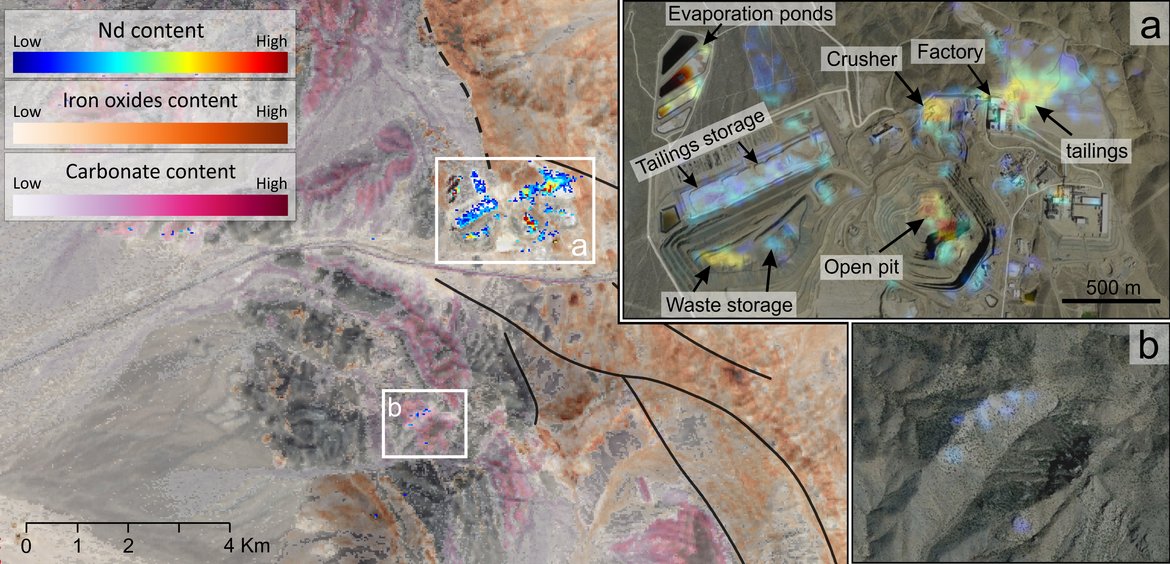
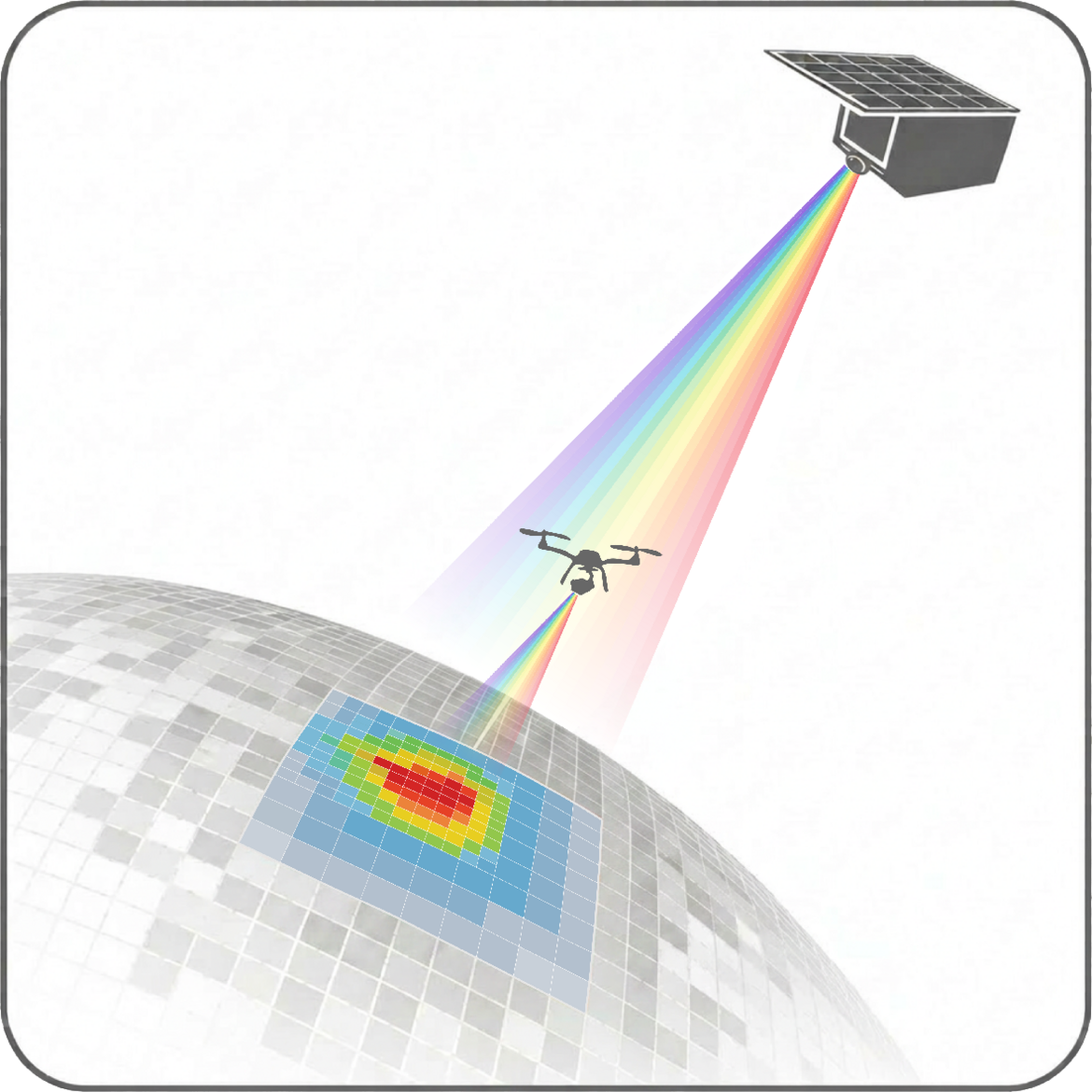
Dr. Saeid Asadzadeh is currently establishing a research group focused on mineral exploration using remote sensing from air and space.
Since June 2026, Dr. Saeid Asadzadeh from the Hyperspectral Remote Sensing Application Group (GFZ section Remote Sensing and Geoinformatics) has been establishing a new Young Investigator Group focused on raw material exploration. Funded by the Federal Ministry of Research, Technology, and Space (BMFTR) with a total of more than three million euros for five years, the Geo-Spectral Exploration (Geospex) group aims to advance next-generation exploration technologies while training future mineral exploration experts.
The transition to a low-carbon economy is driving an unprecedented demand for critical raw materials. Metals such as neodymium and dysprosium, both rare-earth elements, are essential for high-performance magnets used in wind turbines and electric vehicles, while lithium and nickel are key components of rechargeable batteries. Copper, meanwhile, forms the backbone of the expanding electricity networks needed to support the energy transition.
At the same time, rising geopolitical uncertainties and the risks of dependence on a limited number of suppliers have underscored the need for the European Union and Germany to diversify their raw material sources and strengthen the resilience of their supply chains. Achieving this goal requires rebuilding eroded expertise, closer collaboration with resource-rich countries, and developing innovative exploration technologies capable of identifying undiscovered mineral resources.
The new Young Investigator Group Geospex will integrate multi-scale and multi-wavelength imaging spectroscopy with artificial intelligence and real-world exploration datasets to develop quantitative methods for characterizing and predicting ore-system properties across different spatial scales. The project seeks to improve the discovery and assessment of critical mineral resources required for the energy transition.
The initiative builds on GFZ's extensive expertise in remote sensing and imaging spectroscopy.
According to Sabine Chabrillat, working group lead and scientific PI of the EnMAP mission, “Geospex brings together our long-standing expertise in hyperspectral data acquisition and processing—demonstrated through the DLR EnMAP mission and our contribution to the upcoming ESA CHIME mission—with expertise in mineralogy, geology, and exploration.”
Martin Herold, head of GFZ’s section Remote Sensing and Geoinformatics, says: “The Geospex project aligns perfectly with the objectives of our new research programme “One Earth–Science and Solutions for a liveable planet” within the Helmholtz Research Field Earth and Environment. The programme marks the 5th funding period of Programme-orientied Funding (PoF V), starting in 2028, which places a strong emphasis on understanding and securing the geo-resources needed to support a sustainable and livable future”.
Philipp Weis, lead of the Topic “Georesources” in the currently running PoF-IV programme, confirms: “Geospex is breaking new ground at the interface between novel cross-scale mineral system models and innovative applications in mineral exploration in collaboration with multiple international partners, while also providing a unique training platform for the next generation of economic geologists.”
Sascha Brune (lead of PoF-V Topic “Dynamic Earth”) highlights the interdisciplinary nature of the project: "Science is often most impactful at the boundaries between disciplines, which is why interdisciplinary research is a cornerstone of PoF V. The Geospex group exemplifies this vision by bringing together GFZ's remote sensing expertise and our ore deposit research — creating the scientific foundation for next-generation mineral exploration.”
Martin Herold, who is not only head of section Remote Sensing and Geoinformatics but also GFZ’s programme coordinator for PoF V, emphasizes the strategic relevance of the initiative: “The establishment of the Geospex Young Investigator Group comes at exactly the right time. By leveraging GFZ’s outstanding infrastructure and scientific expertise, the project is well-positioned to contribute to addressing the growing national demand for secure and sustainable raw material supplies.”
For Saeid Asadzadeh, GFZ provides an ideal environment for establishing the new research group: “GFZ offers a unique combination of world-class scientific infrastructure and expertise,” he says. “From advanced geochemical laboratories in Section 3.1 to state-of-the-art spectroscopy facilities in Section 1.4, the centre provides everything needed to conduct cutting-edge research. As the birthplace of EnMAP, GFZ is also a global leader in imaging spectroscopy, and working with EnMAP data over the past four years has demonstrated its enormous potential for mineral exploration. Equally important is the highly collaborative atmosphere at GFZ, where colleagues openly share their knowledge and expertise.”
The research will be conducted across five study sites in Australia, Chile, Canada, Namibia, and Brazil. These sites encompass several important deposit types, hosting critical mineral resources of Li, Cs, Ta, Rb, rare earth elements (REEs), Zr, Nb, Cu, Mo, Au, and Ni.
Geospex will expand its team by recruiting four doctoral researchers and two master’s students, providing new opportunities for early-career scientists to contribute to innovative research at the intersection of hyperspectral remote sensing, artificial intelligence, and mineral exploration.


![[Translate to English:] Alle Länder Afrikas gelistet mit relativem Malariarisiko](/fileadmin/_processed_/1/b/csm_2026-08-20-L%C3%A4nderliste_Malariarisiko_web_d547ebb81d.webp "[Translate to English:]")


![[Translate to English:] Bewaldetes Gebiet mit historischen Gebäuden](/fileadmin/_processed_/5/e/csm_Telegrafenberg-2021_300dpi_Marcel-Ludwig-GFZ_web_70a5c15a88.webp "[Translate to English:]")


![[Translate to English:] Karte](/fileadmin/_processed_/4/8/csm_20260625-0945b_Venezuela_Nachbeben_-c-EarthquakeExplorer-GFZ_04f208410a.webp)


