![[Translate to English:]](/fileadmin/_processed_/7/f/csm_tws_timeseries_deutschland_043634ef65.png "[Translate to English:]")
The water deficit in Germany and Europe has worsened in recent years. This is shown by the latest data from the GRACE Follow-On satellite mission, which is operated by the GFZ Helmholtz Centre for Geosciences in collaboration with NASA and the German Aerospace Centre (DLR). The twin-satellites of GRACE FO measure changes in total water storage (TWS) on and below the Earth’s surface. This data can be used to calculate the extent to which water storage is changing.
For Germany, the figures show a continuing negative trend: “Since 2015, we have been seeing increasingly drier conditions in Germany than in the 15 years prior to that,” says Prof. Annette Eicker, Head of GFZ’s section Global Geomonitoring and Gravity Field. “Although the above-average wet year of 2024 brought about some recovery in water storage, this was immediately followed by another sharp decline,” adds Prof. Andreas Güntner, research group leader in the Hydrology section at the GFZ. The data from GRACE FO show not only near-surface soil moisture but also changes in groundwater levels. “The decline in groundwater storage accounts for the majority of the long-term decline in water storage in Germany,” says Güntner.
No recovery in sight
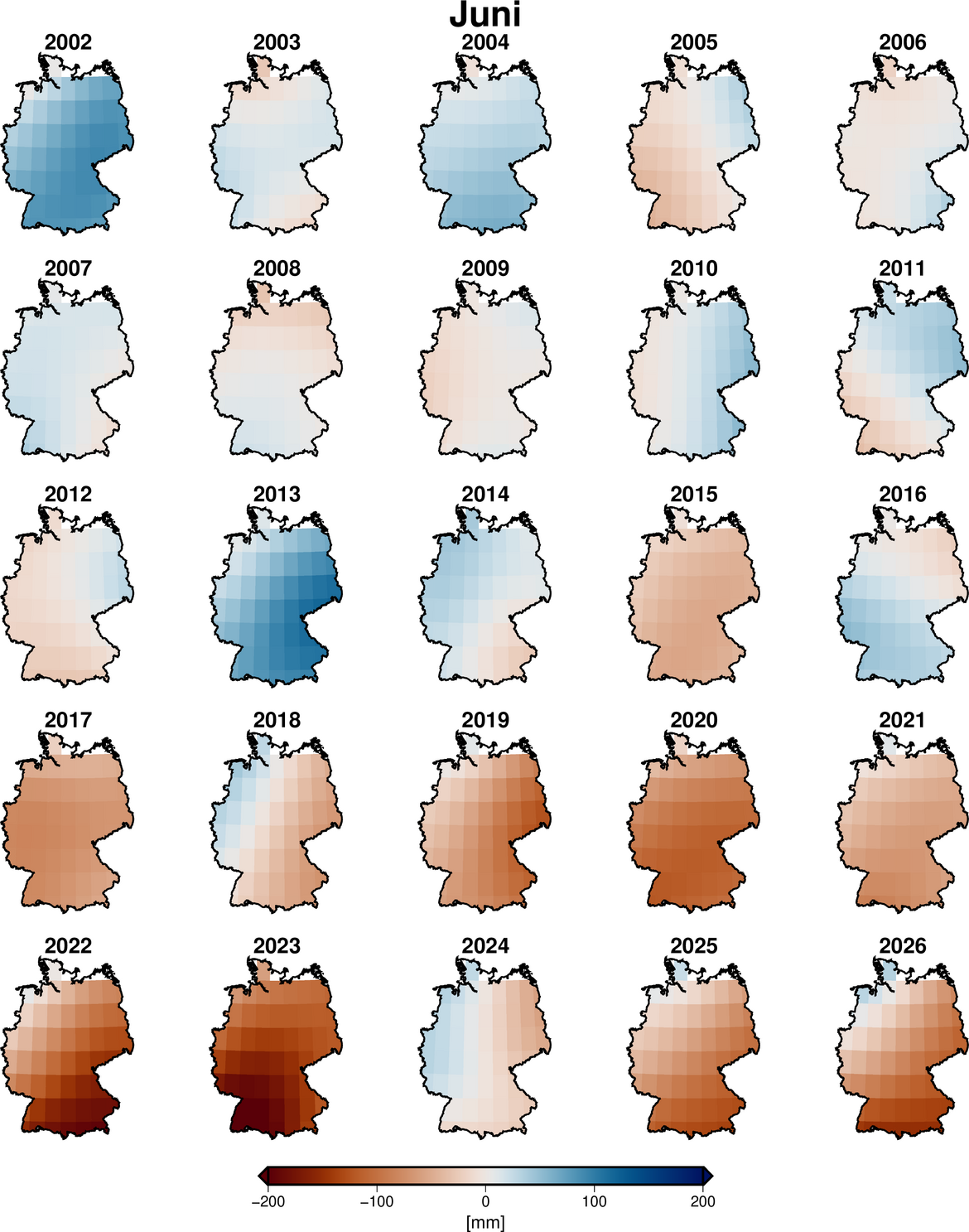
Dr Eva Börgens from the Earth System Modelling Section at the GFZ has analysed the latest data and adds: “In the summer of 2025, there was a decline in total water storage that was more severe than anything previously observed by GRACE and GRACE Follow On in a summer half-year.” In June 2026, water storage in Germany was at roughly the same level as in 2025, meaning there was a shortfall of 25 gigatonnes compared with the long-term average (1 gigatonne, or Gt for short, is one billion tonnes). By way of comparison, the entire Lake Constance contains around 48 Gt of water.
The researchers fear that water storage levels will not recover by the end of the year, even if there is more rain than usual in the autumn. Another cause for concern is that the data up to June did not yet reflect the hot summer in Germany. The consequences of the heatwaves will only become apparent in the data for the coming months. Due to the complex calculations required to analyse the satellite measurements, this data will not be available until later in the autumn.
Heat reduces water storage through several processes: higher temperatures lead to greater direct evaporation from surface waters; added to this is evaporation from plants, which tends to increase as temperatures rise, and draws water from the soil until it is no longer accessible to the plant roots.
A consistent pattern over the last 15 years
According to Eva Börgens, a comparison with precipitation data shows “that we do not see a long-term negative trend in precipitation levels, but rather an increase in potential evaporation due to higher air temperatures – that is, the amount of water that can be transported from the ground into the atmosphere”.
Spatial analysis of satellite data covering Germany reveals a consistent pattern over the past ten to fifteen years:
- Deficits in water storage in June 2026 are particularly evident in the south, south-west and east of Germany, whilst less severe deficits are found in the north-west, in the vicinity of the North Sea
- Since 2015, there has been a marked increase in the number of June months with lower water storage compared with previous years
- Overall, the deficits are often more pronounced in the south and east
Methodology and limitations
The GRACE and GRACE Follow-On satellite missions have been providing data since 2002. Each mission consists of two satellites that measure changes in the Earth’s gravitational field. From this data, researchers calculate monthly maps of the Earth’s mass distribution, the variation in which is primarily caused by changes in water storage. The spatial resolution is approximately 250 by 250 kilometres, meaning that no conclusions can be drawn for smaller areas. However, comparisons with groundwater monitoring stations and measurements of gravitational pull using ground-based gravimeters, as well as meteorological data, paint a consistent picture. The most recent observations of low water levels in the River Rhine in south-west Germany have drastically confirmed this.


![[Translate to English:] Veranschaulichung der Veranstaltung.](/fileadmin/_processed_/c/5/csm_20260928_Kachel_37c583cb50.webp)


![[Translate to English:] Alle Länder Afrikas gelistet mit relativem Malariarisiko](/fileadmin/_processed_/1/b/csm_2026-08-20-L%C3%A4nderliste_Malariarisiko_web_d547ebb81d.webp "[Translate to English:]")


![[Translate to English:] Bewaldetes Gebiet mit historischen Gebäuden](/fileadmin/_processed_/5/e/csm_Telegrafenberg-2021_300dpi_Marcel-Ludwig-GFZ_web_70a5c15a88.webp "[Translate to English:]")


![[Translate to English:] Karte](/fileadmin/_processed_/4/8/csm_20260625-0945b_Venezuela_Nachbeben_-c-EarthquakeExplorer-GFZ_04f208410a.webp)

