
Summary
An international research team has used high-precision satellite laser ranging to measure a key effect of general relativity in Earth orbit with unprecedented accuracy. The study, published in the journal Nature, shows that LARES-2, together with the older LAGEOS satellite, enables a measurement of the so-called frame-dragging effect—predicted by Einstein’s general theory of relativity—with a relative uncertainty of about 0.2 percent. This represents an improvement in accuracy by a factor of approximately 10 compared to earlier tests in the Solar System. The high-precision gravity-field determinations from the GRACE and GRACE Follow-On satellite missions, in which GFZ has played a leading role, also provide an important basis for this high accuracy. Dr Patrick Schreiner of GFZ was also involved in the study. The fact that this effect can be measured in Earth orbit with such precision demonstrates just how powerful modern satellite geodesy, precise orbital dynamics, and Earth gravity field modelling have become today. As part of their study, the researchers also demonstrated that such precision measurements are not only useful for verifying fundamental physical principles but also provide new insights into Earth’s tides and the dynamics of our planet.
Background: The effect of frame-dragging
Frame-dragging is a prediction of Einstein’s general theory of relativity that is particularly difficult to detect. Put simply: A rotating mass slightly drags the spacetime around it—similar to a spoon spinning in honey. In the case of a satellite, this leads to a very slow shift in its orbital plane compared to the non-relativistic case. In the vicinity of Earth, where the gravitational field is comparatively weak, this effect is extremely small but can be detected using very precise satellite measurements. Near rotating black holes, the same physical effect is much stronger and plays an important role in relativistic astrophysics.
The study, now published in the journal Nature, builds on a long history of research in relativity physics. Among the co-authors is Sir Roger Penrose from the University of Oxford, whose work demonstrated that the formation of black holes is a robust prediction of general relativity. For this work, he was awarded the 2020 Nobel Prize in Physics. However, the new study does not examine black holes, but rather the same relativistic effect in Earth’s comparatively weak gravitational field—where it becomes detectable only through high-precision satellite geodesy.
The study’s first author is Italian physicist Ignazio Ciufolini of Sapienza University of Rome and the Chinese Academy of Sciences in Wuhan, who has been a key driver of the development and scientific use of the LARES satellites for many years. Dr Patrick Schreiner of GFZ, head of the “Earth System Parameters and Orbital Dynamics” research group in GFZ Section 1.2 “Global Geomonitoring and Gravity Field,” is also a co-author of the study.
Satellite orbits as a measuring instrument for spacetime
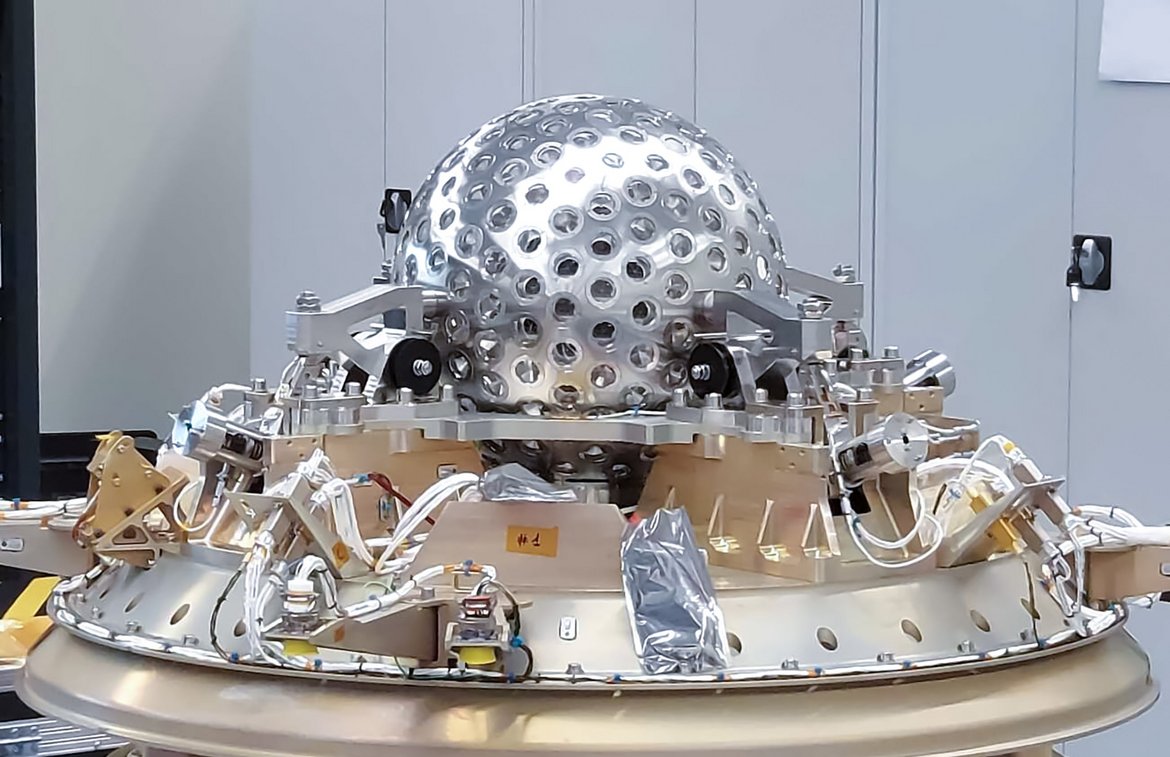
For the new measurement, the international research team used the geodetic satellites LARES-2 (Laser Relativity Satellite 2) and LAGEOS (Laser Geodynamics Satellite), which orbit the Earth at an altitude of approximately 5,900 kilometres. Both are passive, spherical satellites equipped with hundreds of retroreflectors. Ground stations transmit short laser pulses to the satellites, where they are reflected. Their distance can be determined with very high precision based on the time it takes for the light to return. In this way, even the smallest changes in the satellites’ orbits can be measured.
LAGEOS was developed by NASA and has been in Earth orbit since 1976. LARES-2 was developed by the Italian Space Agency (ASI) and launched in 2022. The satellite is particularly well-suited for such precision experiments: With a diameter of 42 centimetres and a weight of 295 kilograms, it is small, very heavy, and has an exceptionally low area-to-mass ratio. As a result, its orbit is only very slightly affected by non-gravitational influences such as the Sun’s radiation pressure.
Together with LAGEOS, LARES-2 forms a particularly suitable configuration: The two satellites move on orbits that are inclined almost symmetrically with respect to the equatorial plane, with inclinations that add up to nearly 180 degrees. This allows many of the classical orbital perturbations caused by Earth’s non-spherical gravity field to largely cancel out. To precisely model Earth’s gravity field and its temporal variations, the team was able to draw on the highly accurate gravity-field determinations from the GRACE and GRACE Follow-On satellite missions. This makes it possible to isolate the very small relativistic signal of frame-dragging. The two satellite orbits thus serve as a precise instrument for measuring how the rotating Earth drags spacetime around it.
Confirmation of general relativity and new limits for alternative models
For the Nature study, the team analysed approximately 200,000 laser ranging measurements from LARES-2 and LAGEOS, taken over a period of 1,050 days between July 2022 and June 2025.
A comparison illustrates just how small the effect is: frame-dragging alters the orientation of the orbital planes of LARES-2 and LAGEOS by only about 30.7 milliarcseconds per year each. One milliarcsecond corresponds to just 1/3,600,000 of a degree.
At the satellites’ orbital distance of approximately 12,300 kilometres from the centre of Earth, this angular change corresponds to a distance of only about 1.8 metres per year.
The result confirms the frame-dragging effect and thus the prediction of general relativity with a relative uncertainty of only about 0.2 percent—that is, two thousandths. This makes the measurement about ten times more accurate than previous tests in the Solar System.
“The fact that this effect can be measured in Earth orbit with such precision demonstrates just how powerful modern satellite geodesy, precise orbital dynamics, and Earth gravity field modelling are today,” says co-author Dr Patrick Schreiner of GFZ.
The high precision not only provides further confirmation of Einstein’s theory in the immediate vicinity of Earth, but also allows tighter constraints to be placed on alternative theories of gravity. These include models that predict the same effects as general relativity in many classical tests but may differ specifically with regard to frame-dragging.
Some of these approaches have been discussed in connection with open questions in modern cosmology, such as the accelerated expansion of the universe. This is precisely why the new measurement is so relevant: it tests gravity in a regime where possible deviations from Einstein’s theory could become particularly apparent.
Also relevant for the geosciences
At the same time, the study shows that high-precision tests of fundamental physics can also provide geoscientific information: One of the greatest challenges of the analysis was the so-called K1 tide. This is a lunisolar Earth tide: The gravitational pull of the Moon and the Sun slightly deforms the Earth’s body and displaces masses of water. This alters the Earth’s gravitational field, which in turn affects the orbits of satellites.
This tide poses a particular challenge for measuring the frame-dragging effect because its impact on the orbital planes of LARES-2 and LAGEOS has a period of approximately 1,050 days and can thus mask the relativistic effect that builds up over this period. In the joint analysis of the two satellite orbits, its influence was isolated, and at the same time, a correction to the modelled K1 tidal amplitude was determined.
“The study thus links two fields that are closely related at the GFZ: precise satellite orbit determination and the observation of dynamic processes in the Earth system. The same measurements that confirm a prediction of general relativity also provide new information about Earth tides and the dynamics of our planet,” says Schreiner.
GFZ contribution
The GFZ Helmholtz Centre for Geosciences is represented in the study by Dr Patrick Schreiner from Section 1.2 “Global Geomonitoring and Gravity Field.” The work uses high-precision satellite laser ranging observations and methods of precise orbit determination. In part, the GFZ orbit program EPOS-OC (Earth Parameter and Orbit System, core module: Orbit Computation) was also used—software that has been continuously refined at the GFZ for decades.
GFZ has been successfully operating an SLR station in Potsdam for decades. It has observed hundreds of orbital arcs of the LAGEOS and LARES-2 satellites with a precision of a few millimetres, thereby making an important contribution to the global high-precision SLR data set.
“The study thus builds on the GFZ’s expertise in satellite geodesy, precise orbit analysis, and Earth gravity field modelling. At the same time, it demonstrates that these precision geodetic methods also address fundamental questions in physics, including tests of general relativity,” explains Schreiner.
Outlook
LARES-2 and LAGEOS are passive geodetic satellites and are expected to remain observable for decades to come. As the observation period lengthens, further improvements will become possible, both for tests of general relativity and for geodetic and geophysical applications.
The Nature study thus demonstrates the scope of modern satellite geodesy: it not only measures the Earth’s shape, rotation, and dynamics, but also makes it possible to measure subtle properties of spacetime in the vicinity of our planet.
Original study
Ciufolini I, Paolozzi A, Pavlis EC, Ries JC, Paris C, Ortore E, Matzner R, Kuzmicz-Cieslak M, Deka D, Pavlis DE, Schreiner P, Ni WT, Penrose R, Gurzadyan V (2026) LARES-2 satellite measures frame-dragging effect around the Earth. Nature 655, 332–335 (2026). DOI: 10.1038/s41586-026-10715-0

![[Translate to English:] Veranschaulichung der Veranstaltung.](/fileadmin/_processed_/c/5/csm_20260928_Kachel_37c583cb50.webp)


![[Translate to English:] Alle Länder Afrikas gelistet mit relativem Malariarisiko](/fileadmin/_processed_/1/b/csm_2026-08-20-L%C3%A4nderliste_Malariarisiko_web_d547ebb81d.webp "[Translate to English:]")


![[Translate to English:] Bewaldetes Gebiet mit historischen Gebäuden](/fileadmin/_processed_/5/e/csm_Telegrafenberg-2021_300dpi_Marcel-Ludwig-GFZ_web_70a5c15a88.webp "[Translate to English:]")


![[Translate to English:] Karte](/fileadmin/_processed_/4/8/csm_20260625-0945b_Venezuela_Nachbeben_-c-EarthquakeExplorer-GFZ_04f208410a.webp)


