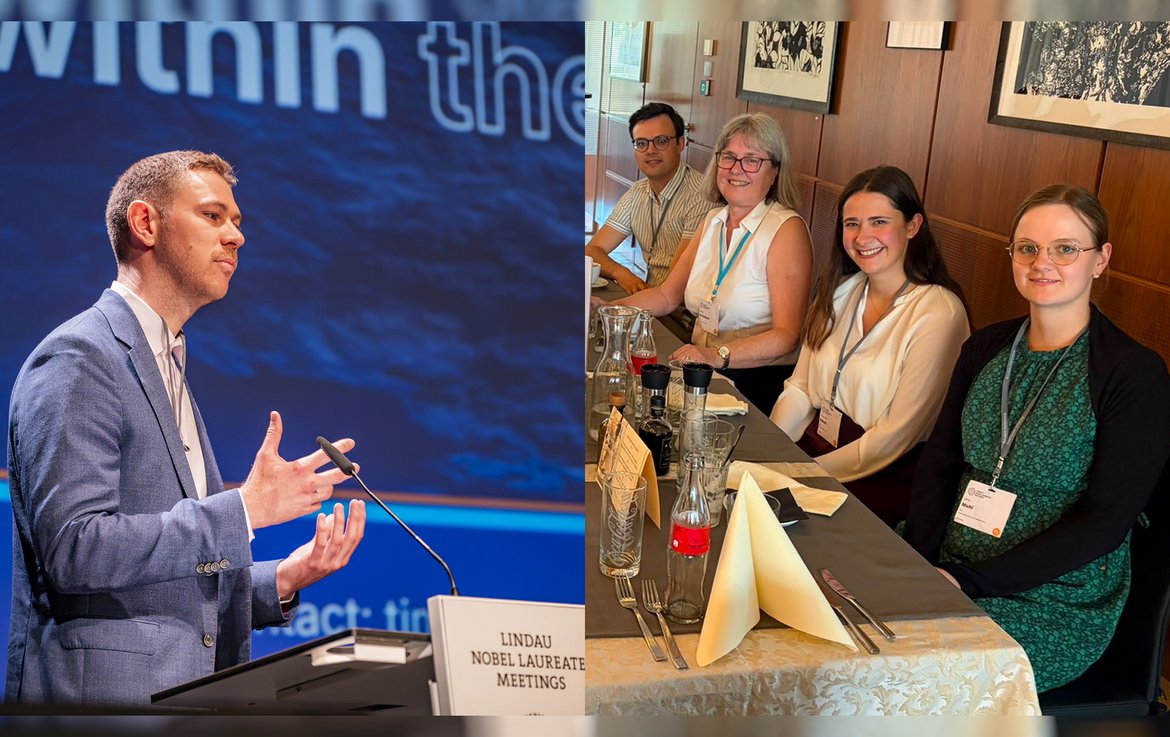
From 28 June to 3 July 2026, the scientific community celebrated a special anniversary: the 75th Lindau Nobel Laureate Meeting in Lindau at Lake Constance. Around 70 Nobel Laureates in Physiology or Medicine, Chemistry, and Physics met with more than 600 outstanding young scientists from across the globe to celebrate decades of scientific excellence, engage in dialogue, and collectively develop new ideas for the challenges of tomorrow. This year, the meeting focused on the theme of interdisciplinarity. Among the selected participants were two PhD students from the GFZ: Lena Muhl, GFZ Section 4.3 “Geoenergy”, who researches on geothermal energy, and Tim Schöne, Section 3.4 “Reactive Fluids and Geomaterials”, who is doing research on the disposal of high-level radioactive waste.
Established in 1951, the Lindau Meetings have become a globally recognised forum for intergenerational scientific exchange. They inspire young scientific talents and enable them to build sustainable, international networks. An invitation to this event is considered a great honour and requires the highest qualifications. Lena Muhl and Tim Schöne were proposed by the GFZ last year, subsequently nominated by the Helmholtz Association, and successfully progressed through a competitive, multi-stage selection process.
General information and impressions from this year’s conference can be found on the conference website.
Tim Schöne had the honour of presenting his work on the disposal of high-level radioactive waste to a distinguished audience as part of the “Next Gen Science” session. In doing so, he represented the GFZ exceptionally well on the international stage. Out of more than 400 submitted proposals, 54 presentations were selected for this format by the young scientists via a poll.
What did it mean to the two GFZ researchers to be able to attend the Nobel Laureates’ Conference?
M.Sc. Lena Muhl, PhD student in Section 4.3 “Geoenergy”:
„Having the opportunity to attend the 75th Lindau Meeting was a special privilege for me. The conversations with other young scientists were highly inspiring and offered insights into other research fields and groups. The lectures given by the Nobel Laureates showed me that research is much more than just generating knowledge, and that many different paths in life can lead to success. Personal discussions with Nobel Laureates and supporters of the meeting were extremely motivating and encouraged me to forge new paths and keep an open mind. Thinking outside the box, a degree of composure with a pinch of optimism, and intrinsic motivation provide a solid foundation for moving forward. This week has given me many insights and experiences that I will remember fondly as I continue on my path in life. It was a great pleasure and honour to be part of it. I look forward to staying in touch with some of the contacts I made there.“
In her doctoral thesis, Lena Muhl is conducting research on the use of environmentally friendly chelating agents to chemically stimulate geothermal reservoirs. Stimulation is intended to help improve the permeability of the rock and create flow paths so that the hot water can be pumped out or through the reservoir for use.
Lena Muhl has already received several awards; among other honours, she was awarded a prize at the 2023 German Geothermal Congress for the best contribution to the “Science Bar”, where early-career researchers present their bachelor’s, master’s, or doctoral theses as posters. She also took first place at the Brandenburg Science Slam in Luckenwalde—which can be viewed in the video.
M.Sc. Tim Schöne, PhD student in Section 3.4 “Reactive Fluids and Geomaterials”:
„To participate in such a prestigious event at an early stage of my scientific career fills me with immense gratitude. Besides the approachability, down-to-earth nature, and valuable advice of the Nobel Laureates, I was particularly impressed by the lively, optimistic atmosphere and attitude of the many young researchers. Witnessing the passion and conviction with which researchers worldwide tackle today’s challenges – and the wealth of solutions science already offers – leaves me even more hopeful for the future.
A personal highlight for me was the opportunity to draw attention to the disposal of high-level radioactive waste during the “Next Gen Science” session. Preparing and delivering a presentation for such an outstanding, yet academically highly diverse audience was an exciting task that I thoroughly enjoyed. I was also particularly pleased, and frankly a little surprised, by the high level of interest in our topic. After all, in Lindau, you are operating alongside topics that are more prominent in society and the media, as well as perennial themes such as advances in cancer therapy, the development of quantum computers and the latest semiconductor technologies, and the role of AI in all of this. The many conversations during the meeting have shown me once again how relevant our research is and the potential it holds to inspire people. This motivates me immensely for my future work.”
Tim Schöne is doing research on how dissolved substances move through clay rock, which is a potential host rock for the final disposal of high-level radioactive waste. His focus is on the hydrogeological and hydrogeochemical processes controlling solute transport in the pore water of clay stones, as well as their interactions with adjacent aquifers. Using numerical models, he analyses the transport of natural tracers such as chloride in these systems over timescales of several million years. From this, he infers information about radionuclide migration to identify and characterise specific site features that favour safe deep geological disposal of high-level radioactive waste.
Tim Schöne has already been honoured with the “2025 Outstanding Student and PhD Candidate Presentation (OSPP) Award” from the European Geosciences Union (EGU).

![[Translate to English:] Veranschaulichung der Veranstaltung.](/fileadmin/_processed_/c/5/csm_20260928_Kachel_37c583cb50.webp)


![[Translate to English:] Alle Länder Afrikas gelistet mit relativem Malariarisiko](/fileadmin/_processed_/1/b/csm_2026-08-20-L%C3%A4nderliste_Malariarisiko_web_d547ebb81d.webp "[Translate to English:]")


![[Translate to English:] Bewaldetes Gebiet mit historischen Gebäuden](/fileadmin/_processed_/5/e/csm_Telegrafenberg-2021_300dpi_Marcel-Ludwig-GFZ_web_70a5c15a88.webp "[Translate to English:]")


![[Translate to English:] Karte](/fileadmin/_processed_/4/8/csm_20260625-0945b_Venezuela_Nachbeben_-c-EarthquakeExplorer-GFZ_04f208410a.webp)


