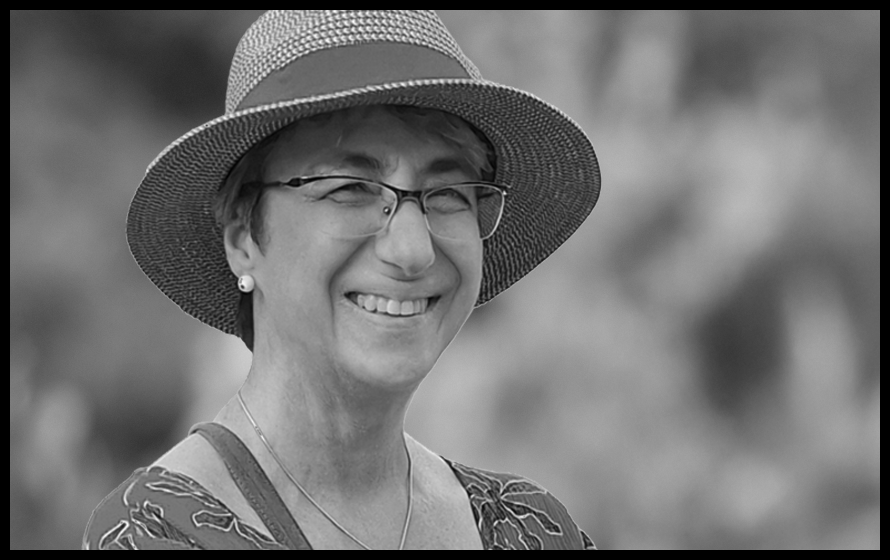
GFZ mourns the loss of Dr Saskia Esselborn. Our colleague passed away suddenly and unexpectedly on July 1. Saskia Esselborn was a senior scientist in Section 1.2 “Global Geomonitoring and Gravity Field”. Her research focused on the analysis of satellite data on sea level. She was a renowned and internationally acclaimed expert in this field. She started working on sea level data very early in her scientific career: She completed her Ph.D. as part of the World Ocean Circulation Experiment (WOCE) at the University of Hamburg and, in that context, had also participated in a research cruise across the Atlantic.
Saskia joined the GFZ in 2002 from the Institute for Coastal Research at what was then the “Gesellschaft für Kernenergieverwertung in Schiffbau und Schifffahrt (GKSS)”—now the Helmholtz-Zentrum Hereon. As a postdoc at GKSS, she had also worked on sea-level data, particularly for the North Sea and the North Atlantic.
During her 23 years at the GFZ, she authored numerous important publications. She was also always committed to the GFZ as a whole as well as to the campus. For example, she was one of the driving forces behind our Green Campus team. Sustainability in the scientific work as well as protecting our campus on Telegrafenberg were a heartfelt desire for Saskia.
Communicating our Centre’s work to the public was also very important to her. Just a few weeks ago, she spoke to local politicians in Potsdam about what climate change means right on our doorstep.
She was an enthusiastic athlete and actively participated in dragon boat racing, stand-up paddling, and (city-)cycling, among other activities. Saskia Esselborn is survived by her husband and two daughters.
Saskia Esselborn has left a lasting mark on GFZ, and we will honour her memory.


![[Translate to English:] Veranschaulichung der Veranstaltung.](/fileadmin/_processed_/c/5/csm_20260928_Kachel_37c583cb50.webp)


![[Translate to English:] Alle Länder Afrikas gelistet mit relativem Malariarisiko](/fileadmin/_processed_/1/b/csm_2026-08-20-L%C3%A4nderliste_Malariarisiko_web_d547ebb81d.webp "[Translate to English:]")


![[Translate to English:] Bewaldetes Gebiet mit historischen Gebäuden](/fileadmin/_processed_/5/e/csm_Telegrafenberg-2021_300dpi_Marcel-Ludwig-GFZ_web_70a5c15a88.webp "[Translate to English:]")


![[Translate to English:] Karte](/fileadmin/_processed_/4/8/csm_20260625-0945b_Venezuela_Nachbeben_-c-EarthquakeExplorer-GFZ_04f208410a.webp)

