
Summary
Issues surrounding the security of critical raw materials supply and the hitherto far too limited use of renewable heat – these are just two of the challenges facing society as it transitions to a low-carbon energy supply. A two-in-one solution to this is offered by the combined extraction of critical raw materials and heat from the mineral-rich thermal waters of geothermal plants. A perspective paper by various research centres of the Helmholtz Association, in cooperation with other research institutions, demonstrates that there is also promising potential for this in the North German Basin. Led by Prof. Dr Simona Regenspurg of the GFZ Helmholtz Centre for Geosciences in Potsdam, the authors summarise the current state of knowledge, discuss feasibility and economic viability, and highlight future research needs. In doing so, they define five success factors. This co-production could also improve the sustainability and economic viability of geothermal projects. The study has been published in the journal Geothermics.
Background: The demand for critical raw materials and geothermal energy
For the energy transition towards a low-carbon society, both the heat transition and the supply of critical raw materials are of crucial strategic importance. This applies to Germany as well as to the EU, which has set this out in its ‘Critical Raw Materials Act’.
In Germany, heat supply accounts for around half of total energy consumption and is still far too little covered by climate-friendly alternatives. At least a quarter of this could be provided in future through the use of deep geothermal energy – available 24/7, low-carbon, domestically sourced and independent of geopolitical upheavals.
At the same time, modern technologies and the transition to non-fossil energy supplies require significant quantities of critical raw materials such as lithium and copper – for electronics, widespread electrification and the expansion of infrastructure for the generation, distribution and storage of electricity.
Global demand for lithium has risen significantly in recent years, and the IEA expects it to increase by a factor of 40 between 2020 and 2040. Battery applications account for around 70 per cent of this demand.
Global demand for copper is expected to rise by a factor of 2.7 between 2020 and 2040.
The challenge of security of supply
At the same time, the security of supply for these metals is under pressure – due to dependence on just a few producing countries, including China and Chile, and increasing geopolitical tensions.
It is therefore the aim – shared by the German Government and the EU – to diversify sources of supply and expand domestic production capacity. This will help reduce reliance on imports, strengthen security of supply and promote more sustainable production, as these raw materials often come from water-scarce regions with low environmental standards.
The joint development of geothermal energy and critical minerals
One approach in this direction is the joint development of geothermal energy and critical minerals, which is attracting increasing attention in both the scientific community and industry.
“Due to geological conditions, deep thermal waters often contain critical raw materials such as lithium, strontium or boron, and occasionally copper as well. Consequently, there have long been initiatives to use geothermal plants not only for heat supply or electricity generation, but also for the extraction of raw materials. This could also help to improve the sustainability and economic viability of geothermal projects, which involve high initial investment costs for drilling,” explains Prof. Dr Simona Regenspurg, head of the ‘Geothermal Fluids’ research group in GFZ Section 4.3 Geoenergy, who led the current study. If raw materials were extracted in addition to heat, this would also create new local value chains.
Using the North German Basin as an example, Regenspurg and her research team have highlighted the benefits, risks and challenges of the combined extraction of heat and critical raw materials from deep sedimentary brines. To this end, they have combined geological data, laboratory analyses and technical models. They also draw on findings from the Groß Schönebeck research site in the Schorfheide region of Brandenburg, where the GFZ has been operating a real-world laboratory for geothermal research for 25 years.
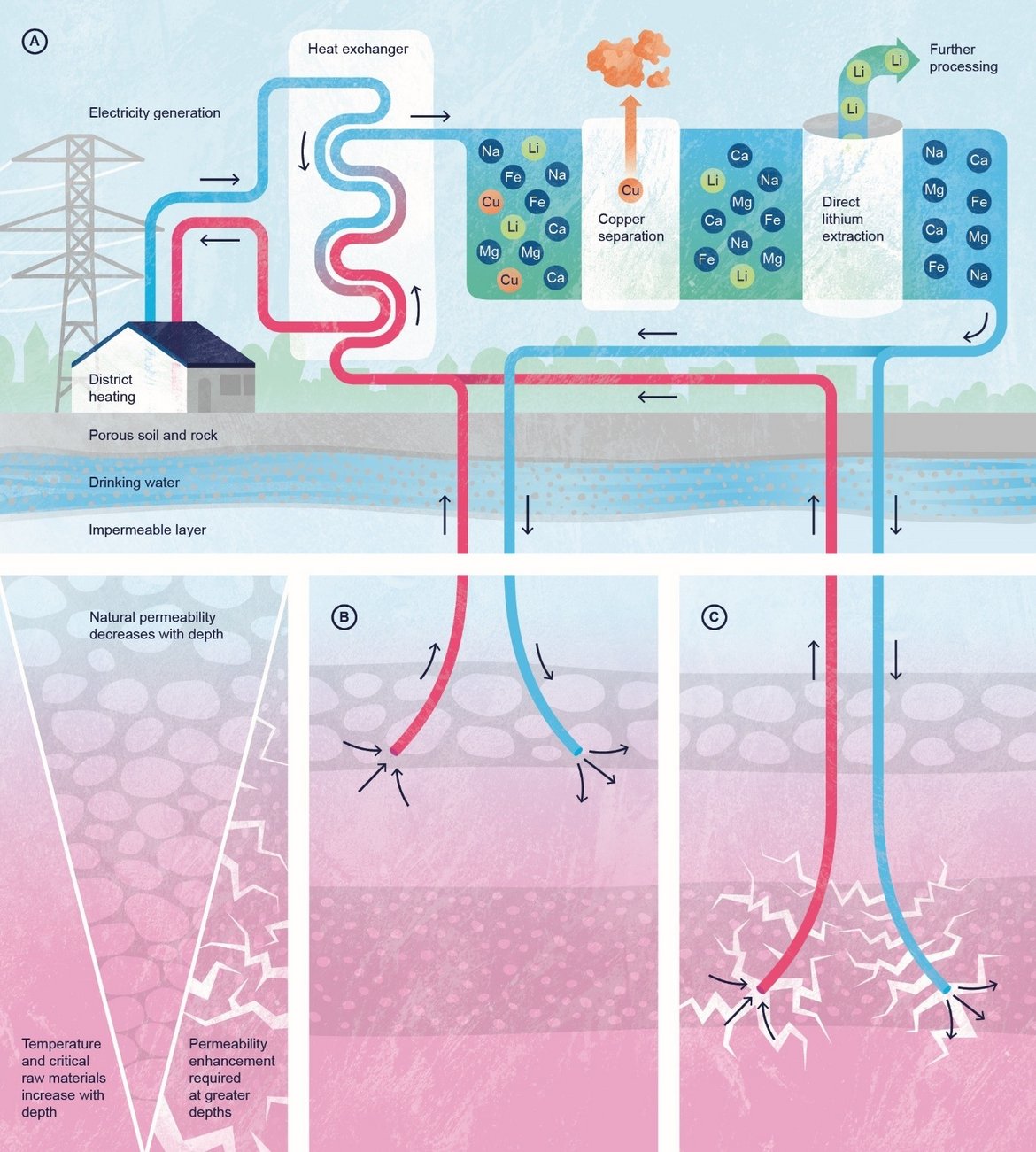
The basic principle of this technology is simple: hot, mineral-rich water is pumped up from a borehole several thousand metres deep. In a heat exchanger, the heat is transferred to a district heating network or used for industrial heating or electricity generation. Before or after passing through the heat exchanger, the desired elements – such as lithium or copper – are extracted from the water before it is pumped back underground via a second borehole.
The authors also discuss in their paper the processes currently used to extract the metals, as well as their advantages and disadvantages.
The first pilot projects by companies are already underway, for example at the Salton Sea in California (USA) or in the Upper Rhine Graben (Germany, France), where brine solutions from deep boreholes are considered to be economically promising. As things stand, the authors do not yet envisage a commercially operated site for geothermal lithium extraction.
The potential in the North German Basin
The North German Basin, which extends across large parts of northern Germany – see Figure 1 – offers considerable geothermal potential due to the temperature gradient (temperature increase with depth), porosity, permeability and other structural characteristics of the subsurface. There are currently three research and five commercial sites for the utilisation of hydrothermal energy from deep reservoirs. A further 50 geothermal projects are in the planning stage.
The fact that some of the saline thermal waters there also have a comparatively high lithium and copper content makes them attractive for co-extraction. Lithium concentrations of up to 600 milligrams per litre can occur in deep sandstones. Initial estimates of the total potential in the North German Basin put the figure at up to 26.5 million tonnes of lithium metal (equivalent to 141 million tonnes of marketable lithium carbonate). The researchers also see good potential for copper, due to the so-called Rotliegend formations in the area and the experience gained from geothermal experiments in Groß Schönebeck.
Challenges in the co-production of heat and critical raw materials
To realise this potential, various challenges must be overcome, as the researchers write:
As the joint extraction of heat and raw materials is a highly complex process. Therefore, simply attaching a lithium extraction plant to an existing geothermal well is unlikely to lead to success without a thorough understanding and integration of the underlying processes.
In particular, this also depends on the properties of the formation, especially its permeability (hydraulic conductivity).
Technical challenges therefore lie primarily in the development of environmentally friendly, cost-effective extraction technologies that must be adapted to the high-salinity, multi-component fluid systems characteristic of deep geothermal reservoirs.
Economic and technical feasibility is closely linked to environmental considerations and public acceptance. This requires the development of joint strategies to ensure the combined extraction of raw materials and heat in the most sustainable way possible.
Five factors for economic success
In their conclusion, the researchers identify five key questions that are crucial to the economic success of the joint extraction of heat and raw materials from sedimentary brines. To this end, they set out the corresponding specific challenges, categorise them and propose measures.
- In which geological formations can elevated lithium concentrations be expected?
- (How) Can the lithium-rich deep water be brought to the surface at a sufficient flow rate over a long period of time?
- (How) Can lithium be removed from the water selectively, quickly and efficiently during the thermal water cycle?
- Which materials can withstand the demanding conditions underground?
- Are environmental compatibility, regulatory approval and public acceptance in place?
Summary: Great potential, further demonstration projects required
In view of the predicted rise in demand, the authors consider it unlikely that the unconventional sources of critical raw materials discussed here will replace traditional mining in the near future. However, their integration into a more comprehensive supply strategy represents a step towards a more diversified and sustainable raw materials base:
“The simultaneous extraction of critical raw materials such as lithium and copper, together with geothermal heat from deep waters in sedimentary basins, offers great potential to contribute to the sustainable meeting of the rising demand for metals and energy,” concludes Simona Regenspurg.
“Using the North German Basin as an example, we have investigated key geological, technical, materials science and environmental challenges. The results so far are promising, but further demonstration projects are needed to prove technical and economic feasibility.”
Project Funding
This work was carried out under the umbrella of the “Helmholtz Forum Earth and Environment” as part of the CuLiWell project. It was partly funded by the European Union’s Horizon Europe research and innovation programme as part of the project “CRM-geothermal – Raw materials from geothermal fluids: occurrence, enrichment, extraction” under grant agreement number 101058163. Further funding was provided by the “Li-Fluids” project of the Federal Ministry for Economic Affairs and Energy (BMWE), grant reference numbers: 03EE4034A (BGR) and 03EE4034B (Fraunhofer).
Project partners
GFZ Helmholtz Centre for Geosciences, Karlsruhe Institute of Technology, Fraunhofer IEG, Federal Institute for Materials Research and Testing (BAM), BWG Geochemische Beratung GmbH, GEOMAR Helmholtz Centre for Ocean Research, University of Kiel, University of Potsdam and Federal Institute for Geosciences and Natural Resources (BGR).
Original publication
Simona Regenspurg, Elisabeth Eiche, Katharina Alms, et al., “Perspectives of co-extraction of geothermal heat with the critical raw materials lithium and copper from sedimentary basin fluids on the example of the North German Basin”, Geothermics, Volume 140, 2026, 103726, ISSN 0375-6505,
https://doi.org/10.1016/j.geothermics.2026.103726
Further information on the GFZ’s current geothermal research at the Groß Schönebeck research site in the Schorfheide region of Brandenburg can be found in the press release marking the 25th anniversary of the research site.
Further information on geothermal energy and GFZ activities can be found on our focus website.


![[Translate to English:] Veranschaulichung der Veranstaltung.](/fileadmin/_processed_/c/5/csm_20260928_Kachel_37c583cb50.webp)


![[Translate to English:] Alle Länder Afrikas gelistet mit relativem Malariarisiko](/fileadmin/_processed_/1/b/csm_2026-08-20-L%C3%A4nderliste_Malariarisiko_web_d547ebb81d.webp "[Translate to English:]")


![[Translate to English:] Bewaldetes Gebiet mit historischen Gebäuden](/fileadmin/_processed_/5/e/csm_Telegrafenberg-2021_300dpi_Marcel-Ludwig-GFZ_web_70a5c15a88.webp "[Translate to English:]")


![[Translate to English:] Karte](/fileadmin/_processed_/4/8/csm_20260625-0945b_Venezuela_Nachbeben_-c-EarthquakeExplorer-GFZ_04f208410a.webp)

