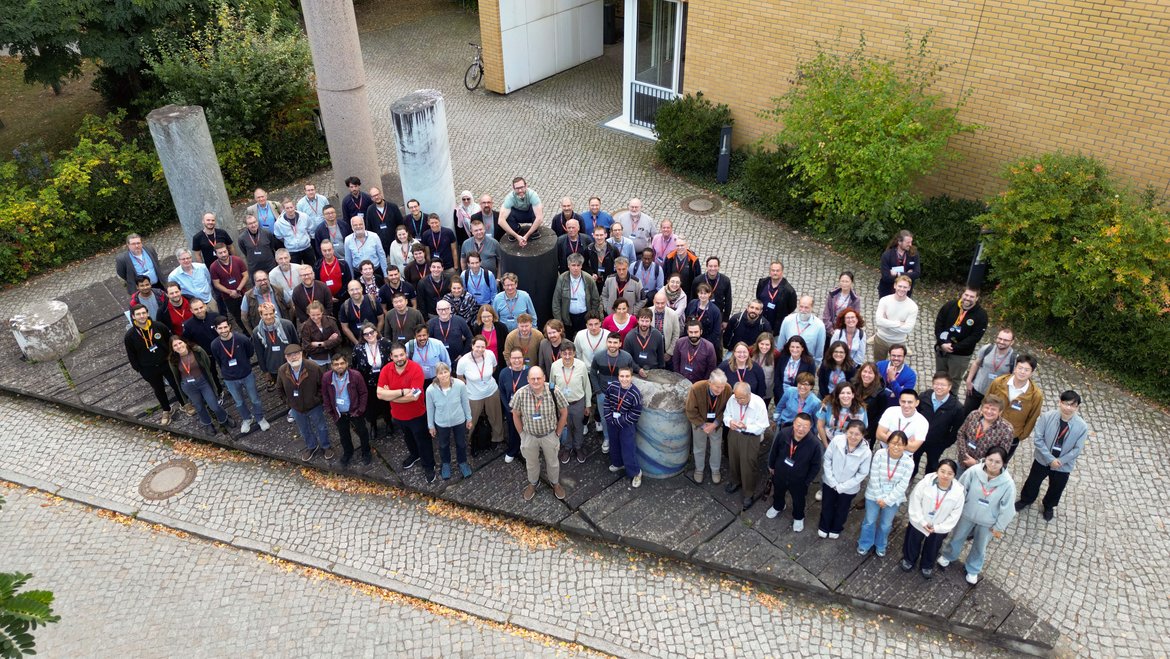
In the first week of October, two workshops organized by the European Space Agency (ESA) took place at the GFZ: The 16th Swarm Data Quality Workshop (Oct. 5–8), held in conjunction with the 2nd NanoMagSat Symposium (Oct. 8–9). Swarm and NanoMagSat are two satellite missions designed for high-precision observation of the Earth’s magnetic field. Swarm is a constellation of three satellites that have been in orbit since 2013. NanoMagSat is a planned small-satellite mission, also consisting of three satellites, with the first satellite scheduled for launch in 2027.
More than 120 scientists from over 20 countries worldwide attended the workshop in person, with up to 30 additional participants joining online. The event provided an opportunity for intensive exchange between satellite operators and data users to ensure high-quality measurement data, as well as for fruitful discussion of scientific findings.
The ESA satellite missions Swarm and NanoMagSat are specifically designed to measure the Earth’s magnetic field and also provide important data on the upper atmosphere — particularly the ionosphere and thermosphere — as well as data products for characterizing and monitoring space weather conditions. The Earth’s magnetic field plays a vital role as a protective shield against the solar wind and cosmic radiation (space weather). It also continues to play an important role in navigation alongside the modern GPS system. It provides science with insights into the Earth’s deep interior and its history. Since it exhibits both rapid fluctuations and long-term changes, continuous, accurate measurement data is indispensable for research and practical applications.
Global phenomena such as the Earth’s magnetic field can serve these various purposes only through international cooperation and global sharing of observational data. Therefore, international conferences such as this one are of great importance. The GFZ proposed the ESA’s Swarm mission in 2002 in collaboration with institutes from Denmark and France. It has thus been heavily involved in the international mission from the beginning and today plays an important role in the Swarm DISC Consortium for data products and the scientific analysis of measured data. The many years of experience gained from the German CHAMP mission provided an important foundation for this. This satellite mission to measure the Earth’s magnetic and gravitational fields was scientifically led by the GFZ and operated very successfully from 2000 to 2010.
The GFZ is the leading institute in Germany for Earth’s magnetic field measurements and research. It provides measurement data from the ground and from satellites, maps of the Earth’s magnetic field as well as activity indices and forecasts on space weather activity.
Local workshop coordination:
GFZ Section 2.3 (Dr. Guram Kervalishvili and Dr. Karina Izabela Wilgan) and Leibniz Institute for Atmospheric Physics.


